
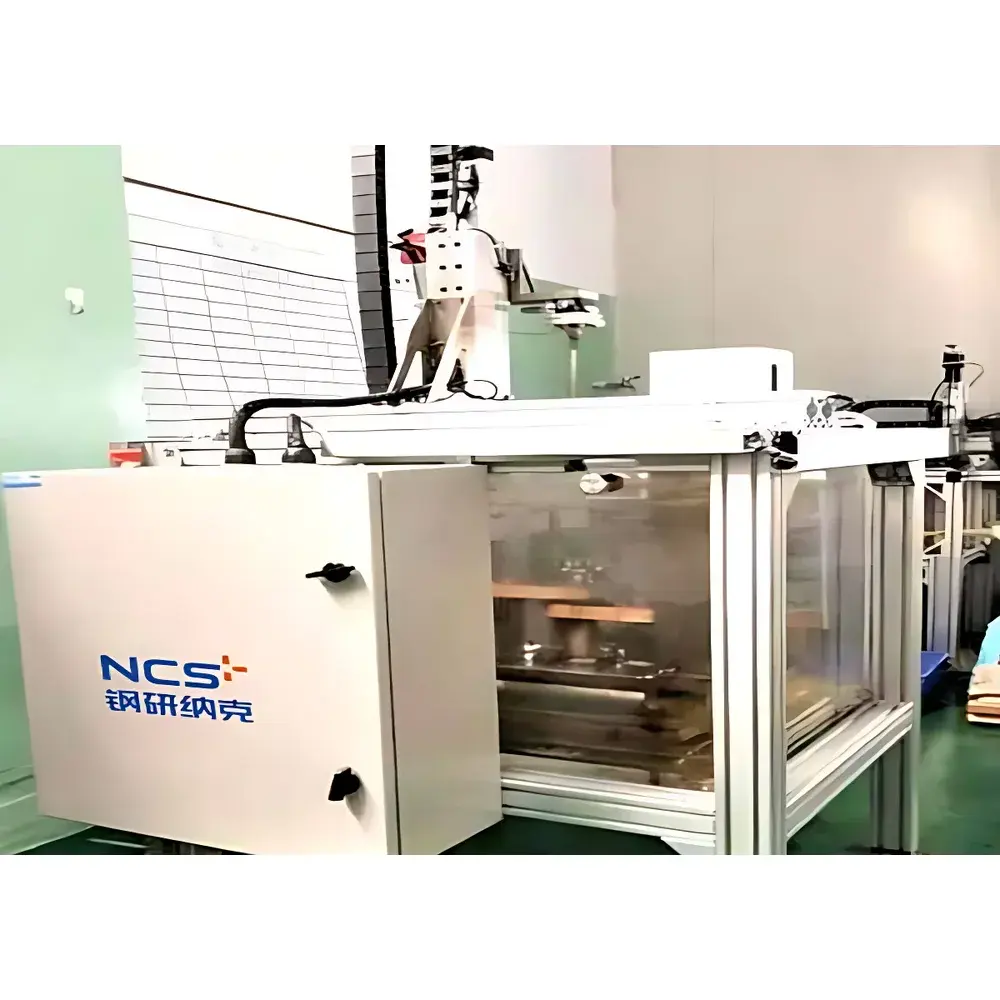
NCS NC-C-SCAN Series Compact C-Scan Ultrasonic Testing System
| Brand | NCS (China Iron and Steel Research Institute Group) |
|---|---|
| Model | NC-C-SCAN Series |
| Origin | Beijing, China |
| Manufacturer Type | Original Equipment Manufacturer (OEM) |
| Regional Classification | Domestic (PRC) |
| Pricing | Available Upon Request |
Overview
The NCS NC-C-SCAN Series is a compact, high-stability ultrasonic C-scan imaging system engineered for precision volumetric inspection of small- to medium-sized industrial components. Based on pulse-echo or through-transmission ultrasonic principles, the system employs high-frequency transducers (typically 2.25–10 MHz) coupled with precision mechanical scanning stages to generate two-dimensional planar (C-mode) representations of internal reflectors—such as voids, inclusions, delaminations, and porosity—within solid materials. Unlike A-scan (time-amplitude waveform) or B-scan (cross-sectional slice), C-scan delivers spatially registered amplitude or time-of-flight maps across an XY raster grid, enabling quantitative defect sizing, positional repeatability, and archival traceability. Designed specifically for routine production-line and laboratory-based non-destructive evaluation (NDE), the NC-C-SCAN system meets the geometric and sensitivity requirements for cylindrical pressure vessels—including CNG automotive cylinders, seamless high-pressure gas cylinders, welded LPG cylinders, and specialty composite-wrapped tanks—while maintaining full compliance with Chinese national standards GB/T 5777 (ultrasonic testing of seamless steel tubes), GB/T 18248 (seamless stainless steel tubes), and GB/T 4730 (non-destructive testing—Ultrasonic testing part).
Key Features
- Simultaneous detection of transverse and longitudinal flaws, laminar discontinuities, and wall thickness measurement within a single scan pass
- Modular network architecture supporting distributed control, remote calibration, and synchronized data acquisition across multiple transducer channels
- Dual-axis (axial + circumferential) positioning capability for full rotational coverage of cylindrical and toroidal geometries
- Real-time waveform monitoring with adjustable gate settings, threshold triggers, and dynamic range optimization
- High-fidelity C-scan image generation with pixel-level amplitude mapping, color-coded depth/time-of-flight overlays, and defect annotation tools
- Integrated scan path recording with timestamped waveform capture, enabling full audit trail per inspection event
Sample Compatibility & Compliance
The NC-C-SCAN system accommodates a broad spectrum of metallic and non-metallic components, including forged rings, turbine disks, extruded rods, seamless tubes, welded assemblies, carbon fiber-reinforced polymer (CFRP) laminates, aluminum honeycomb structures, and billets. Its mechanical scanning envelope supports diameters from 50 mm to 600 mm and lengths up to 1200 mm, with optional custom fixtures for irregular geometries. All system firmware, calibration procedures, and reporting outputs are aligned with ISO 16810 (Non-destructive testing — General principles for ultrasonic testing), ISO 9712 (Qualification and certification of NDT personnel), and GB/T 9445 (Chinese equivalent). Data integrity conforms to GLP/GMP documentation practices, with optional 21 CFR Part 11-compliant electronic signatures and audit logs available via software upgrade.
Software & Data Management
The proprietary NCS ScanView™ software provides a unified interface for hardware control, real-time visualization, post-processing, and report generation. It supports DICOM-RT export for integration into enterprise-level NDE databases, CSV/Excel output for statistical process control (SPC) analysis, and PNG/TIFF image archiving with embedded metadata (scan parameters, operator ID, date/time stamp, transducer model). All raw RF waveforms and C-scan matrices are stored in vendor-neutral HDF5 format, ensuring long-term readability and third-party interoperability. The software includes automated defect recognition (ADR) algorithms trained on representative flaw libraries, customizable pass/fail criteria per zone, and batch reporting templates compliant with ASME BPVC Section V and API RP 579-1/ASME FFS-1.
Applications
Primary deployment domains include aerospace component qualification (e.g., disk forgings, compressor blades), automotive safety-critical parts (CNG cylinder liners, brake caliper castings), defense ordnance inspection (warhead casings, rocket motor cases), petrochemical infrastructure (LPG tank weld zones, heat exchanger tubing), and power generation equipment (turbine shafts, generator rotor bars). Secondary use cases span R&D laboratories performing material characterization studies, failure analysis investigations, and validation of additive manufacturing processes where subsurface porosity and lack-of-fusion defects must be quantified at micron-scale resolution.
FAQ
What types of ultrasonic transducers are compatible with the NC-C-SCAN system?
Standard configurations support immersion and contact piezoelectric transducers ranging from 2.25 MHz to 10 MHz, with optional phased array and EMAT modules available upon request.
Does the system support automated defect classification per ASTM E2375 or ISO 10893-11?
Yes—the ScanView™ software includes configurable rule sets aligned with those standards, and reports can be generated with explicit reference to acceptance criteria tables.
Can the NC-C-SCAN be integrated into an existing factory MES or QMS platform?
Yes—via OPC UA or RESTful API interfaces, enabling bidirectional communication with SAP QM, Siemens Opcenter, or custom quality management systems.
Is on-site installation and ISO/IEC 17025-compliant calibration included in the standard delivery?
Installation, mechanical alignment verification, and initial performance qualification (per EN 1330-4) are provided; full ISO/IEC 17025 accreditation requires engagement with an accredited third-party lab.
What is the typical lead time for delivery and commissioning?
Standard delivery is 12–16 weeks from PO confirmation, inclusive of FAT (Factory Acceptance Test) and SAT (Site Acceptance Test) protocols.



