
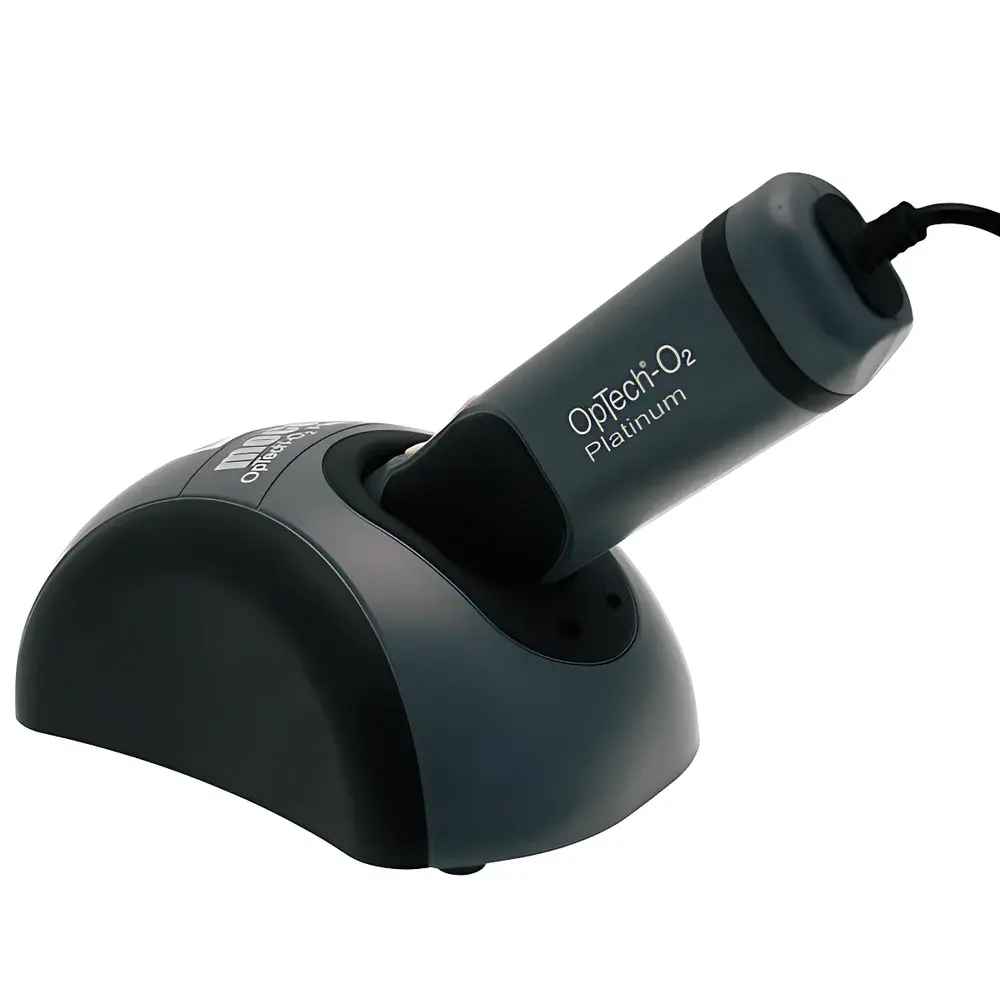
Mocon Optech-O2 P Non-Destructive Headspace & Dissolved Oxygen Analyzer
| Brand | Mocon |
|---|---|
| Origin | USA |
| Manufacturer Type | Authorized Distributor |
| Origin Category | Imported |
| Model | Optech-O2 P |
| Power Supply | USB-powered (2.5 W) |
| Operating Temperature | 5–40 °C (Headspace Mode), 10–35 °C (Dissolved O₂ Mode) |
| Measurement Principle | Fluorescence-based Confocal Optical Sensing |
| Detection Range (Headspace) | 0.050%–25% O₂ (500 ppm–250,000 ppm) |
| Detection Range (ImPULSE™ Adhesive Sensor) | 0.001%–25% O₂ (10 ppm–250,000 ppm) |
| Repeatability (Needle Probe, 0–150 mmHg) | ±0.100% O₂ or ±5% of reading (whichever is greater) |
| Repeatability (Needle Probe, 150–1000 mmHg) | ±0.015% O₂ or ±2% of reading (whichever is greater) |
| Repeatability (ImPULSE™ Sensor) | ±0.015% O₂ or ±3% of reading (whichever is greater) |
| Probe Dimensions (w/ Needle) | 4.83 × 3.30 × 15.24 cm (H×W×D) |
| Probe Dimensions (w/o Needle) | 4.83 × 3.30 × 22.86 cm (H×W×D) |
| Preheat Time | 20 min |
| Compliance | CE, CSA, UL certified |
| Pressure Compensation | Integrated for needle-based measurements |
Overview
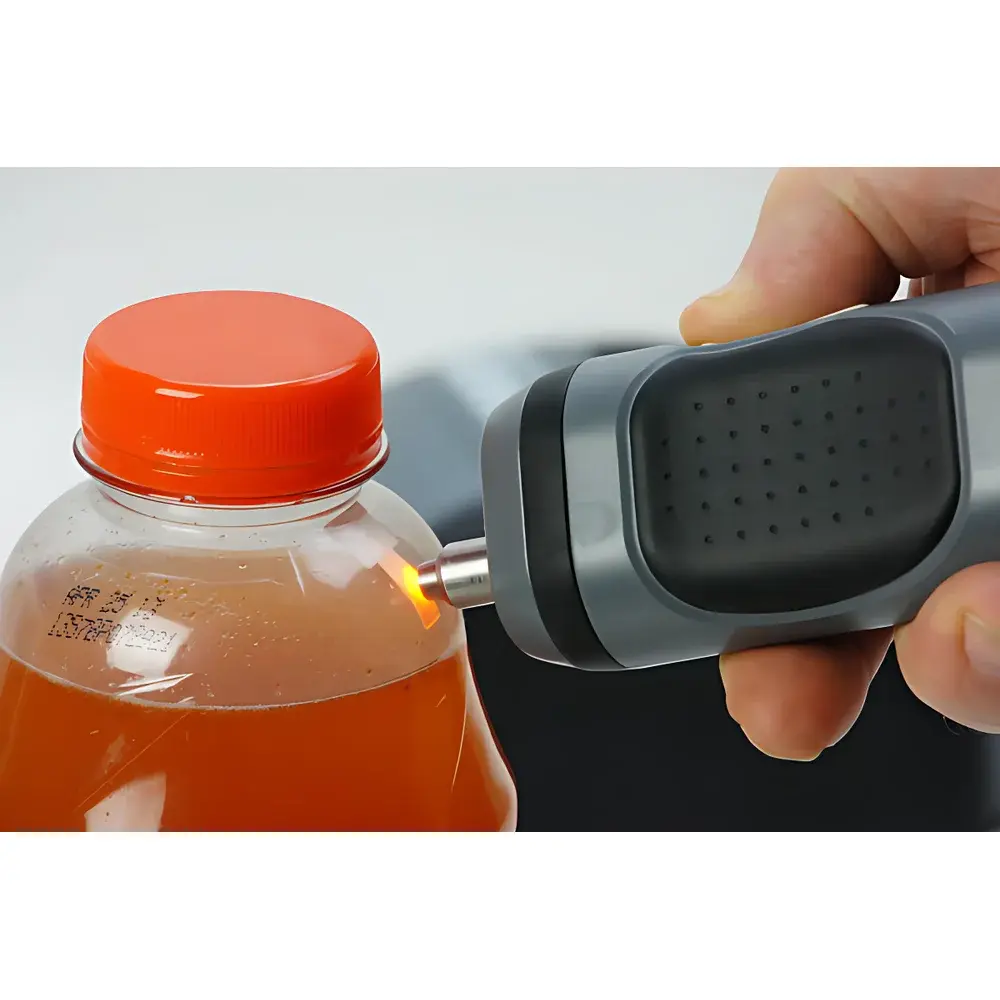
The Mocon Optech-O₂ P is a benchtop optical analyzer engineered for non-destructive, real-time quantification of dissolved oxygen (DO) and headspace oxygen (O₂) in sealed packaging systems. Unlike electrochemical or paramagnetic methods, it employs fluorescence quenching principles within a confocal optical architecture—where an oxygen-sensitive luminophore embedded in a proprietary sensor film emits light upon excitation by pulsed blue LED, and the phase shift or intensity decay of that emission is inversely proportional to local O₂ partial pressure. This photophysical relationship enables absolute, calibration-free measurement without gas extraction, membrane fouling, or electrode drift—making the Optech-O₂ P uniquely suited for longitudinal stability studies, shelf-life modeling, and quality assurance across modified atmosphere packaging (MAP), pharmaceutical blister packs, and active food packaging systems.
Key Features
- True non-invasive operation: Measures O₂ through transparent polymer films (e.g., PET, PP, CPET) using surface-mounted platinum-optimized optical sensors—no puncture, no headspace disturbance, no risk of package integrity compromise.
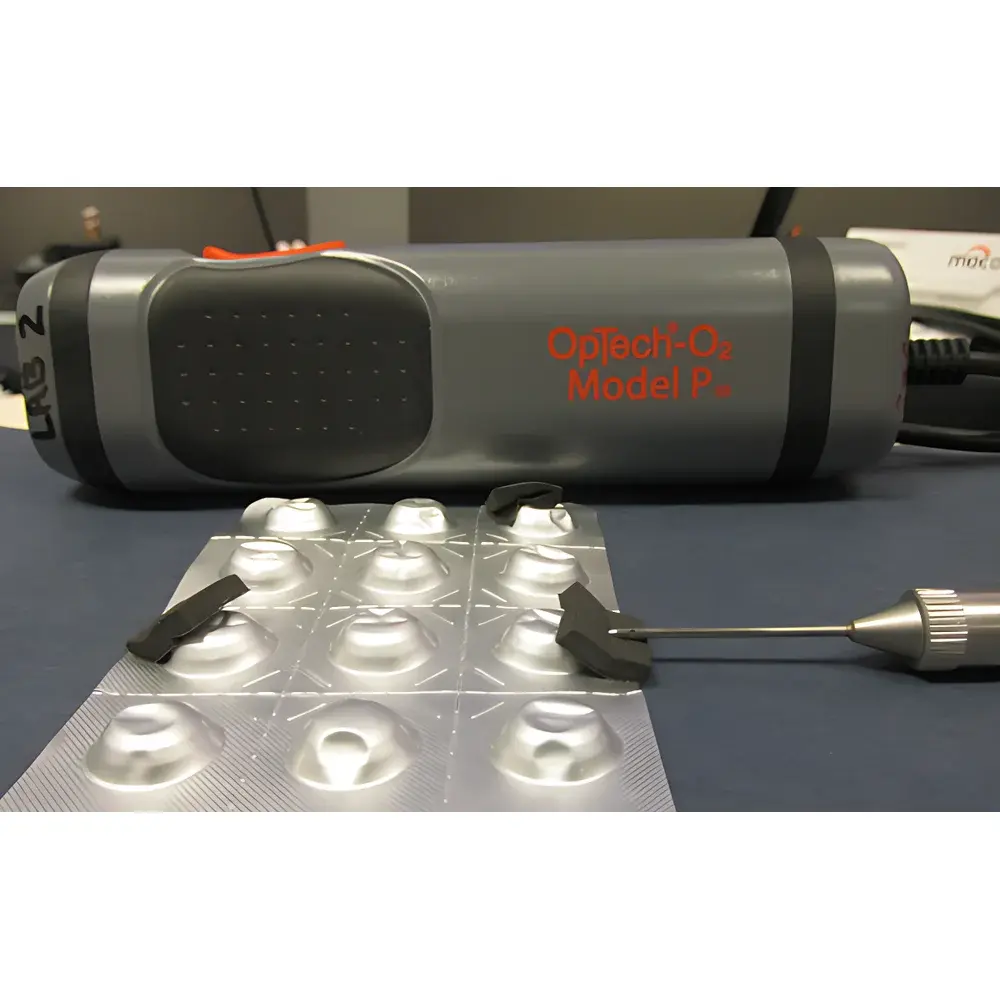
- Multi-modal sensor compatibility: Supports three distinct operational configurations: (1) reusable adhesive-backed optical patches for transparent packaging; (2) ImPULSE™ disposable adhesive sensors for opaque, metallized, or vapor-barrier laminates; and (3) sterile stainless-steel needle probes for low-headspace applications such as coffee pouches, thermoformed trays, or sachets with <5 mL internal volume.
- USB-powered portability: Consumes only 2.5 W via standard USB 2.0 interface—no external power supply required. Compact probe footprint (≤4.83 cm height) facilitates integration into glove boxes, stability chambers, and QC lab workstations.
- Integrated pressure compensation: Needle-based measurements automatically correct for ambient and internal package pressure differentials across 0–1000 mmHg, ensuring traceable accuracy under variable sealing conditions.
- Rapid thermal stabilization: Full optical system readiness achieved within 20 minutes of power-on—minimizing instrument downtime between sequential sample batches.
Sample Compatibility & Compliance
The Optech-O₂ P accommodates rigid, semi-rigid, and flexible packaging formats—including blister cards, stand-up pouches, vacuum-sealed trays, and injection-molded containers—provided the measurement site exhibits optical clarity (for patch mode) or permits adhesive sensor application (for ImPULSE™). It complies with CE, CSA, and UL safety standards and supports audit-ready documentation per ISO 17025-accredited laboratories. While not inherently 21 CFR Part 11 compliant out-of-the-box, its included PC software (Optech Control Suite v4.x) supports user-defined electronic signatures, audit trails, and data export in CSV/PDF formats compatible with LIMS integration. The instrument meets ASTM F2338–22 (Standard Test Method for Oxygen Transmission Rate of Flexible Barrier Materials Using Optical Sensors) and aligns with USP guidance on container closure integrity testing (CCIT) for sterile pharmaceutical products.
Software & Data Management
Control and analysis are executed via the Windows-based Optech Control Suite, which provides real-time O₂ concentration plotting, multi-sample comparison overlays, automatic pass/fail threshold evaluation, and customizable report generation. All measurement metadata—including timestamp, sensor ID, ambient temperature/humidity, pressure compensation status, and operator login—are embedded in each data file. Raw fluorescence decay waveforms are archived for retrospective reprocessing, enabling method validation and root-cause investigation during regulatory review. Data files support password-protected user roles (Administrator, Technician, Viewer) and optional encryption (AES-256) for GxP environments.
Applications
- Accelerated and real-time shelf-life prediction of oxygen-sensitive foods (e.g., nuts, dairy powders, ready-to-eat meals)
- Validation of MAP gas flush efficacy and residual O₂ mapping across production lots
- CCIT assessment of pharmaceutical blister packs and vial stoppers using headspace O₂ as a surrogate indicator
- Respiratory activity monitoring in fresh produce packaging (via time-series DO depletion kinetics)
- Barrier performance qualification of novel biopolymer films and nanocomposite laminates
- Stability protocol execution per ICH Q5C and Q1A(R2) guidelines for biologics in pre-filled syringes
FAQ
Can the Optech-O₂ P measure dissolved oxygen inside liquid-filled containers without opening them?
Yes—when used with the ImPULSE™ adhesive sensor applied to the exterior surface of glass or rigid plastic containers, it quantifies DO in aqueous or oil-based phases via diffusion-coupled optical sensing, validated per AOAC 992.03 for beverage and pharmaceutical applications.
Is sensor calibration required before each measurement?
No. The optical sensors are factory-calibrated against NIST-traceable O₂ standards and maintain stability for ≥12 months under typical storage conditions. A single-point air-saturation verification is recommended prior to critical studies.
Does the system support GLP-compliant data archiving?
Yes—when deployed with the optional Audit Trail Module (p/n SW-ATM-01), the software enforces ALCOA+ data integrity principles, including attributable, legible, contemporaneous, original, and accurate recordkeeping.
What is the minimum headspace volume detectable with the needle probe?
The 320191 needle probe achieves reliable quantification down to 0.2 mL headspace, provided the container geometry allows stable insertion and optical coupling.
Can ImPULSE™ sensors be reused?
No—ImPULSE™ sensors are single-use, sterilizable components designed for consistent inter-batch reproducibility and elimination of cross-contamination risk in regulated environments.






