
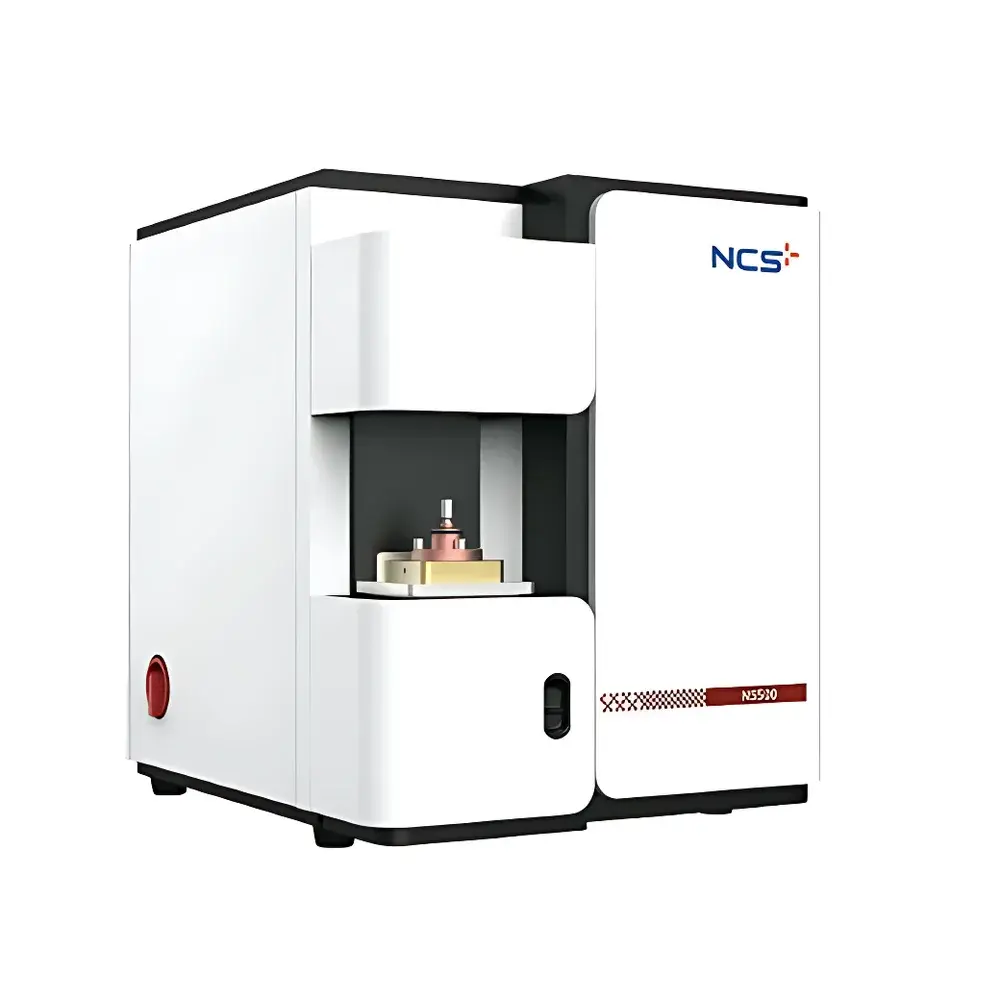
NCS N5500 Nitrogen Analyzer
| Brand | NCS (China Iron & Steel Research Institute Group – National Center for Steel Quality Inspection) |
|---|---|
| Origin | Beijing, China |
| Manufacturer Type | Original Equipment Manufacturer (OEM) |
| Instrument Type | Pulse-heated Inert Gas Fusion Nitrogen Analyzer |
| Measurement Principle | Thermal Conductivity Detection (TCD) after High-Temperature Inert Gas Fusion |
| Analysis Range | Low-N: 0.1 ppm – 0.5% |
| High-N | 0.5% – 50% |
| Precision | ±1 ppm or RSD ≤ 1.0% |
| Sensitivity | 0.01 ppm |
| Analysis Time | ~3 min per sample |
| Furnace Power | 0–1500 A, 8.5 kVA, max. temperature 3500 °C |
| Sample Mass | Typically 1 g (adjustable per matrix and concentration) |
| Carrier Gas | Ultra-high-purity helium (≥99.9995%) |
| Dimensions | 63 cm (W) × 76 cm (D) × 76 cm (H) |
| Weight | ~180 kg |
Overview
The NCS N5500 Nitrogen Analyzer is a high-performance pulse-heated inert gas fusion analyzer engineered for precise, trace-to-major-level nitrogen quantification in solid inorganic materials. Developed by the National Center for Steel Quality Inspection (NCS), part of the China Iron & Steel Research Institute Group, the N5500 implements the established principle of inert gas fusion followed by thermal conductivity detection (TCD). In this method, samples are rapidly heated to temperatures up to 3500 °C under a controlled helium atmosphere within a graphite crucible inside a water-cooled copper furnace. Nitrogen liberated from the matrix forms diatomic N2, which is swept through a CO2 scrubber and moisture trap before reaching a high-stability TCD sensor. The instrument’s design reflects four decades of refinement in vacuum and pulse-fusion gas analysis—originating from NCS’s pioneering 1977 vacuum fusion analyzer and its 1991 industrial-scale pulse infrared oxygen analyzer.
Key Features
- High-temperature pulse furnace capable of sustained operation at 3500 °C with precise current control (0–1500 A) and stable 8.5 kVA power delivery, ensuring complete decomposition of refractory nitrides (e.g., TiN, AlN, VN) and interstitial nitrogen in steels and ceramics.
- Optimized low-flow gas circuit architecture minimizes helium consumption by >30% compared to conventional systems, reducing operational cost without compromising detection stability or response time.
- High-sensitivity thermal conductivity detector with 0.01 ppm detection limit and calibrated linearity across five orders of magnitude (0.1 ppm to 50 wt%).
- Real-time parametric monitoring interface—including furnace current, gas pressure, flow rate, detector voltage, and system vacuum status—integrated into the control software for full process transparency.
- Automated leak-check routine executed pre-analysis, verifying system integrity against ASTM E144–22 requirements for inert gas fusion instrumentation.
- Critical components—including TCD cell, graphite crucibles, and high-temperature electrodes—sourced from Tier-1 international suppliers to ensure long-term reproducibility and service life exceeding 10,000 analyses under routine QC conditions.
Sample Compatibility & Compliance
The N5500 supports heterogeneous solid matrices including carbon steels, stainless steels, tool steels, titanium alloys, nickel-based superalloys, metal powders (additively manufactured or atomized), aluminum and copper alloys, silicon carbide and alumina ceramics, and geological silicates and ores. Its dual-range calibration strategy (low-N and high-N modes) accommodates both ultra-trace interstitial nitrogen in high-purity metals and bulk nitrogen in nitrided coatings or cast iron. The system complies with core metrological and procedural standards including ISO 14284:1996 (steel—determination of nitrogen content—inert-gas fusion thermal conductivity method), ASTM E1019–23 (standard test methods for determination of carbon, sulfur, nitrogen, and oxygen in steel, iron, nickel, and cobalt alloys), and JIS G 1211–2019. Full audit trail, user access control, and electronic signature support align with GLP and FDA 21 CFR Part 11 requirements when configured with optional secure software licensing.
Software & Data Management
The N5500 operates via NCS Analytical Suite v3.2—a Windows-based platform supporting method-driven workflows, multi-point calibration with polynomial and spline-based linearization, and automatic baseline correction. All analytical parameters—including integration window, peak threshold, carrier gas flow setpoint, and furnace ramp profile—are fully configurable per application. Raw signal data (voltage vs. time) and processed results are stored in encrypted SQLite databases with timestamped metadata (operator ID, sample ID, calibration ID, instrument serial number). Export options include CSV, PDF reports (with customizable templates), and direct integration with LIMS via ODBC or HL7-compliant APIs. Software updates and firmware patches are delivered through NCS’s secure customer portal, requiring cryptographic verification prior to installation.
Applications
- Quality control of nitrogen-sensitive steels (e.g., austenitic stainless, duplex, and maraging grades) where excess nitrogen induces porosity or embrittlement.
- Verification of nitrogen content in powder metallurgy feedstocks and AM build plates to prevent delamination or microcracking during sintering.
- Characterization of nitride dispersion in advanced ceramics used in semiconductor processing equipment and wear-resistant components.
- Regulatory testing of scrap metal and secondary raw materials for nitrogen contamination prior to electric arc furnace charging.
- Research-grade nitrogen partitioning studies in Fe–Cr–Ni–N and Ti–Al–N systems using sequential low-mass/high-precision runs.
FAQ
What sample preparation is required prior to analysis?
Solid samples must be clean, dry, and free of surface oxides or lubricants. Cylindrical or chip-shaped specimens (typically 1 g, 3–5 mm diameter) are recommended; fine powders require pressing into pellets to ensure consistent fusion kinetics.
Is helium the only acceptable carrier gas?
Yes. Ultra-high-purity helium (≥99.9995%) is mandatory to avoid background nitrogen interference and ensure TCD baseline stability. Argon or nitrogen carriers introduce unacceptable spectral overlap and detector drift.
Can the N5500 measure oxygen or hydrogen simultaneously?
No. The N5500 is dedicated exclusively to nitrogen analysis. For combined O/N/H measurement, NCS offers the ONH-5500 series, which integrates separate IR and TCD detection channels with shared furnace and gas handling modules.
How often does the graphite crucible require replacement?
Under standard operating conditions (1 g steel samples, ≤3500 °C, 5–10 analyses/day), crucibles typically last 200–300 runs. Lifespan decreases significantly with high-carbon or abrasive matrices (e.g., cast iron, WC-Co composites).
Does the system support remote diagnostics and service intervention?
Yes. With customer-authorized network connectivity, NCS technical support can initiate secure remote sessions to review error logs, verify calibration history, and guide troubleshooting—fully compliant with ISO/IEC 27001 information security protocols.






