
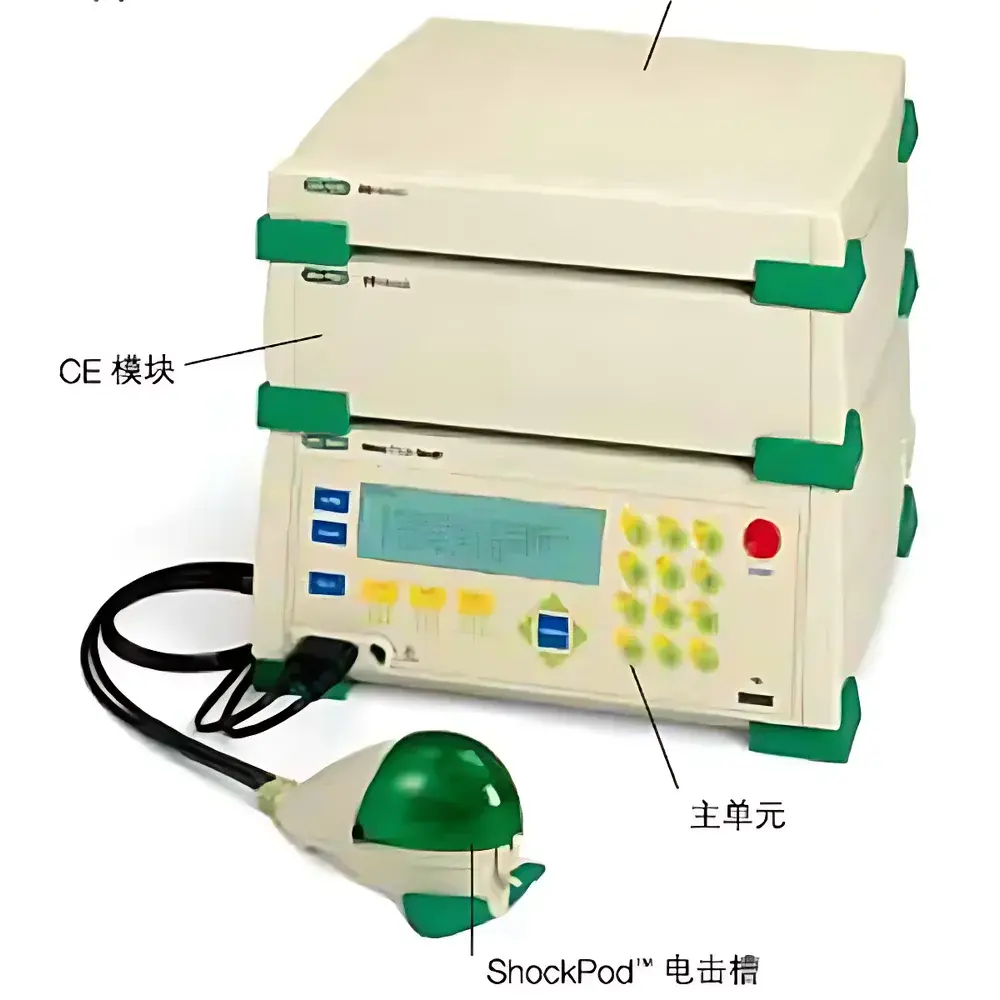
Bio-Rad Gene Pulser Xcell Electroporator
| Brand | Bio-Rad |
|---|---|
| Origin | USA |
| Model | Gene Pulser Xcell |
| High Voltage Range | 3000 V |
| Low Voltage Range | 10 V |
| Pulse Duration | 0.05–10 ms (0.05 ms increments) for 10–500 V |
| Number of Pulses | 1–10 (0.1–10 s interval for 10–500 V) |
| Capacitance | 25–3275 µF (25 µF increments) at 10–500 V |
| Resistance | 50–1000 Ω (50 Ω increments) + ∞ |
Overview
The Bio-Rad Gene Pulser Xcell Electroporator is a modular, programmable electroporation system engineered for high-precision transfection and cell fusion across diverse biological systems—from bacterial and fungal cells to mammalian and plant protoplasts. It operates on the principle of controlled electrical pulse delivery to transiently permeabilize cellular membranes, enabling efficient introduction of nucleic acids, proteins, or other macromolecules into living cells. The system supports two fundamental pulse waveforms—exponential decay and square wave—each optimized for distinct physiological and biophysical requirements: exponential decay pulses are ideal for high-resistance, small-volume microbial samples, while square wave pulses deliver consistent field strength over defined durations, critical for sensitive eukaryotic cells requiring precise energy control. Its dual-mode architecture, combined with real-time circuit monitoring via PulseTrac™ technology, ensures reproducible field delivery and minimizes arcing-induced sample damage—essential for low-yield primary cells or precious CRISPR reagents.
Key Features
- Modular hardware design: Select between PC Module (for prokaryotes/fungi), CE Module (for eukaryotes), or full-system configuration to match experimental scope.
- PulseTrac™ circuitry: Actively monitors and stabilizes voltage delivery during pulse discharge, enhancing inter-run reproducibility and protecting delicate samples from uncontrolled current surges.
- Dual waveform capability: Independent parameter control for exponential decay (time constant, peak voltage, resistance tuning) and square wave (pulse duration, field strength, number of pulses, inter-pulse interval) modes.
- Intuitive digital interface: Graphical LCD display with rotary encoder navigation; supports rapid protocol optimization without software dependency.
- Built-in validated protocols: Pre-loaded, empirically verified programs for common cell lines—including E. coli DH5α, CHO-K1, HEK293, and Arabidopsis protoplasts—reducing method development time.
- Extended memory capacity: Stores up to 144 user-defined protocols; retains full pulse parameter logs (voltage, capacitance, resistance, duration) for the most recent 100 runs for audit-ready traceability.
Sample Compatibility & Compliance
The Gene Pulser Xcell accommodates a broad spectrum of sample formats and resistivities—from low-conductivity bacterial suspensions (≥1 kΩ·cm) to high-conductivity mammalian media (≤100 Ω·cm)—via configurable resistance and capacitance modules. The PC Module enables parallel resistor integration to reduce effective time constants in exponential mode, while the CE Module delivers high-capacitance discharge essential for sustained square-wave delivery into conductive eukaryotic buffers. All configurations comply with IEC 61010-1 safety standards for laboratory electrical equipment. When operated under documented SOPs with version-controlled protocols and electronic parameter logging, the system supports GLP and GMP-aligned workflows. While not inherently 21 CFR Part 11-compliant, its deterministic pulse output and non-volatile parameter storage facilitate integration into validated environments when paired with compliant LIMS or ELN platforms.
Software & Data Management
The Gene Pulser Xcell operates as a standalone instrument with no mandatory PC connectivity; however, optional Bio-Rad Electroporation Software (v3.x) enables remote protocol deployment, batch parameter export (CSV), and comparative analysis of transfection efficiency across conditions. All pulse parameters—including actual delivered voltage (not just setpoint), measured time constant, and post-pulse impedance—are recorded internally and retrievable via front-panel review. Audit trails include timestamped run history with operator ID fields (when configured with external authentication). Data export supports ISO/IEC 17025-compliant calibration verification and facilitates inclusion in regulatory submissions where instrument performance documentation is required.
Applications
- High-efficiency plasmid transformation of Gram-negative and Gram-positive bacteria, including electrocompetent E. coli, Bacillus subtilis, and Pseudomonas aeruginosa.
- Stable and transient transfection of adherent and suspension mammalian cell lines—particularly challenging models such as primary neurons, iPSC-derived cardiomyocytes, and hard-to-transfect immune cells.
- Plant protoplast electroporation for CRISPR/Cas9 editing, promoter-reporter assays, and organelle-targeted protein delivery.
- Yeast and filamentous fungal transformation for metabolic engineering and synthetic biology applications.
- Electrofusion of somatic cells for hybridoma generation and nuclear transfer studies.
- Delivery of siRNA, mRNA, and Cas9 ribonucleoprotein complexes (RNPs) under low-energy square-wave conditions to minimize cytotoxicity.
FAQ
What distinguishes exponential decay from square wave electroporation?
Exponential decay pulses deliver rapidly diminishing voltage over time, governed by RC time constants; they are optimal for high-resistance, low-volume samples like bacterial cells. Square wave pulses maintain constant voltage for a user-defined duration and are preferred for eukaryotic cells where precise energy dosage and reduced thermal stress are critical.
Can the Gene Pulser Xcell be used for CRISPR RNP delivery?
Yes—square wave mode with short pulse durations (e.g., 10–20 ms at 100–300 V) and low capacitance settings enables efficient RNP delivery into mammalian cells while preserving complex integrity and viability.
Is calibration required before use?
The system undergoes factory calibration per IEC 61010-1; users should verify output accuracy annually using a calibrated high-voltage oscilloscope or certified pulse analyzer, particularly after module replacement or extended high-voltage operation.
How does PulseTrac™ improve reproducibility?
PulseTrac™ continuously measures actual voltage across the cuvette during discharge and dynamically adjusts internal switching to compensate for load impedance shifts—ensuring delivered field strength matches the programmed value within ±3% tolerance across repeated runs.
What safety certifications does the instrument hold?
It is certified to IEC 61010-1 (Ed. 3.1) for measurement, control, and laboratory use, with double insulation, grounded chassis, and automatic arc detection with immediate circuit cutoff.





