
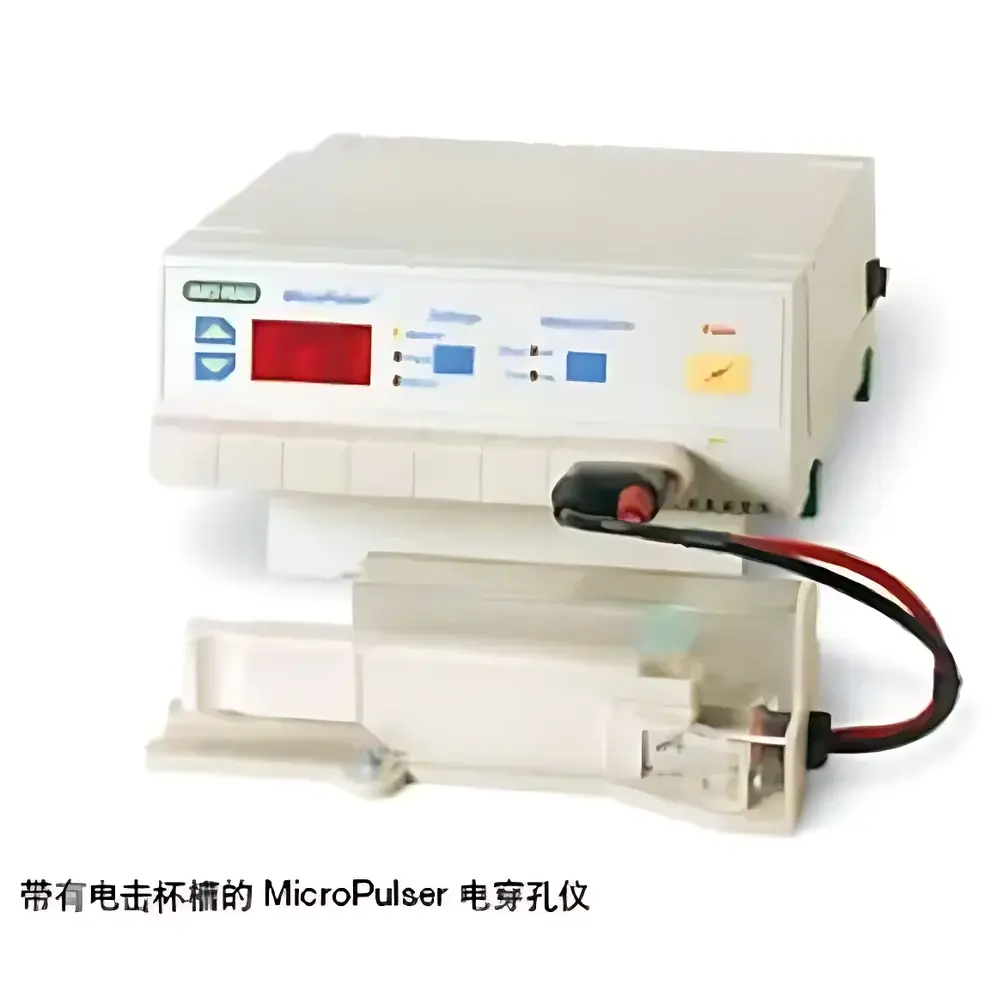
Bio-Rad MicroPulser Electroporator
| Brand | Bio-Rad |
|---|---|
| Origin | USA |
| Model | MicroPulser |
| High Voltage Range | 300–3000 V |
| Low Voltage Range | 200–2500 V |
| Pulse Duration | 0.1–5.0 ms (adjustable in 0.1 ms increments) |
| Capacitance Settings | 100, 250, 500, and 1000 µF |
| Internal Resistance | Fixed ~100 Ω (optimized for standard electroporation cuvettes) |
Overview
The Bio-Rad MicroPulser Electroporator is a benchtop, microprocessor-controlled instrument engineered for reliable, reproducible electroporation of prokaryotic and eukaryotic cells—including Escherichia coli, Bacillus subtilis, Saccharomyces cerevisiae, and other microbial systems. It operates on the principle of transient membrane permeabilization via controlled high-voltage electrical pulses, enabling efficient delivery of nucleic acids (plasmid DNA, linear fragments, siRNA), proteins, or small molecules across the cell membrane. Unlike chemical transformation methods, electroporation delivers higher transformation efficiencies—particularly for recalcitrant strains—and eliminates batch-to-batch variability associated with chemical reagents. The MicroPulser’s fixed internal resistance (~100 Ω) and calibrated capacitance options ensure consistent pulse decay profiles (τ = R × C), critical for achieving optimal membrane destabilization without irreversible electroporation damage.
Key Features
- Single-button pulse initiation with audible and visual confirmation—minimizing operator error and improving workflow consistency.
- Dedicated integrated cuvette holder with spring-loaded contacts, ensuring precise alignment and repeatable electrode contact pressure across 0.1 cm, 0.2 cm, and 1.0 cm gap-width cuvettes.
- Active arc suppression circuitry that monitors real-time current draw and terminates pulses upon arc detection—protecting both sample integrity and instrument longevity.
- Four selectable capacitance values (100, 250, 500, and 1000 µF) paired with fine-resolution voltage control (200–3000 V, ±10 V accuracy) and pulse duration adjustment (0.1–5.0 ms, ±0.1 ms resolution).
- Preset protocols for common applications: E. coli DH5α, TOP10, BL21(DE3); S. cerevisiae BY4741; and B. subtilis 168—each optimized for maximal colony-forming unit (CFU) recovery post-electroporation.
- Fast recharge time (<10 s at 2.5 kV with 250 µF setting), supporting high-throughput screening workflows without thermal drift or capacitor fatigue.
Sample Compatibility & Compliance
The MicroPulser is validated for use with standard sterile, disposable electroporation cuvettes (0.1–1.0 cm gap widths) and compatible with a broad range of biological matrices—including chemically competent and electrocompetent bacterial suspensions, yeast spheroplasts, and algal protoplasts. It meets IEC 61010-1:2010 safety requirements for laboratory electrical equipment and incorporates double-insulated high-voltage circuitry compliant with UL/CSA Class I protection standards. While not a GLP/GMP-certified device per se, its deterministic parameter control, non-volatile protocol storage, and absence of software-based user authentication align with basic audit-trail readiness for academic and pre-clinical research environments governed by ISO/IEC 17025 or NIH-funded compliance frameworks.
Software & Data Management
The MicroPulser operates as a standalone hardware platform with no external PC dependency. All parameter settings—including voltage, capacitance, and pulse duration—are retained in non-volatile memory after power-down. No proprietary drivers, firmware updates, or cloud connectivity are required. Protocol recall is achieved via front-panel navigation, eliminating version control risks associated with software-dependent instruments. For laboratories requiring documentation traceability, users may manually log parameters and outcomes in electronic lab notebooks (ELNs) aligned with 21 CFR Part 11 principles—though the device itself does not generate digital audit trails or electronic signatures.
Applications
- High-efficiency plasmid transformation in E. coli strains for cloning, library construction, and CRISPR vector delivery.
- Yeast transformation for homologous recombination, synthetic biology chassis engineering, and metabolic pathway optimization.
- Electrotransfection of Gram-positive bacteria (e.g., Lactococcus lactis, Streptococcus pneumoniae) where chemical competence is inefficient.
- Delivery of CRISPR-Cas ribonucleoprotein (RNP) complexes into primary mammalian cells during early-stage assay development.
- Preparative-scale electroporation in teaching labs—leveraging its intuitive interface and robust safety interlocks for undergraduate instruction.
FAQ
What cuvette gap widths are supported?
The MicroPulser is mechanically and electrically optimized for standard commercial cuvettes with 0.1 cm, 0.2 cm, and 1.0 cm electrode gaps. Use only certified, undamaged cuvettes to maintain pulse fidelity and avoid arcing.
Can I use the MicroPulser for mammalian cell transfection?
While primarily designed for microbial systems, low-voltage protocols (e.g., 120–250 V, 100–250 µF, 0.5–1.0 ms) have been published for suspension-adapted lines such as Jurkat or K562—but viability and efficiency require empirical optimization and are not guaranteed by Bio-Rad.
Is calibration required or supported?
The MicroPulser does not support user-accessible calibration routines. Voltage and timing accuracy are factory-verified per Bio-Rad’s quality system (ISO 9001:2015) and documented in the Certificate of Conformance supplied with each unit.
How does the arc suppression system function?
The system continuously samples current during pulse discharge; if instantaneous current exceeds a predefined threshold indicative of gaseous breakdown (arc), the pulse is terminated within <50 µs to prevent thermal damage to samples and electrodes.
What maintenance is recommended?
Wipe external surfaces with 70% ethanol; inspect cuvette contacts quarterly for oxidation or pitting; store in a dry, dust-free environment. No internal servicing is intended for end users—contact Bio-Rad Technical Support for out-of-specification performance.





