
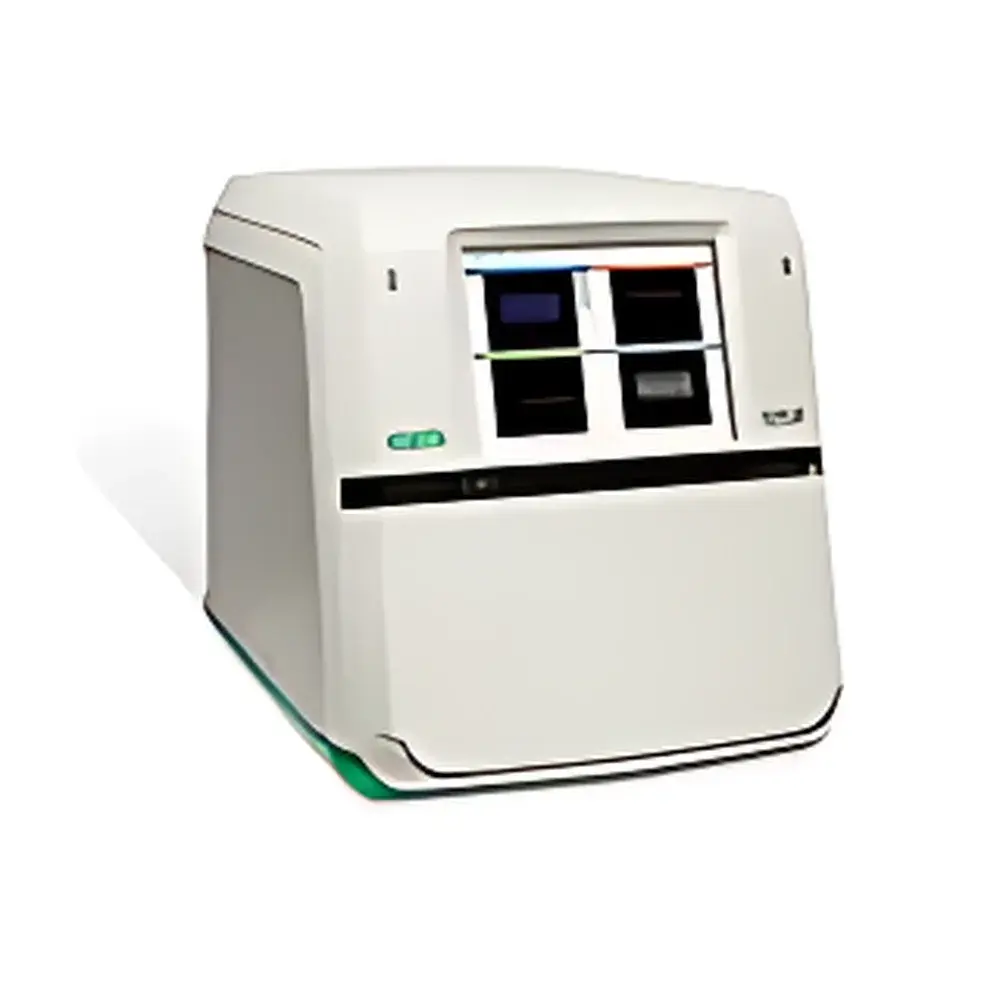
Bio-Rad ChemiDoc MP Multimodal Gel Imaging System
| Brand | Bio-Rad |
|---|---|
| Origin | Singapore |
| Model | ChemiDoc MP |
| Instrument Type | Multicolor Fluorescent Gel Imaging System |
| CCD Resolution | 6.1 Megapixels |
| Bit Depth | 16-bit |
| Dynamic Range | 0–4.8 OD |
| CCD Sensor Size | 1-inch |
| Detection Sensitivity | Sub-femtogram (fg) for Proteins |
| Signal-to-Noise Ratio | >56 dB |
| Lens | Fixed-Focus Optical Lens |
| Imaging Modalities | Chemiluminescence, Multiplex Fluorescence (RGB + Dual NIR), UV Transillumination, White Light Reflection |
Overview
The Bio-Rad ChemiDoc MP Multimodal Gel Imaging System is an engineered platform designed for quantitative, high-sensitivity detection across multiple imaging modalities—including chemiluminescence, multiplex fluorescence, UV transillumination, and white-light reflection—within a single integrated instrument. Based on cooled, scientific-grade CCD detection architecture with 16-bit digitization and a 1-inch sensor format, the system delivers high-fidelity digital capture of protein gels, nucleic acid gels, Western blots, and membrane-based assays. Its optical design employs a fixed-focus lens optimized for consistent working distance and minimal field curvature, ensuring reproducible signal acquisition without manual refocusing between samples. The system’s dynamic range of 0–4.8 optical density (OD) enables linear quantitation across broad intensity spans—critical for comparative analysis of low-abundance targets alongside highly expressed controls. Engineered to meet the operational rigor of core facilities and regulated research environments, the ChemiDoc MP supports GLP-compliant workflows through audit-trail-capable software and instrument-level calibration traceability.
Key Features
- Cooled 6.1-megapixel CCD detector with thermoelectric cooling to –25°C, minimizing dark current and enabling long-exposure chemiluminescent imaging without thermal noise degradation.
- Five-channel fluorescence excitation/emission capability: discrete red (630/670 nm), green (530/580 nm), blue (470/520 nm), and two near-infrared channels (700 nm and 800 nm), facilitating simultaneous detection of up to three proteins on a single blot using spectrally distinct fluorophores.
- Integrated UV transilluminator (302 nm) with adjustable intensity and safety interlock, compatible with ethidium bromide, SYBR Safe, and other DNA/RNA stains.
- Dual-mode white-light illumination for Coomassie- and silver-stained gels, as well as documentation of non-fluorescent membranes or plates.
- Automated exposure optimization algorithm that evaluates preview images in real time to determine optimal integration time, gain, and lens aperture—reducing user-dependent variability.
- Onboard LED-based excitation sources with narrow-band filters ensure spectral fidelity and minimize crosstalk between fluorescent channels.
Sample Compatibility & Compliance
The ChemiDoc MP accommodates standard electrophoretic formats including mini-gels (up to 10 × 10 cm), midi-gels (up to 16 × 16 cm), and Western blot membranes (up to 20 × 20 cm). It supports common gel matrices (polyacrylamide, agarose), staining chemistries (Coomassie Brilliant Blue, silver nitrate, SYPRO Ruby), and chemiluminescent substrates (luminol/peroxide, acridan-based reagents). All hardware and firmware comply with IEC 61010-1 for laboratory equipment safety and CE marking requirements. The system is validated for use in environments adhering to ISO/IEC 17025 and FDA 21 CFR Part 11 when deployed with Image Lab Touch Software configured for electronic signature and audit trail functionality.
Software & Data Management
Controlled exclusively via Bio-Rad’s Image Lab Touch Software (v6.1+), the ChemiDoc MP provides intuitive touch-screen operation, automated protocol recall, and integrated quantitative analysis tools—including background subtraction, lane/band profiling, molecular weight estimation, and multi-channel overlay alignment. Raw image data are stored in vendor-neutral TIFF format with embedded metadata (exposure time, gain, filter selection, date/time stamp). Software supports export to CSV, PDF, and publication-ready PNG/JPEG; integrates with LIMS via secure file transfer protocols (SFTP); and maintains full audit trails compliant with GLP/GMP documentation standards—including user logins, parameter changes, and analysis modifications.
Applications
- Quantitative Western blotting with chemiluminescent or fluorescent detection, including multiplexed target validation under identical experimental conditions.
- DNA/RNA gel documentation and densitometric analysis for PCR product verification, restriction digest profiling, and RNA integrity assessment.
- Protein expression screening across cell lysates, tissue extracts, or purified fractions using total protein normalization strategies.
- Validation of CRISPR/Cas9 editing efficiency via fluorescently labeled oligonucleotide probes or antibody-based detection.
- Quality control of recombinant protein purification batches using SDS-PAGE and SYPRO Ruby staining.
- Teaching laboratory applications requiring robust, turnkey imaging for undergraduate biochemistry and molecular biology curricula.
FAQ
Does the ChemiDoc MP support time-resolved fluorescence or FRET imaging?
No—the system is optimized for steady-state epifluorescence detection and does not incorporate pulsed excitation or lifetime measurement capabilities.
Can third-party antibodies or dyes be used with the five fluorescence channels?
Yes—provided emission spectra fall within the defined bandpass windows (e.g., Alexa Fluor 488, Cy3, IRDye 680RD, IRDye 800CW), cross-channel validation is recommended prior to quantitative multiplex experiments.
Is routine calibration required, and how is it performed?
A factory-calibrated reference standard is included; users perform daily intensity checks using the onboard uniformity grid, and full optical calibration is recommended annually by certified Bio-Rad service engineers.
What data security features are available for regulated environments?
Image Lab Touch supports role-based access control, electronic signatures, and immutable audit logs—all configurable to satisfy 21 CFR Part 11 and EU Annex 11 requirements when deployed on domain-authenticated Windows systems.
How does the system handle overexposed or saturated pixels during chemiluminescent imaging?
The 16-bit acquisition engine captures linear signal response up to 4.8 OD; saturation warnings appear in real time during preview mode, and automatic exposure adjustment prevents clipping in final acquisition.




