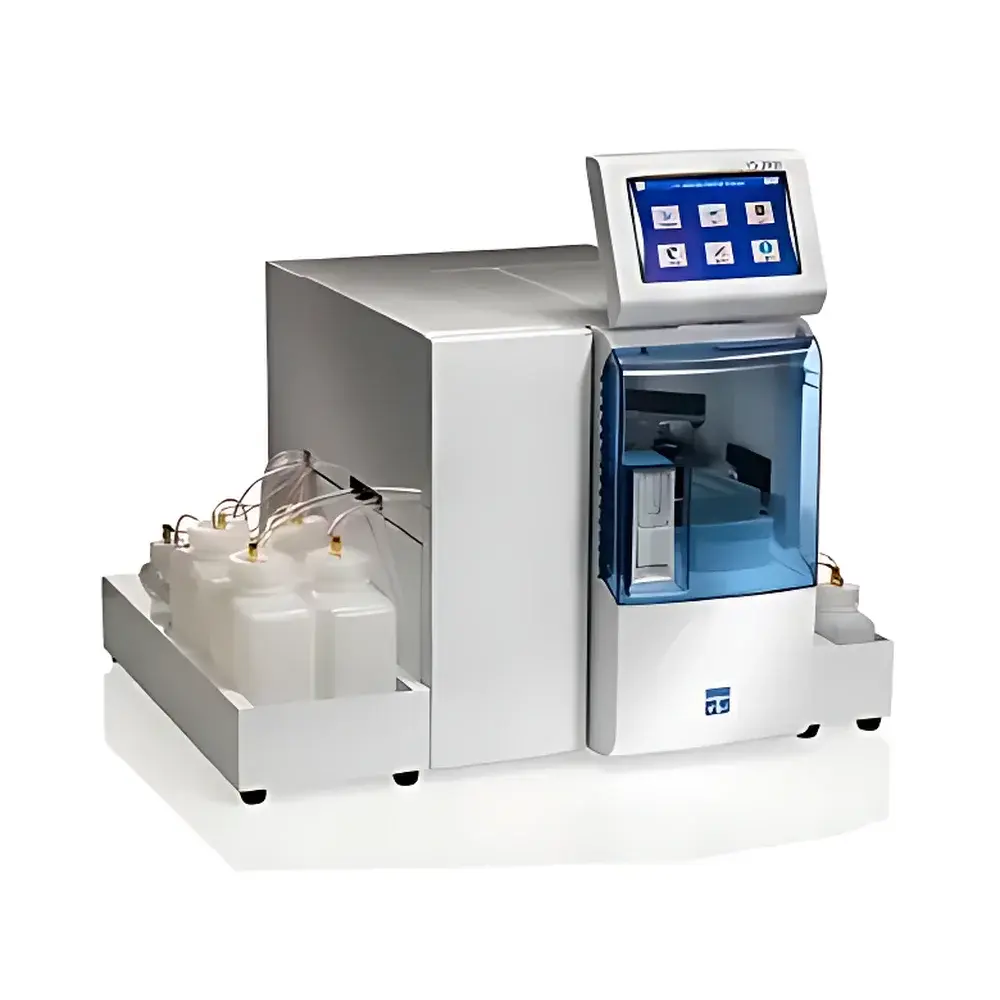
YSI 2950 Cell Culture Biochemical Analyzer
| Brand | INFORS |
|---|---|
| Origin | Switzerland |
| Model | YSI 2950 |
| Measurement Volume | 10–50 µL (user-defined) |
| Analysis Time | 60 s |
| Precision | CV < 2% |
| Linearity Deviation | ±5% |
| Auto-Calibration | Yes |
| Temperature Compensation | Integrated fluid temperature sensing and real-time correction |
| Liquid Level Detection | Yes (calibrant, reagent, waste bottles) |
| Dimensions (W×D×H) | 35.6 × 52.1 × 40.0 cm |
| Weight | 17.7 kg (excl. rack) |
| Operating Environment | 15–35 °C, 10–90% RH |
| Power | 220–240 VAC, 50–60 Hz, 50 W |
| Compliance | CE, RoHS |
| Sample Throughput | Up to 96 samples (single tubes, 8-tube strips, 24-well or 96-well microplates) |
| Modular Analyte Capacity | 2–6 analytes simultaneously |
Overview
The YSI 2950 Cell Culture Biochemical Analyzer is a high-precision, benchtop enzymatic biosensor platform engineered for real-time, multi-analyte quantification in complex biological matrices—particularly mammalian cell culture supernatants, fermentation broths, and clinical biofluids. Unlike conventional spectrophotometric or HPLC-based methods, the YSI 2950 employs immobilized enzyme membrane electrochemistry, combining selective biocatalysis with amperometric detection to deliver rapid, interference-resistant measurements within 60 seconds per analyte. Its core measurement principle relies on enzyme-specific oxidation or reduction reactions that generate stoichiometric hydrogen peroxide (H₂O₂), which is then electrochemically detected at a platinum working electrode. For ionic species such as ammonium (NH₄⁺) and potassium (K⁺), the system integrates ion-selective electrodes (ISEs) with integrated temperature compensation and automatic calibration verification. This hybrid sensor architecture enables robust performance in high-cell-density cultures (>10⁷ cells/mL) where particulate load and protein fouling commonly compromise conventional flow-cell systems.
Key Features
- Modular multi-analyte configuration supporting simultaneous analysis of 2–6 analytes—including glucose, lactate, glutamine, glutamate, ammonium, potassium, ethanol, methanol, xylose, sucrose, galactose, lactose, choline, glycerol, and hydrogen peroxide
- Anti-clog chambered fluidics design featuring optimized laminar flow paths and self-flushing protocols to prevent occlusion in viscous or particulate-rich samples (e.g., CHO or HEK293 harvest streams)
- User-defined sample volume (10–50 µL) minimizing precious bioreactor sample consumption while maintaining analytical reproducibility (CV < 2%)
- Integrated temperature sensor in the sample module enabling real-time thermal compensation of electrode sensitivity—critical for maintaining accuracy across process-relevant temperature shifts (e.g., 32–37 °C bioreactor runs)
- Automated calibration validation with fault detection: system monitors reagent depletion, enzyme membrane integrity, and electrode drift, triggering alerts when calibration deviation exceeds ±5% linearity tolerance
- Touchscreen GUI with intuitive graphical workflow navigation, compatible with both standalone operation and integration into supervisory control systems via RS-232 or optional Ethernet interface
Sample Compatibility & Compliance
The YSI 2950 is validated for direct analysis of undiluted, unfiltered cell culture supernatants—including fed-batch and perfusion processes with viable cell densities up to 20 × 10⁶ cells/mL. Its enzyme membranes exhibit minimal cross-reactivity with structurally analogous metabolites (e.g., fructose vs. glucose; α-ketoglutarate vs. glutamate), ensuring specificity without pre-chromatographic separation. The instrument complies with CE marking requirements and RoHS directives for electrical safety and hazardous substance restriction. While not certified under FDA 21 CFR Part 11 out-of-the-box, its audit-trail-capable software architecture supports qualification for GLP/GMP environments when deployed with validated electronic record procedures and user access controls. All calibration standards and consumables are traceable to NIST-certified reference materials.
Software & Data Management
The embedded firmware supports automated batch processing of up to 96 samples across multiple formats: individual Eppendorf tubes, 8-tube strips, 24-well plates, and standard SBS-format 96-well microplates. Each run generates timestamped, metadata-enriched datasets including sample ID, operator, calibration status, temperature log, and raw current response curves. Data export is available in CSV and Excel-compatible formats; optional LIMS connectivity enables direct upload to enterprise laboratory information management systems. Software versioning and change logs are maintained internally, supporting retrospective review during regulatory audits. No cloud storage or remote telemetry is enabled by default—data residency remains fully on-device unless explicitly configured per institutional IT policy.
Applications
- Biopharmaceutical process development and monitoring: real-time tracking of critical quality attributes (CQAs) such as lactate accumulation and ammonium buildup during monoclonal antibody production
- Fermentation optimization for biofuel feedstocks (e.g., ethanol yield in yeast-based lignocellulosic hydrolysates)
- Stem cell and primary neuron culture metabolic phenotyping—glucose-lactate shuttle kinetics, glutaminolysis profiling
- Clinical research labs performing point-of-process blood chemistry assays (e.g., whole-blood lactate in sepsis models)
- Food & beverage R&D: rapid quantification of fermentative metabolites (ethanol, glycerol, organic acids) in craft brewing and dairy fermentation trials
FAQ
What sample preparation is required prior to analysis?
Minimal preparation is needed: samples should be centrifuged (e.g., 10,000 × g, 5 min) to remove intact cells and large debris, but filtration is not required. Supernatants may be loaded directly.
Can the YSI 2950 measure analytes in serum or plasma?
Yes—glucose, lactate, and ammonium have been validated in human and animal serum; however, matrix-matched calibrations are recommended due to protein-binding effects on electrode response.
How often must enzyme membranes be replaced?
Typical membrane lifetime is 2–4 weeks under continuous daily use (≈50–100 assays/day), depending on sample turbidity and analyte concentration range.
Is method validation support available from INFORS or YSI?
INFORS provides IQ/OQ documentation templates and application notes aligned with ICH Q2(R2) guidelines; full PQ execution requires site-specific protocol development and execution.
Does the system support ASTM or ISO standard test methods?
While no single ASTM/ISO standard covers the entire platform, individual analyte modules align with principles described in ASTM D6730 (glucose in fermentation broths) and ISO 15198 (enzyme-based clinical analyzers).