
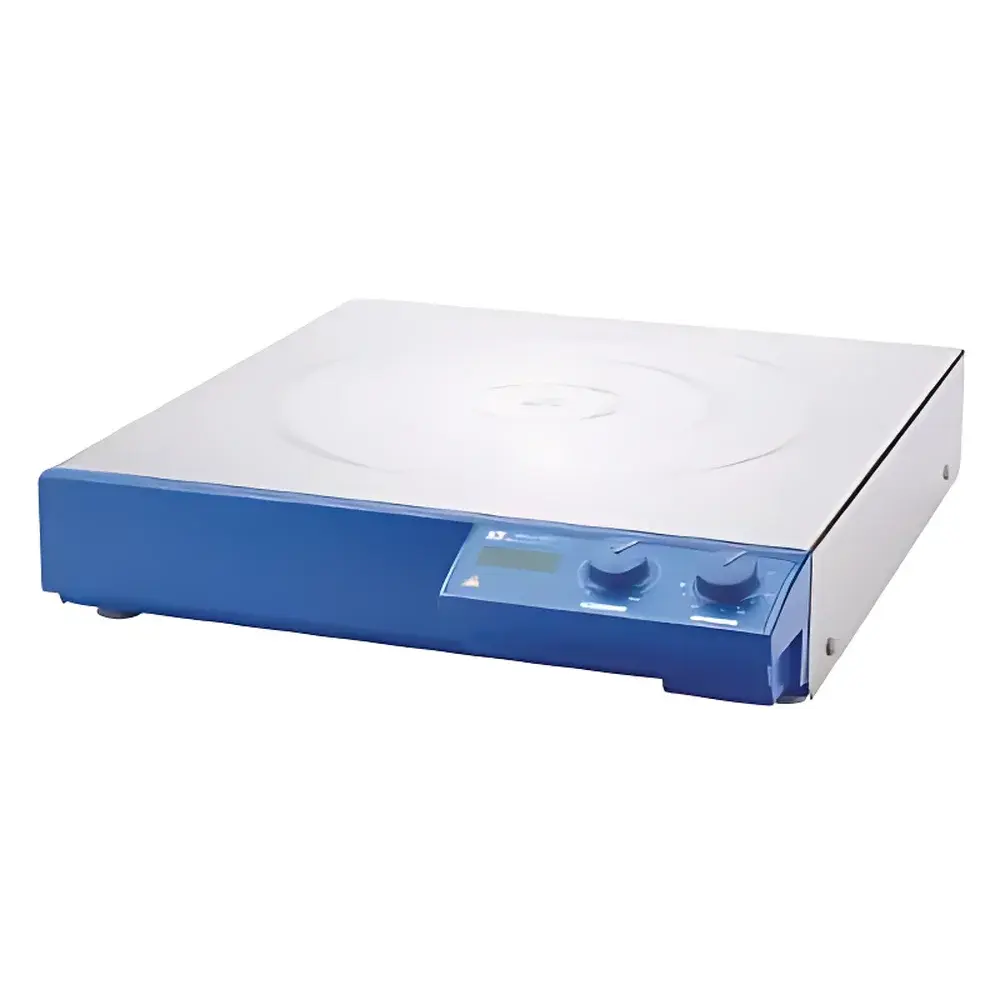
IKA Maxi MR 1 Digital Magnetic Stirrer
| Brand | IKA |
|---|---|
| Origin | Germany |
| Manufacturer | IKA Werke GmbH & Co. KG |
| Type | Magnetic Stirrer |
| Model | Maxi MR 1 |
| Maximum Stirring Volume | 150 L (H₂O) |
| Speed Range | 0–600 rpm |
| Display | LED/LCD Digital Speed Readout |
| Timer Function | 0–56 min or Continuous Operation |
| Motor Input Power | 80 W |
| Motor Output Power | 35 W |
| Max Stir Bar Length | 155 mm |
| Plate Material | Stainless Steel 1.4301 (AISI 304) |
| Plate Dimensions | 500 × 500 mm |
| Overall Dimensions | 505 × 110 × 585 mm |
| Weight | 16 kg |
| Ambient Temperature Range | 5–40 °C |
| Relative Humidity Limit | ≤80 % RH |
| Ingress Protection | IP21 |
| Voltage | 230 V / 100–120 V |
| Frequency | 50/60 Hz |
| Compliance | DIN EN 60529 |
Overview
The IKA Maxi MR 1 Digital Magnetic Stirrer is a high-capacity, single-position benchtop stirring system engineered for reproducible, low-shear mixing of large-volume liquid samples in research laboratories, quality control environments, and industrial R&D settings. Unlike heated stirrers, the Maxi MR 1 operates without temperature control—making it purpose-built for applications where thermal stability is externally managed or not required. Its core operation relies on precise electromagnetic coupling between the internal drive magnet and standard PTFE- or glass-coated magnetic stir bars, delivering consistent torque transmission even at low speeds and across viscous media. Designed around a robust stainless-steel housing and a heavy-duty electronic motor, the unit maintains stable rotational output under continuous load, supporting extended batch processing workflows without drift or thermal overload.
Key Features
- Single-point stirring platform with 500 × 500 mm stainless steel (1.4301/AISI 304) work surface—corrosion-resistant, non-magnetic, and compatible with aggressive solvents and cleaning agents
- Stepless speed control from 0 to 600 rpm with real-time digital LCD readout ensuring traceable, repeatable setpoints
- Integrated timer function offering programmable operation from 0 to 56 minutes or indefinite continuous mode—ideal for standardized mixing protocols
- High-torque DC motor delivering 35 W mechanical output from an 80 W electrical input, optimized for sustained performance with stir bars up to 155 mm in length
- IP21-rated enclosure providing protection against vertically falling drips and solid objects >12.5 mm—suitable for general laboratory environments per DIN EN 60529
- Broad voltage compatibility (230 V / 100–120 V) and dual-frequency support (50/60 Hz) enabling global deployment without hardware modification
Sample Compatibility & Compliance
The Maxi MR 1 accommodates aqueous and organic solutions up to 150 L (water-equivalent volume), provided appropriate stir bar geometry, material, and rotational dynamics are selected for the specific medium viscosity and container geometry. It supports standard cylindrical, square, or rectangular vessels made of glass, stainless steel, or chemically resistant polymers. While the device itself does not incorporate heating elements, its mechanical design complies with essential safety and electromagnetic compatibility standards—including DIN EN 60529 (IP21), EN 61000-6-3 (EMC emission limits), and EN 61000-6-2 (immunity). Though not intrinsically compliant with GLP or FDA 21 CFR Part 11 out-of-the-box, its deterministic timer logic and non-volatile speed setting retention support audit-ready documentation when integrated into validated SOPs.
Software & Data Management
The Maxi MR 1 operates as a standalone instrument with no embedded microprocessor-based data logging or PC interface. All operational parameters—including speed setpoint, timer duration, and run status—are controlled and displayed locally via front-panel buttons and the integrated LCD. This architecture eliminates firmware dependencies, reduces cybersecurity exposure, and ensures long-term operational continuity without software updates or driver installations. For laboratories requiring electronic recordkeeping, external USB or RS-232 data loggers (e.g., compliant with ASTM E2500-13 Annex A2) may be interfaced using third-party analog signal converters, provided validation protocols address accuracy, resolution, and timestamp integrity per ALCOA+ principles.
Applications
- Large-volume buffer preparation and reagent homogenization in biopharmaceutical upstream processing
- Consistent dispersion of nanoparticles or colloidal suspensions in materials science labs
- Stirring of culture media prior to sterilization or inoculation in microbiology workflows
- Blending of polymer solutions, emulsions, and coating formulations in chemical R&D
- Pre-mixing of calibration standards and reference materials for analytical instrumentation (e.g., HPLC, ICP-MS)
- Supporting ISO/IEC 17025-compliant sample conditioning where thermal neutrality and mechanical consistency are critical
FAQ
Does the Maxi MR 1 include a heating function?
No. The Maxi MR 1 is a non-heating magnetic stirrer. Temperature control must be achieved externally via water baths, cooling jackets, or climate-controlled enclosures.
What is the maximum recommended viscosity for reliable operation at full capacity?
While rated for 150 L of water, optimal performance with higher-viscosity fluids (e.g., >500 mPa·s) requires empirical validation using appropriately sized stir bars and reduced speed settings to maintain vortex formation and bottom-layer suspension.
Can the timer be reset during operation?
Yes—the timer can be paused, cleared, and reprogrammed at any time without interrupting motor rotation, enabling flexible protocol adjustments during active mixing.
Is the stainless steel plate grounded for electrostatic discharge (ESD) safety?
The 1.4301 plate is electrically conductive but not actively grounded by default; users handling flammable solvents should verify grounding continuity per IEC 61340-5-1 and implement supplemental static dissipation measures if required.
What maintenance is required for long-term reliability?
Routine cleaning with isopropyl alcohol and periodic inspection of stir bar integrity are sufficient; no lubrication or calibration is needed due to the brushless motor design and absence of mechanical feedback sensors.



