
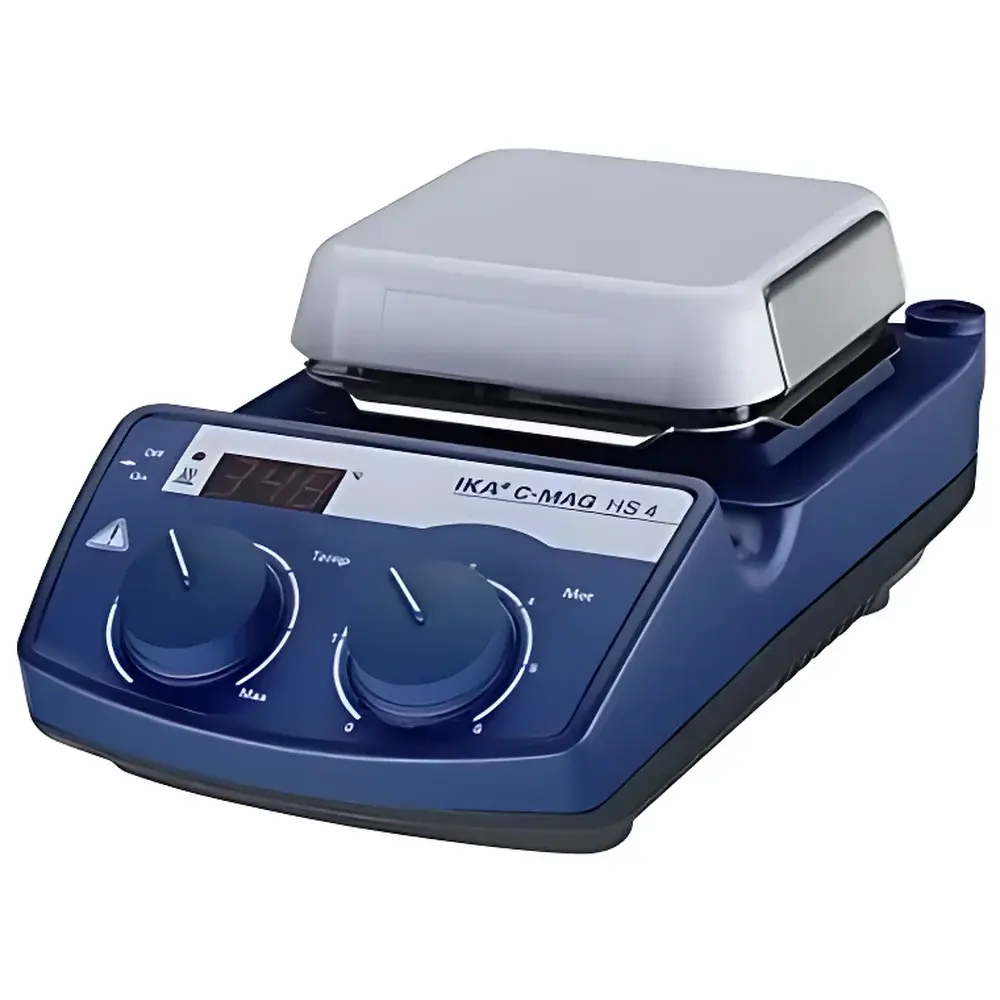
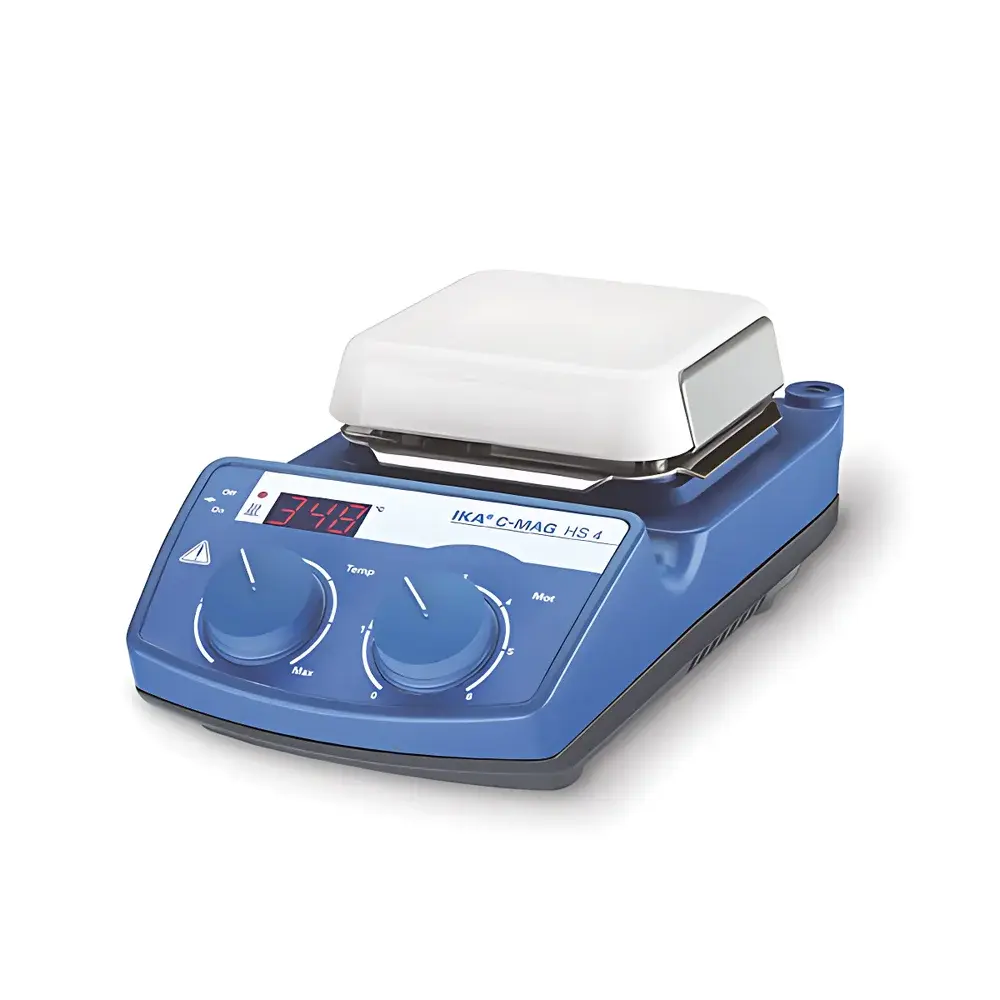
IKA C-MAG HS 4 Magnetic Stirrer
| Brand | IKA |
|---|---|
| Origin | Germany |
| Manufacturer | IKA-Werke GmbH & Co. KG |
| Product Type | Magnetic Stirrer |
| Model | C-MAG HS 4 |
| Maximum Stirring Volume (H₂O) | 5 L |
| Speed Range | 100 – 1500 rpm |
| Heating Temperature Range | 50 – 500 °C |
| Heating Power | 250 W |
| Motor Output Power | 1.5 W |
| Plate Material | Ceramic |
| Plate Dimensions | 100 × 100 mm |
| Safety Cut-off Temperature | 550 °C |
| Protection Rating | IP21 |
| Operating Ambient Temperature | 5 – 40 °C |
| Relative Humidity Limit | ≤80 % |
| Voltage | 100 / 120 / 230 V, 50/60 Hz |
| Overall Dimensions | 150 × 105 × 260 mm |
| Weight | 3 kg |
Overview
The IKA C-MAG HS 4 is a compact, microprocessor-controlled magnetic stirrer with integrated heating, engineered for precision, repeatability, and safety in routine laboratory applications. It operates on the principle of electromagnetic induction: a rotating magnetic field generated beneath the ceramic plate couples with a magnetic stirring bar immersed in the sample, inducing rotational motion without mechanical contact. The device combines precise speed regulation and stable thermal control—critical for temperature-sensitive reactions, dissolution studies, or viscosity-dependent mixing protocols. Its robust architecture supports continuous operation under GLP-compliant workflows, and its design conforms to DIN EN 60529 (IP21) for protection against vertically falling solid objects and limited ingress of moisture—making it suitable for standard chemistry, pharmaceutical, and quality control laboratories.
Key Features
- Ceramic heating plate (100 × 100 mm) with seamless, chemically inert surface—resistant to strong acids, bases, and organic solvents commonly used in synthesis and analytical prep.
- Microprocessor-based dual-loop control: independent feedback circuits regulate both motor speed (100–1500 rpm, adjustable via analog dial) and plate temperature (50–500 °C), ensuring minimal drift during extended runs.
- Dedicated safety systems: hardware-enforced thermal cut-off at 550 °C prevents overheating; blinking LED indicator warns users of elevated surface temperature (>50 °C) to mitigate accidental contact burns.
- Elevated control panel design minimizes risk of liquid splashes compromising interface integrity while improving visibility of digital speed and temperature readouts.
- High-torque motor (1.5 W output) delivers consistent rotation even with viscous media up to 5 L (water-equivalent volume), reducing “jumping” of stir bars through optimized magnetic coupling strength.
- Compliance-ready construction: meets IEC/EN 61010-1 safety standards for electrical equipment used in laboratories; compatible with optional external temperature probes (e.g., ETS-D5) for solution-phase temperature monitoring per USP or ISO 17025 traceability requirements.
Sample Compatibility & Compliance
The C-MAG HS 4 accommodates standard round-bottom flasks (up to 5 L), beakers, and crystallization dishes placed directly on the ceramic plate. Its non-porous surface ensures compatibility with aggressive reagents including concentrated HNO₃, NaOH solutions, and chlorinated solvents—eliminating risk of corrosion-induced calibration drift. For regulated environments, the instrument supports audit-ready documentation when paired with validated temperature sensors and logging software compliant with FDA 21 CFR Part 11 (electronic records and signatures). While not intrinsically rated for hazardous area use, its IP21 enclosure provides sufficient protection for general-purpose lab spaces operating within ambient conditions of 5–40 °C and ≤80% RH.
Software & Data Management
The C-MAG HS 4 operates as a standalone unit with no embedded firmware update capability or USB connectivity. However, it integrates seamlessly into broader laboratory data ecosystems via analog-compatible external temperature probes (e.g., IKA ETS-D5) that feed real-time solution temperature data to third-party DAQ systems or LIMS platforms. All parameter settings—including speed setpoint, target temperature, and elapsed runtime—are retained across power cycles. For facilities requiring full electronic audit trails, pairing with IKA’s labCOM software (via RS232-enabled models such as RET basic or RCT basic) enables remote parameter logging, alarm history export, and CSV-formatted session reports aligned with GLP/GMP documentation practices.
Applications
- Controlled heating and homogenization during solvent-based extractions, polymer dissolution, or buffer preparation.
- Preparation of calibration standards and reference materials where reproducible thermal history and mixing uniformity are essential.
- Supporting ASTM D2196 (viscosity of paints) or ISO 3219 (rheological behavior of polymer solutions) sample conditioning steps.
- Cell culture media warming and reagent equilibration prior to sterile filtration or dispensing.
- Accelerated stability testing protocols requiring defined thermal ramp rates (2.5 K/min nominal) and hold-time accuracy.
FAQ
Can the C-MAG HS 4 maintain precise solution temperature?
No—it regulates plate surface temperature only. For accurate solution temperature control, an external probe (e.g., IKA ETS-D5) must be connected and configured in external sensor mode.
Is the device compatible with 120 V AC power supplies?
Yes—the unit supports universal input (100 / 120 / 230 V, 50/60 Hz) and ships with region-specific mains cables.
What is the maximum recommended viscosity for reliable stirring?
While rated for 5 L of water, performance with high-viscosity fluids (e.g., glycerol, PEG solutions) depends on stir bar geometry and vessel shape; use cross-shaped or fleur-de-lis bars and minimize headspace for optimal torque transfer.
Does the C-MAG HS 4 support programmable ramp-and-hold temperature profiles?
No—this model features manual analog control only. For programmable thermal protocols, consider IKA’s RCT basic or HS 7 series with digital interfaces.
How often should the ceramic plate be cleaned to ensure long-term accuracy?
Wipe after each use with ethanol or isopropanol; avoid abrasive cleaners. Inspect quarterly for micro-scratches or residue buildup, which may impair thermal conductivity or magnetic coupling efficiency.



