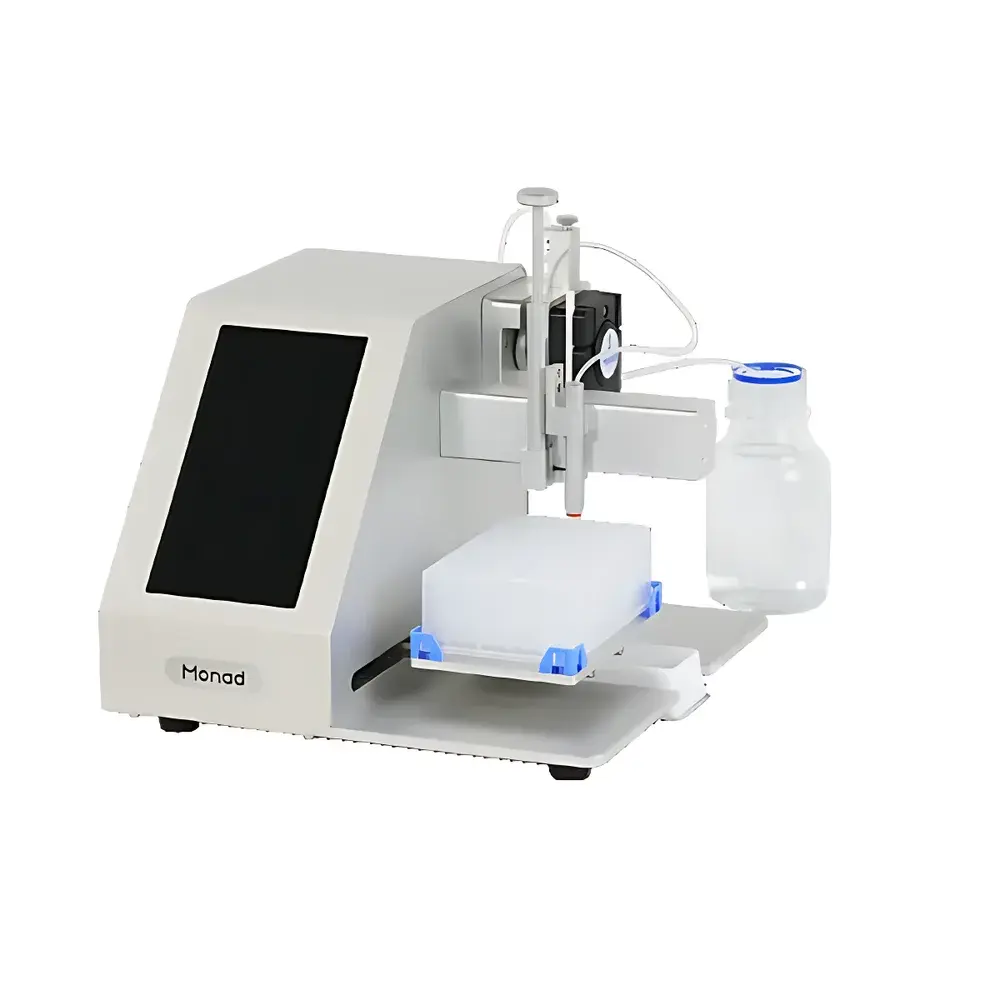
Monad AutoDrip 1 Single-Channel Microplate Dispenser
| Brand | Monad |
|---|---|
| Origin | Jiangsu, China |
| Manufacturer Type | Authorized Distributor |
| Product Origin | Domestic (China) |
| Model | AutoDrip 1 |
| Pricing | Available Upon Request |
| Dispensing Range | 5–2000 µL |
| Precision & Accuracy | <3% CV and %Error (per ISO 8655-6) |
| Calibration | Dual-point volumetric calibration (low/high range) |
| Compatible Plate Formats | 24-well, 48-well, 96-well microplates |
| Pump Technology | Dual-head peristaltic pump system |
| Included Tubing Sets | Five pre-calibrated disposable tubing paths (GLA9005–GLA9009) |
| Standard Accessories | Small nozzle holder (GLA9001), large nozzle holder (GLA9002), small-pump calibrator (GLA9003), spare small-nozzle gaskets (5/pk, GLA9004) |
Overview
The Monad AutoDrip 1 Single-Channel Microplate Dispenser is an engineered solution for precise, reproducible, and hands-free liquid dispensing in life science laboratories. Designed around a dual-head peristaltic pumping architecture, the system delivers non-contact, drop-on-demand fluid transfer without tip contact or cross-contamination risk—ideal for sensitive assay workflows including ELISA, cell-based assays, qPCR setup, and reagent stock preparation. Unlike positive-displacement or air-displacement pipettors, the AutoDrip 1 relies on controlled occlusion of flexible tubing to generate consistent flow profiles, eliminating reliance on liquid surface tension or density-dependent piston movement. This principle ensures robust performance across diverse aqueous and low-viscosity buffers (e.g., PBS, Tris-HCl, DMSO-diluted compounds), with minimal maintenance and no need for frequent tip replacement or calibration drift correction.
Key Features
- Dual independent peristaltic pump heads—each optimized for distinct volume ranges—to support seamless transition between low-volume (5–40 µL) and high-volume (300–2000 µL) dispensing tasks without hardware reconfiguration.
- Five factory-calibrated, disposable tubing sets (GLA9005–GLA9009), each traceably certified to ISO 8655-6 for volumetric accuracy and repeatability; tubing is chemically resistant to common lab solvents and sterilizable via ethanol wipe-down.
- Integrated dual-point volumetric calibration routine—performed using gravimetric verification at both low and high ends of each tubing’s operational range—ensuring long-term consistency compliant with GLP documentation requirements.
- Modular nozzle mounting system with interchangeable holders (GLA9001/GLA9002) enabling rapid adaptation to varying plate deck heights and well geometries across 24-, 48-, and 96-well formats.
- Programmable continuous dispensing mode with adjustable dwell time and aspiration/dispense speed profiles—supporting both single-step bulk loading and multi-step serial dilution protocols.
Sample Compatibility & Compliance
The AutoDrip 1 accommodates standard ANSI/SLAS-compliant microplates (SBS footprint), including flat-bottom, U-bottom, and V-bottom configurations. It supports liquids with viscosities up to 15 mPa·s (e.g., 10% glycerol in water) and surface tensions between 25–72 mN/m. All wetted components—including tubing, gaskets (GLA9004), and nozzle interfaces—are manufactured from USP Class VI-certified silicone and polypropylene, ensuring biocompatibility and extractables control per ICH Q5C guidelines. The instrument meets CE marking requirements for laboratory equipment (2014/30/EU EMC Directive and 2014/35/EU LVD Directive) and supports audit-ready operation under FDA 21 CFR Part 11 when paired with validated third-party LIMS integration.
Software & Data Management
While the AutoDrip 1 operates via intuitive front-panel controls (rotary encoder + OLED display), optional USB-host connectivity enables firmware updates and protocol export/import via CSV templates. All calibration logs, dispensing event timestamps, and user-initiated validation runs are stored locally with tamper-evident file attributes. For regulated environments, the system supports external electronic lab notebook (ELN) synchronization through RS-232 or TTL-level trigger outputs—facilitating automated metadata capture (e.g., operator ID, plate barcode, lot number) during high-throughput screening campaigns.
Applications
- Primary and secondary antibody dispensing in immunoassay development and QC release testing.
- Pre-aliquoting of master mixes for nucleic acid amplification workflows (RT-qPCR, digital PCR).
- Cell seeding normalization across multi-well cytotoxicity or proliferation assays.
- Automated buffer exchange in protein purification pre-screening and column equilibration steps.
- High-fidelity reagent distribution for CRISPR guide RNA complex assembly and transfection optimization studies.
FAQ
What regulatory standards does the AutoDrip 1 comply with?
The device conforms to CE directives for electromagnetic compatibility and electrical safety. Its materials and calibration methodology align with ISO 8655-6 for piston-type and peristaltic dispensers, supporting GLP/GMP-aligned usage when integrated into documented SOPs.
Can the AutoDrip 1 be integrated into robotic workcells?
Yes—via TTL-compatible external trigger input and programmable output signals, it synchronizes with third-party liquid handlers, plate stackers, and readers for walk-away automation.
Is tubing replacement required after each use?
No. Tubing sets are designed for extended reuse within defined volume cycles (up to 500 dispenses per set under standard buffer conditions); however, dedicated sets are recommended for incompatible chemistries (e.g., strong acids or organic solvents).
Does the system support variable dispensing across wells?
The base model executes uniform dispensing per plate; variable-volume protocols require external script control via USB/RS-232 interface and compatible host software.
How is accuracy verified post-installation?
Users perform initial two-point gravimetric calibration using certified weights and Class A volumetric flasks; subsequent verification follows internal SOPs referencing NIST-traceable reference standards.
Related Products