
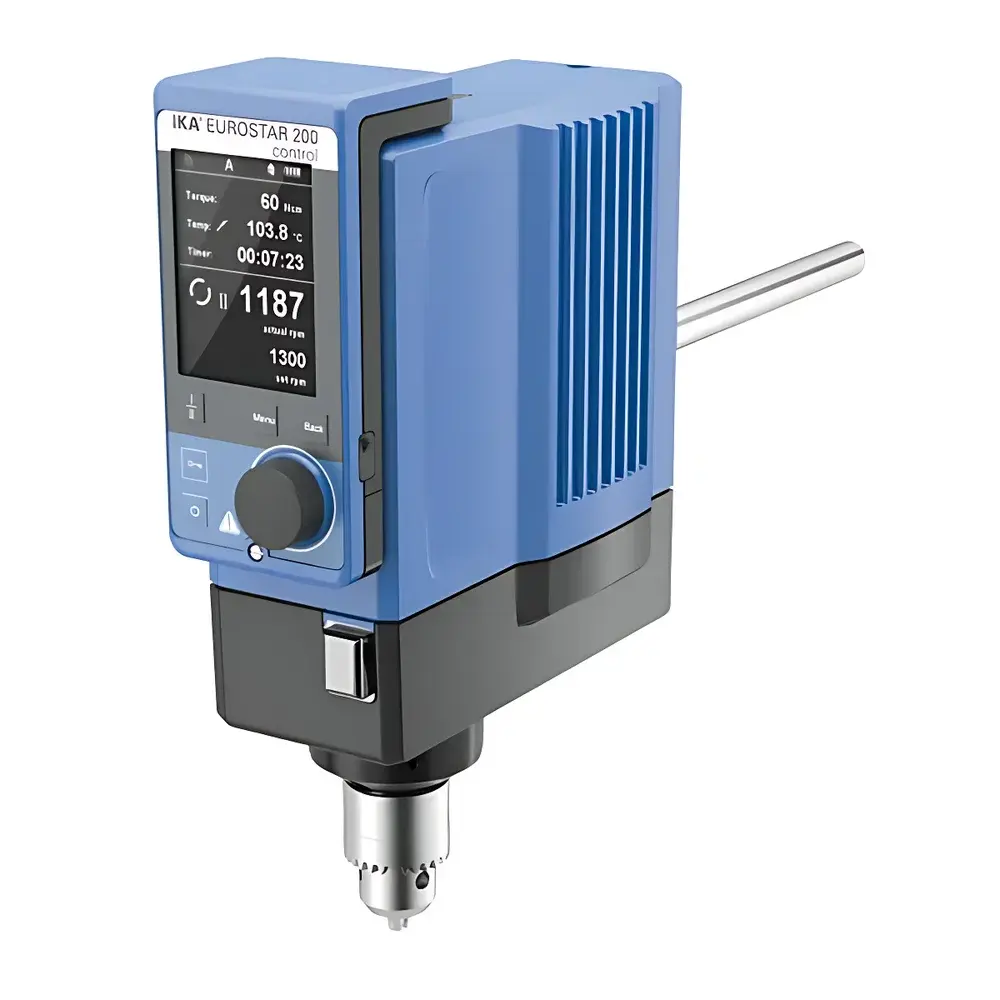
IKA EUROSTAR 200 control Overhead Stirrer
| Brand | IKA |
|---|---|
| Origin | Germany |
| Manufacturer | IKA-Werke GmbH & Co. KG |
| Model | EUROSTAR 200 control |
| Maximum Mixing Volume | 100 L (H₂O) |
| Speed Range | 0/6–2000 rpm (dual-range, infinitely variable) |
| Motor Type | Brushless DC |
| Max Torque | 200 N·cm (Range I), 40 N·cm (Range II) |
| Power Input | 135 W |
| IP Rating | IP40 |
| Interfaces | RS232, USB |
| Display | TFT touchscreen with multilingual UI |
| Temperature Sensing | PT1000 input (–10 to +350 °C, ±0.5 K accuracy per DIN IEC 751 Class A) |
| Wireless Control | WH 11 handheld controller (up to 150 m range) |
| Dimensions (W×H×D) | 91 × 297 × 231 mm |
| Weight | 4.9 kg |
Overview
The IKA EUROSTAR 200 control is a high-performance overhead stirrer engineered for precision mixing, dispersion, and homogenization tasks in research laboratories, quality control environments, and pilot-scale development settings. Designed around a brushless DC motor architecture, it delivers exceptional torque stability and thermal resilience without carbon brush wear—ensuring long-term repeatability and minimal maintenance. Its dual-speed range configuration (6–400 rpm and 30–2000 rpm) supports both high-torque, low-speed operations—ideal for viscous polymer melts, pastes, or suspensions—and high-shear, rapid dispersion of low-to-medium viscosity systems. The system operates on closed-loop speed regulation: real-time comparison between setpoint and actual rotational speed enables continuous micro-adjustment, maintaining deviation within ±1 rpm (>300 rpm) or ±3 rpm (<300 rpm), even during dynamic viscosity shifts. This capability is critical for rheologically complex processes where consistent shear history directly impacts structural development or reaction kinetics.
Key Features
- Brushless DC motor delivering 84 W output power and peak torque of 200 N·cm (Range I) for reliable handling of viscosities up to 100,000 mPa·s
- Infinitely variable electronic speed control with dual-range selection optimized for torque/speed trade-off
- TFT color touchscreen interface supporting 12+ languages, programmable timers (1–6000 min), intermittent operation mode, and real-time torque trend visualization
- Integrated PT1000 temperature input enabling simultaneous monitoring of sample temperature during stirring (–10 to +350 °C; ±0.5 K accuracy per DIN IEC 751 Class A)
- WH 11 wireless handheld controller with 150 m operational range (line-of-sight), enabling remote parameter adjustment and status monitoring without physical access to the unit
- Active safety circuitry with automatic shutdown upon motor stall, overload, or thermal anomaly; includes mechanical locking, overtorque protection, and error-code diagnostics
- RS232 and USB interfaces compliant with standard laboratory data acquisition protocols for GLP/GMP-compliant experiment logging and audit trail generation
- Compact cast-aluminum housing with thermoplastic coating (IP40 ingress protection), low-noise operation (<55 dB(A)), and space-efficient footprint (91 × 297 × 231 mm)
Sample Compatibility & Compliance
The EUROSTAR 200 control accommodates a broad spectrum of sample types—from aqueous solutions and organic solvents to non-Newtonian gels, ceramic slurries, and thermosetting resins—via interchangeable impellers and shaft configurations (0.5–10 mm clamping range; hollow shaft compatible with inline sensors). Its design adheres to key international safety and electromagnetic compatibility standards, including DIN EN 61000-6-3 (EMC emission), DIN EN 61000-6-1 (EMC immunity), and DIN EN 61010-1 (electrical safety for laboratory equipment). While not intrinsically rated for hazardous area use, its robust construction and fail-safe logic make it suitable for ISO 17025-accredited testing labs and facilities operating under FDA 21 CFR Part 11 requirements when paired with validated software workflows.
Software & Data Management
Data export and remote supervision are enabled via native RS232 and USB connectivity. The device supports ASCII-based command protocols compatible with common lab automation platforms (e.g., LabVIEW, MATLAB, Python-based DAQ scripts). All operational parameters—including speed, torque, temperature, elapsed time, and error logs—are timestamped and exportable as CSV files for traceability. When integrated into networked lab infrastructures, the EUROSTAR 200 control satisfies ALCOA+ principles (Attributable, Legible, Contemporaneous, Original, Accurate) through deterministic data capture and unalterable session records—essential for GxP-regulated environments requiring full process accountability.
Applications
- Viscosity-dependent reaction monitoring in pharmaceutical suspension formulation
- High-shear dispersion of nanomaterials in battery electrolyte development
- Controlled agitation during crystallization studies under varying thermal profiles
- Homogenization of high-solid-content food emulsions and cosmetic bases
- Accelerated aging tests of adhesives and sealants under sustained mechanical stress
- Preparation of standardized reference samples for rheological calibration (e.g., against NIST-traceable standards)
FAQ
Does the EUROSTAR 200 control support external temperature feedback for closed-loop thermal control?
No—the PT1000 input provides monitoring only; it does not drive external heating/cooling devices.
Can the WH 11 wireless controller be used with multiple EUROSTAR units simultaneously?
Yes, each WH 11 unit can be paired with one EUROSTAR device; multiple controllers may operate independently within overlapping radio range.
Is the hollow shaft compatible with fiber-optic or pressure probes?
Yes—its 10.3 mm internal diameter permits insertion of standard 6–8 mm OD probes during standstill; dynamic insertion is not supported.
What is the maximum allowable ambient humidity for continuous operation?
Relative humidity must not exceed 80 % non-condensing at operating temperatures between 5 °C and 40 °C.
Does the device meet FDA 21 CFR Part 11 requirements out-of-the-box?
Hardware-level compliance is inherent; full Part 11 adherence requires validation of associated software, user access controls, and electronic signature implementation in the host system.



