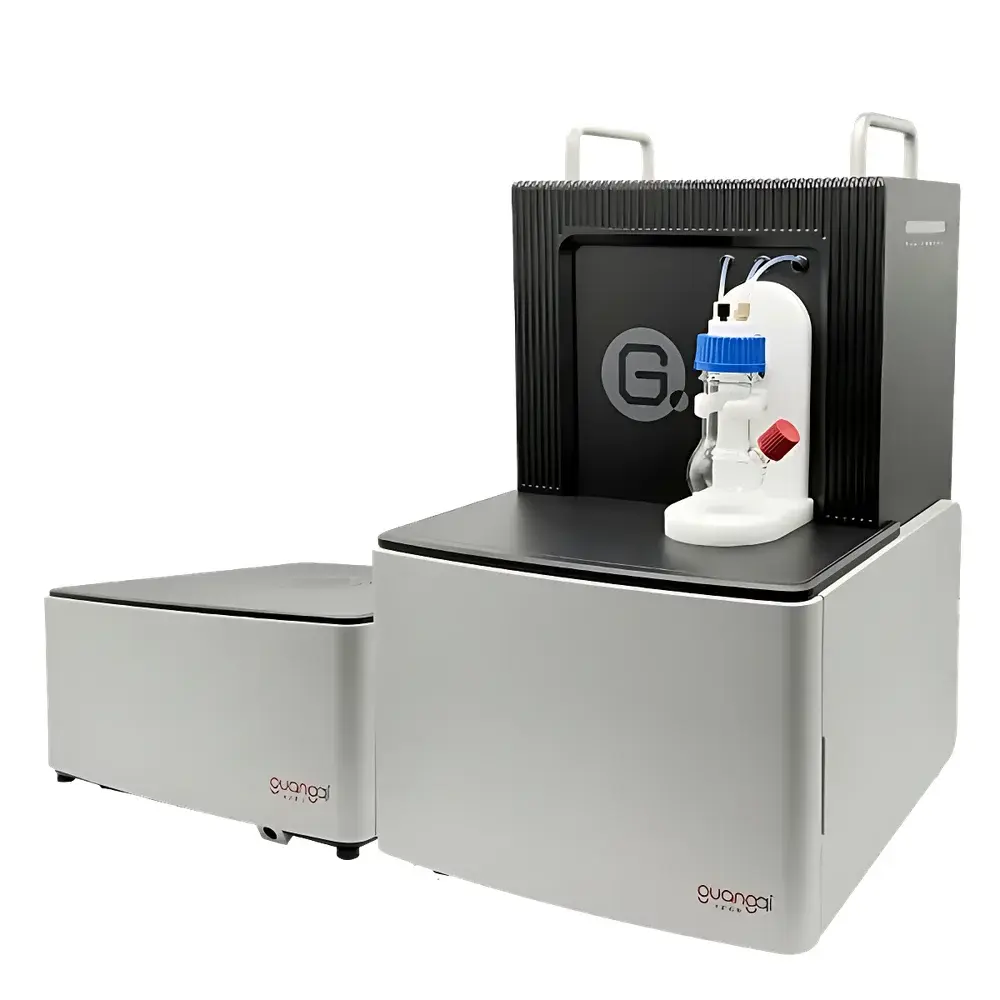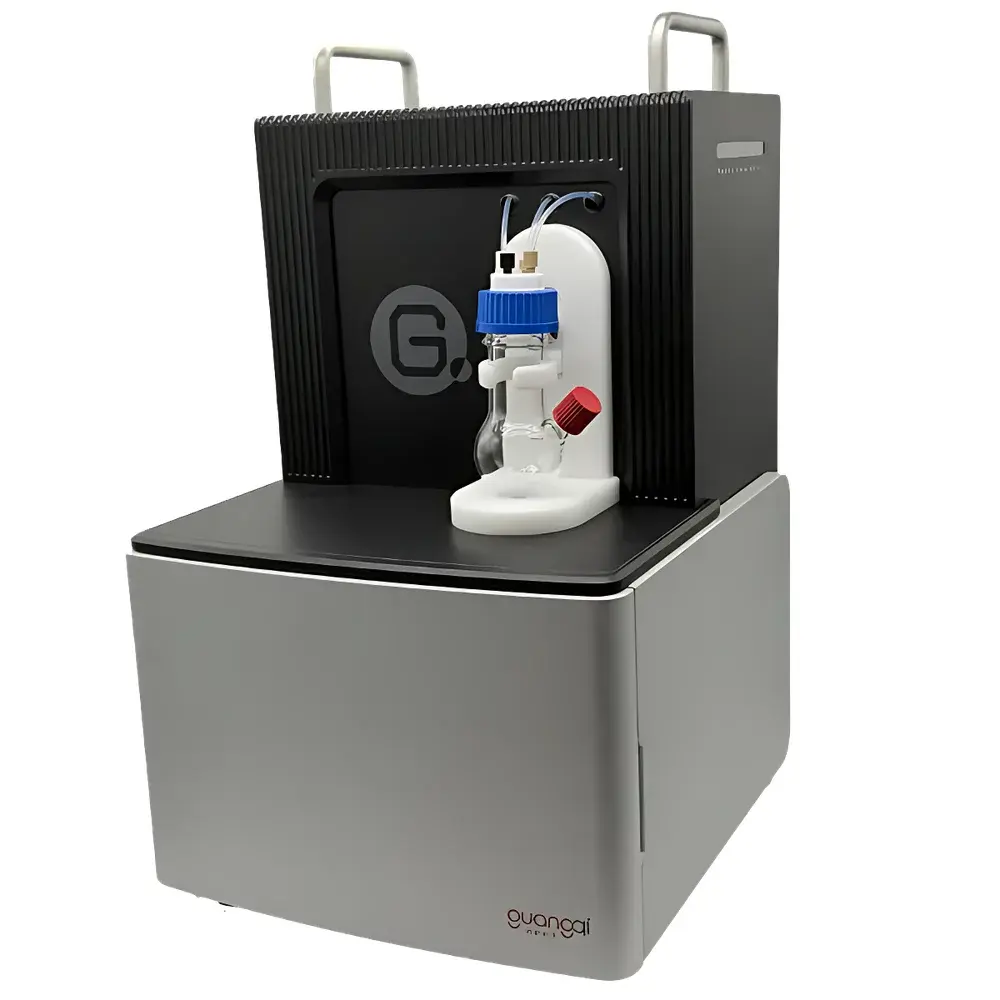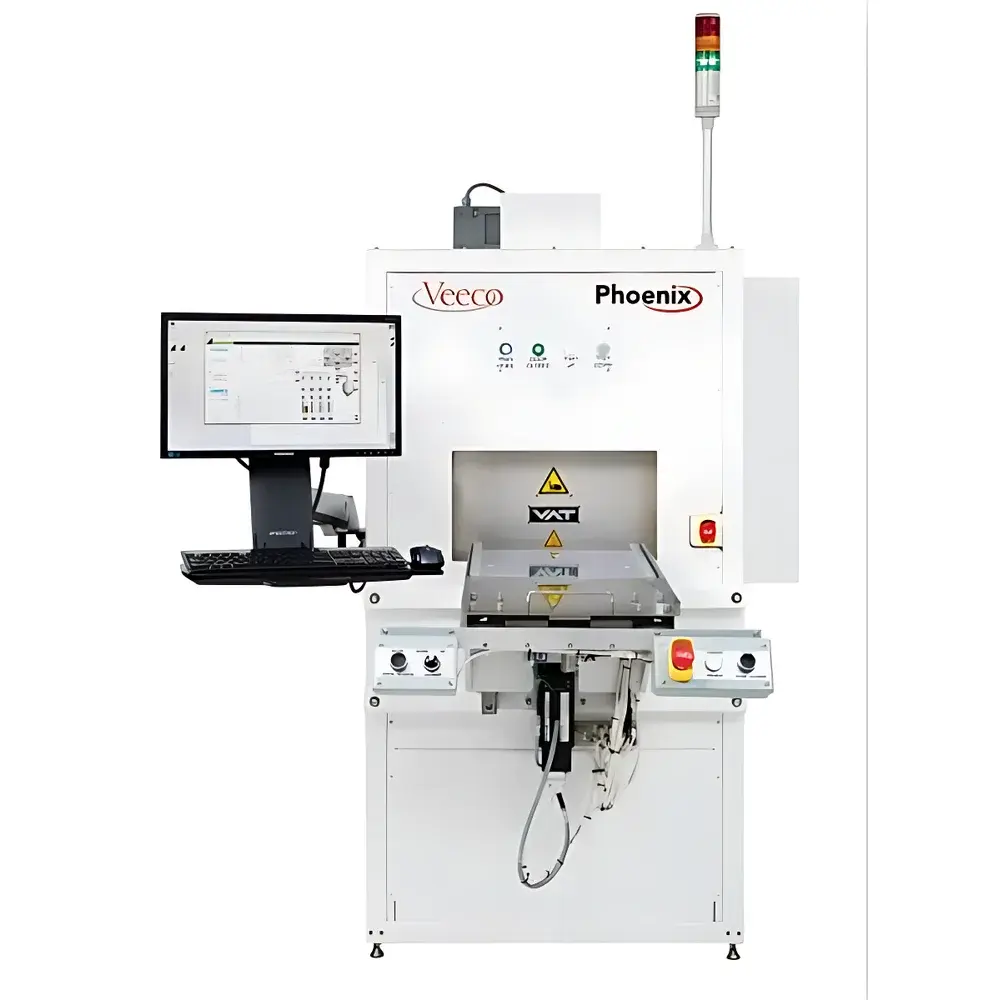
Veeco Phoenix G2 Atomic Layer Deposition System
| Brand | Veeco |
|---|---|
| Origin | USA |
| Model | Phoenix G2 ALD System |
| Substrate Capacity | Up to 370 mm × 470 mm (Gen 2.5 Panels) |
| 100 mm wafers | 240–360 pcs/batch |
| 150 mm wafers | 80–160 pcs/batch |
| 200 mm wafers | 80–100 pcs/batch |
| 300 mm wafers | up to 40 pcs/batch |
| Process Temperature Range | Up to 285 °C |
| Precursor Lines | Standard 4-channel MFC-controlled delivery |
| Dimensions (W × H × D) | 900 mm × 1370 mm × 1700 mm |
| Uniformity | <1.5% (Al₂O₃ on single wafer), <1.0% (Al₂O₃ across full batch) |
| Power Requirement | 208 VAC, 3-phase, 8500 W (including vacuum pump) |
| Gas Control | N₂ or Ar carrier/purge with mass flow controllers (MFCs) |
| Optional In-situ Tools | Ozone generator, LVPD (low-voltage plasma source), integrated glovebox, semi-automated load/unload, SECS/GEM interface |
Overview
The Veeco Phoenix G2 Atomic Layer Deposition System is a high-throughput, thermal batch ALD platform engineered for precision thin-film fabrication in semiconductor manufacturing, advanced packaging, MEMS, and emerging display applications. Based on self-limiting surface reaction chemistry—where sequential, saturating pulses of gaseous precursors react with functionalized substrate surfaces—the Phoenix G2 delivers atomic-scale thickness control, exceptional conformality over high-aspect-ratio features, and industry-leading batch uniformity. As the evolution of Veeco’s legacy ALD platforms (originally developed by Cambridge Nanotech since 2003), the G2 integrates robust thermal process stability, modular precursor management, and factory-integrated automation interfaces—making it suitable for both R&D scale-up and high-volume manufacturing (HVM) environments requiring reproducible, traceable, and auditable deposition processes.
Key Features
- High-capacity thermal batch architecture supporting Gen 2.5 glass panels (370 mm × 470 mm) and silicon wafers from 100 mm to 300 mm—with throughput scalability ranging from 40 wafers (300 mm) to 360 wafers (100 mm) per run.
- Thermal processing capability up to 285 °C, enabling stable ALD of oxides (e.g., Al₂O₃, HfO₂, TiO₂), nitrides (e.g., TiN, TaN), and sulfides with precise stoichiometric control.
- Four independently controlled, MFC-regulated precursor lines with standardized 3.1 L or 600 mL stainless-steel source bottles—compatible with liquid, solid, and volatile precursors requiring temperature-controlled delivery.
- Integrated safety architecture including leak-tight chamber design, redundant pressure interlocks, real-time gas monitoring, emergency purge protocols, and fail-safe valve sequencing compliant with SEMI S2/S8 guidelines.
- Modular in-situ analysis compatibility: optional ozone generation for enhanced oxidation kinetics, low-voltage plasma source (LVPD) for plasma-enhanced ALD (PE-ALD), and integration-ready ports for ellipsometry or QCM monitoring.
Sample Compatibility & Compliance
The Phoenix G2 accommodates flat substrates—including silicon, sapphire, quartz, and low-temperature glass—as well as complex 3D structures via user-configurable fixtures. Its chamber geometry and gas dispersion design ensure uniform precursor exposure and purge efficiency across heterogeneous topographies. The system meets key international standards for semiconductor equipment: SEMI F47 (voltage sag immunity), SEMI E10 (definition of equipment reliability), and ISO 14644-1 Class 5 cleanroom compatibility when installed with appropriate facility interfaces. All software logs—including recipe parameters, gas flows, temperature ramps, and alarm history—are timestamped and exportable to support GLP/GMP documentation requirements and FDA 21 CFR Part 11-compliant audit trails when deployed with validated data management configurations.
Software & Data Management
Controlled via Veeco’s proprietary ALD Commander™ software suite, the Phoenix G2 provides intuitive recipe-driven operation with multi-level user access (operator, engineer, administrator). The interface supports full parameter logging at 100 ms resolution, real-time chamber condition visualization (pressure, temperature, MFC output), and automated fault diagnostics. Recipe libraries are version-controlled and exportable in XML format. For factory integration, the system includes native SECS/GEM (SEMI E30/E37) communication protocols, enabling seamless connectivity with MES systems and automated material handling. Data exports comply with ASTM E1578-22 (standard guide for electronic records in materials testing) and support CSV, PDF, and SQLite formats for long-term archival and cross-platform analysis.
Applications
- Semiconductor gate dielectrics and high-k stacks (e.g., Al₂O₃/HfO₂ bilayers) requiring sub-nanometer thickness control and interface passivation.
- Advanced packaging barrier layers (e.g., AlN, SiNₓ) for fan-out wafer-level packaging (FOWLP) and 2.5D/3D IC interposers.
- MEMS encapsulation films with pinhole-free coverage on micro-cavities and movable structures.
- Flexible electronics: ALD Al₂O₃ moisture barriers on OLED backplanes and thin-film transistor (TFT) gate insulators.
- R&D of novel ALD chemistries—including metal chalcogenides and perovskite precursors—for next-generation memory and photonic devices.
FAQ
What substrate sizes does the Phoenix G2 support?
The system handles Gen 2.5 glass panels (370 mm × 470 mm), 100 mm to 300 mm silicon wafers, and custom 3D objects using application-specific fixtures.
Is plasma-enhanced ALD (PE-ALD) supported?
Yes—via optional integrated low-voltage plasma discharge (LVPD) module, enabling lower-temperature processing of nitrides and metal films without compromising film density.
How is process repeatability ensured across production lots?
Through hardware-level MFC calibration traceability, chamber seasoning protocols, real-time pressure/temperature feedback loops, and software-enforced recipe locking with digital signature authentication.
Can the system be integrated into an automated fab environment?
Yes—the Phoenix G2 includes standard SECS/GEM interface, wafer mapping support, and EDA/Interface A compliance for host communication and remote diagnostics.
What safety certifications does the system meet?
It conforms to SEMI S2 (safety guidelines), SEMI S8 (ergonomics), UL 61010-1, and CE marking requirements for industrial equipment in North America and the EU.