
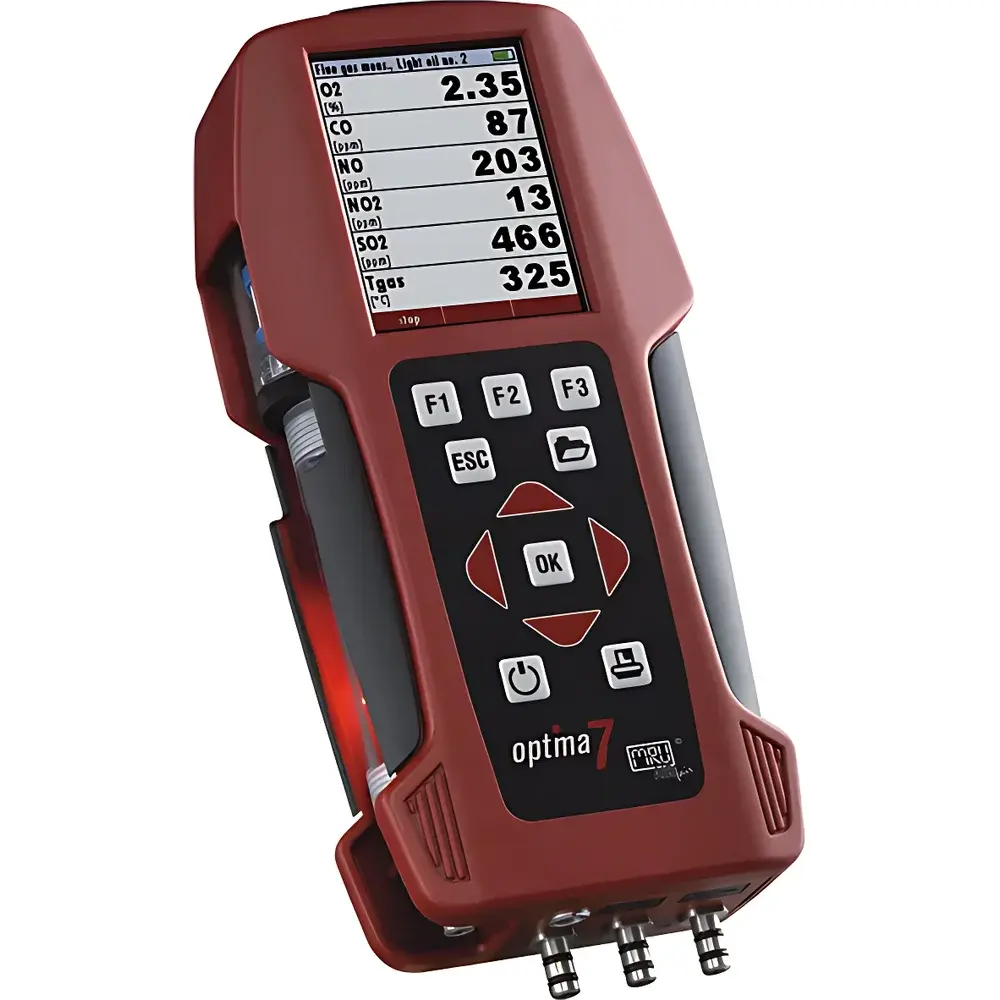
OPTIMA 7 Portable Flue Gas Analyzer
| Brand | — |
|---|---|
| Origin | USA |
| Manufacturer Type | Authorized Distributor |
| Origin Category | Imported |
| Model | OPTIMA 7 |
| Instrument Type | Portable Flue Gas Analyzer |
| Measurement Principle | Electrochemical Sensor (O₂, CO, NOₓ, SO₂, H₂S) |
| Accuracy | ≤ ±1% of full scale |
| Repeatability | ≤ 0.5% (typical, per ISO 12039 & EN 15267-3) |
| Response Time (T₉₀) | ≤ 10 s |
| Drift Stability | ≤ 1% FS/week |
| Measurable Gases | O₂, CO (low/high/very high), CO₂, NO, NO₂, NOₓ, SO₂, H₂S, flue gas temperature (0–1100 °C), ambient air temperature (0–100 °C), differential pressure (±100 hPa), static pressure (±100 hPa), flue gas velocity (3–100 m/s) |
| Display | 3.5″ color TFT LCD with LED backlight & zoom function |
| Data Storage | 16,000 internal records |
| Connectivity | Mini-USB (data transfer & charging), IrDA (infrared printer interface), optional Bluetooth 4.0 |
| Filtration | Integrated PTFE-reusable particulate filter + water separator |
| Gas Path | Stainless steel sampling probe & fittings |
| Power | Rechargeable Li-ion battery (≥6 h standard |
| Weight | < 800 g (main unit only) |
Overview
The OPTIMA 7 Portable Flue Gas Analyzer is an engineered field instrument designed for real-time, on-site measurement of combustion emissions and flue gas composition in accordance with international regulatory frameworks including EPA Method 6C, EN 14181, ISO 12039, and the EU Industrial Emissions Directive (IED). It employs a hybrid sensing architecture: electrochemical cells for selective detection of CO, NO, NO₂, SO₂, H₂S, and O₂ (with optional paramagnetic O₂ module for enhanced accuracy), and non-dispersive infrared (NDIR) technology for CO₂ quantification. This multi-sensor configuration ensures trace-level sensitivity, low cross-sensitivity, and compliance-grade repeatability under variable thermal and humidity conditions typical of stack environments. The device operates across a broad dynamic range—from sub-ppm NO detection to 10% COvery high—enabling comprehensive stoichiometric evaluation of combustion efficiency, excess air ratio (λ), dew point estimation, and NOₓ speciation (NO + NO₂ = NOₓ).
Key Features
- 3.5″ high-brightness color TFT display with LED backlight and user-adjustable zoom for legibility in low-light or outdoor conditions
- Dedicated function keys and intuitive hierarchical menu navigation supporting multilingual UI (including English, German, French, Spanish, and Chinese)
- Integrated PTFE-filtered moisture separator with visual status indicator, minimizing condensate interference and extending sensor life
- Stainless steel gas path components—including probe fitting, sample line connectors, and internal flow manifold—resistant to corrosion from acidic condensates (e.g., sulfurous or nitric acid)
- Dual power configuration: standard rechargeable Li-ion battery (≥6 h continuous operation at 25 °C); optional extended-capacity pack (≥15 h) for prolonged field surveys
- Robust data handling: 16,000 internal measurement records with timestamp, GPS-tagged location (when paired with external GNSS module), and configurable auto-save intervals
- Comprehensive connectivity suite: Mini-USB (for firmware updates, calibration log export, and bulk data retrieval), IrDA-compatible thermal printer support, and optional Bluetooth 4.0 for wireless telemetry to tablet-based reporting apps
Sample Compatibility & Compliance
The OPTIMA 7 is validated for use across diverse combustion sources: residential oil/gas boilers, commercial HVAC burners, small-scale biomass furnaces, diesel generators, and process heaters. Its gas inlet design accommodates particulate-laden streams up to ISO 8573-1 Class 4 (≤5 µm particles), while the integrated PTFE filter maintains >99.5% removal efficiency for aerosols and condensed hydrocarbons. Calibration traceability follows NIST-traceable standards (e.g., certified gas mixtures per ISO 6141), and verification protocols align with EN 15267-3 requirements for automated monitoring systems. Device firmware supports audit-ready logging compliant with GLP and ISO/IEC 17025 documentation practices, including user authentication, calibration history tracking, and tamper-evident event timestamps.
Software & Data Management
Data acquisition and post-processing are supported via the proprietary WinControl software (Windows-compatible), enabling real-time graphing, custom report generation (PDF/CSV/XLSX), and regulatory template export (e.g., EPA Form 7500-1, UK EA emission statements). All stored datasets include metadata fields: operator ID, calibration certificate number, ambient barometric pressure, probe insertion depth, and flue cross-sectional area—critical inputs for volumetric emission rate calculations (g/MJ or mg/Nm³). The system enforces 21 CFR Part 11–compatible electronic signatures for calibration events and allows role-based access control when deployed in QA/QC workflows. Optional cloud synchronization enables centralized fleet management for multi-instrument deployments across regional service teams.
Applications
- Periodic stack testing for regulatory compliance (e.g., Tier I/II reporting under EU IED or US NSPS Subpart D)
- Troubleshooting incomplete combustion in heating systems—identifying CO spikes, oxygen starvation, or burner misalignment
- Commissioning and tuning of low-NOₓ burners through real-time NO/NO₂ ratio analysis and lambda optimization
- Environmental site assessments near industrial perimeters, verifying fugitive emissions and dispersion modeling inputs
- Educational laboratories for teaching combustion chemistry, thermodynamics, and emission control technologies
- Preventive maintenance programs—trending sensor drift, filter clogging, and thermal degradation over operational cycles
FAQ
What calibration gases are required for routine verification?
Certified binary or ternary gas mixtures traceable to NIST or equivalent national metrology institutes—typically O₂/N₂, CO/air, NO/air, SO₂/N₂, and CO₂/air—within ±2% uncertainty. Calibration frequency follows EN 14181 QAL2 guidelines (minimum quarterly) or as dictated by local authority requirements.
Can the OPTIMA 7 measure unburned hydrocarbons (UHC) or methane (CH₄)?
No. The standard configuration does not include catalytic bead (LEL) or PID sensors for total hydrocarbons or specific alkanes. CH₄ detection requires an optional NDIR module with dedicated optical path and reference cell.
Is the instrument suitable for high-dust applications such as cement kiln bypass ducts?
It is rated for ISO Class 4 particulate loading. For kiln or sinter plant use, we recommend pairing it with an active heated probe (up to 180 °C) and upstream ceramic pre-filter—not included in base configuration—to prevent sensor fouling.
Does the device support automatic dilution correction for high-concentration CO measurements?
Yes. When configured with the COhigh (0–1.0%) and COvery high (0–10.00%) channels, the firmware applies stoichiometric dilution algorithms based on measured O₂ and CO₂ to report dry-basis concentrations referenced to 3% O₂, per EN 14792.
How is data integrity ensured during long-term unattended logging?
Internal storage uses wear-leveled flash memory with cyclic redundancy check (CRC-32) validation on each record. Power-loss recovery preserves unsaved buffers, and SD card writes are journal-enabled to prevent filesystem corruption during hot ejection.







