
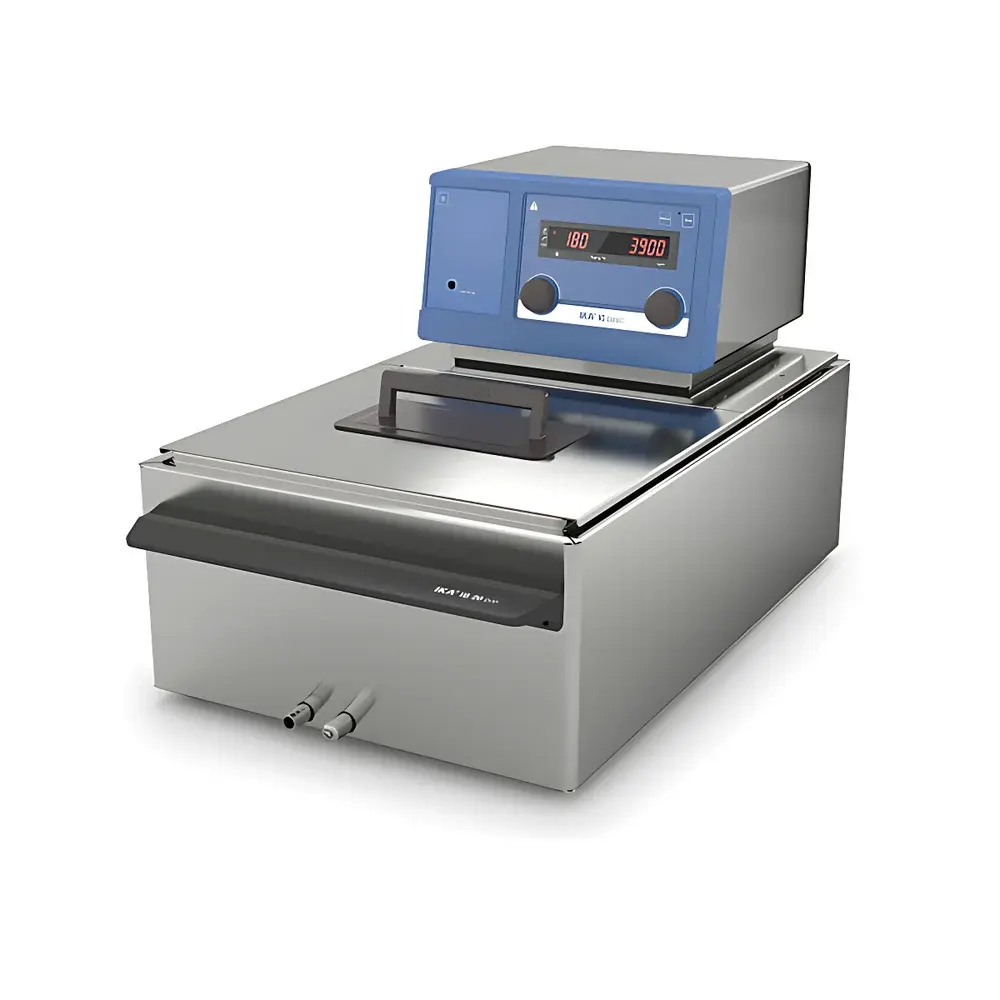
IKA IC basic pro 20 c Immersion Circulator with Stainless Steel Bath Tank
| Brand | IKA |
|---|---|
| Origin | Germany |
| Manufacturer | IKA Werke GmbH & Co. KG |
| Product Type | Immersion Circulator (Heating-Only) |
| Model | IC basic pro 20 c |
| Bath Volume | 3 L |
| Temperature Range | 0–260 °C |
| Temperature Stability | ±0.02 K |
| Heating Power | 2650 W |
| Pump Flow Rate | 31 L/min (at 0 bar backpressure) |
| Max. Pressure | 0.61 bar |
| Max. Suction Pressure | 0.45 bar |
| External Sensor Interface | PT100 compatible |
| Display Resolution | 0.1 K |
| Control Accuracy | ±0.1 K |
| Safety Cut-off Range | 0–260 °C |
| Protection Class | IP21 |
| Input Voltage | 230 V, 50/60 Hz |
| Dimensions (unit only) | 285 × 313 × 291 mm |
| Weight | 10 kg |
| Ambient Operating Conditions | 5–40 °C, ≤80 % RH |
| Compliance | DIN 12876 Class III, DIN EN 60529, CE, RoHS |
Overview
The IKA IC basic pro 20 c is a high-precision, heating-only immersion circulator engineered for stable, reproducible temperature control in laboratory applications requiring rigorous thermal management. Designed and manufactured in Staufen, Germany, it operates on the principle of forced convection—circulating thermostatic fluid (water or silicone oil) through an external stainless steel bath tank via an integrated pressure/suction pump. Its core architecture complies with DIN 12876 Class III safety standards for laboratory heating equipment, ensuring robust performance under continuous operation (100 % duty cycle). The unit delivers precise thermal regulation across a broad operational range—from ambient +10 K up to 260 °C—making it suitable for both water-bath and high-temperature oil-bath configurations. Temperature stability of ±0.02 K at setpoint is achieved through dual-sensor feedback: a primary PT100 working sensor and a redundant PT1000 safety sensor, each independently monitored and displayed via high-resolution LED readouts.
Key Features
- Integrated dual-pump system supporting both internal recirculation and external closed-loop circulation (e.g., jacketed reactors or viscometers)
- High-power 2650 W heating element enabling rapid ramp-up and maintenance at elevated temperatures up to 260 °C
- Adjustable flow rate (0–31 L/min) and pressure output (up to 0.61 bar), optimized for compatibility with diverse external systems
- Dual-sensor architecture: PT100 for process control and PT1000 for independent overtemperature protection with user-configurable cut-off limits (0–260 °C)
- Full digital interface with RS232 and USB ports for remote monitoring, data logging, and integration into automated workflows
- Comprehensive alarm system including visual (LED), audible, and programmable temperature deviation alerts
- IP21-rated enclosure ensuring safe operation in standard laboratory environments (5–40 °C, ≤80 % RH)
- Factory-calibrated design with optional traceable calibration documentation available per ISO/IEC 17025 requirements
Sample Compatibility & Compliance
The IC basic pro 20 c is designed for use with externally mounted stainless steel baths—including the included 3 L tank (255 × 262 mm opening; max 292 × 278 mm)—and supports immersion depths from 95 mm to 135 mm. It accommodates standard laboratory vessels, reaction flasks, and analytical instrumentation requiring precise external temperature control. The device conforms to DIN 12876 Class III for heating equipment used in chemical and pharmaceutical laboratories, and meets essential safety and electromagnetic compatibility requirements per EN 61000-6-2/6-4 and EN 61326-1. Its firmware supports audit-trail-capable operation when connected to compliant LIMS or ELN platforms, aligning with GLP and GMP documentation expectations where temperature-critical steps require traceability.
Software & Data Management
Equipped with native RS232 and USB connectivity, the IC basic pro 20 c enables bidirectional communication with third-party software environments (e.g., LabVIEW, MATLAB, or custom Python-based control suites). All temperature setpoints, real-time readings, alarm events, and pump status parameters are accessible via ASCII protocol commands. Logged data can be exported in CSV format for post-acquisition analysis. While the unit does not include proprietary PC software, its open communication protocol facilitates integration into validated systems governed by FDA 21 CFR Part 11—particularly when deployed alongside electronic signatures and audit trail modules provided by host laboratory informatics infrastructure.
Applications
- Temperature-controlled enzymatic assays and protein stability studies requiring narrow thermal windows
- Calibration of thermometers, RTDs, and thermocouples against NIST-traceable references
- Viscosity measurements using rotational rheometers or capillary viscometers with jacketed sample holders
- Long-duration accelerated stability testing per ICH Q1 guidelines
- Pre-heating and thermal equilibration of GC injectors, HPLC columns, or sample trays
- Material testing under controlled thermal stress (e.g., polymer melt behavior, wax crystallization kinetics)
FAQ
Is the IC basic pro 20 c suitable for cryogenic applications?
No—it is a heating-only circulator with a minimum operating temperature of ambient +10 K. For sub-ambient control, IKA recommends pairing it with an external chiller or selecting a dual-temperature model such as the RC basic series.
Can external PT100 sensors be used for remote temperature feedback?
Yes—the unit features a dedicated PT100 input port and automatically switches control mode when an external probe is detected, enabling jacket or reactor wall temperature regulation.
What safety certifications does this model hold?
It carries CE marking, complies with DIN 12876 Class III, EN 60529 (IP21), and meets RoHS Directive 2011/65/EU requirements for hazardous substance restriction.
Does the device support automatic calibration verification?
While no self-calibration function exists, the instrument provides access to raw sensor voltage outputs and supports manual verification procedures using certified reference standards and traceable calibration reports.
How is pump performance affected by fluid viscosity?
Flow rate and pressure drop scale inversely with kinematic viscosity; users should consult IKA’s published pump curves for silicone oils (e.g., Syltherm XLT) to determine optimal operating points at elevated temperatures.



