
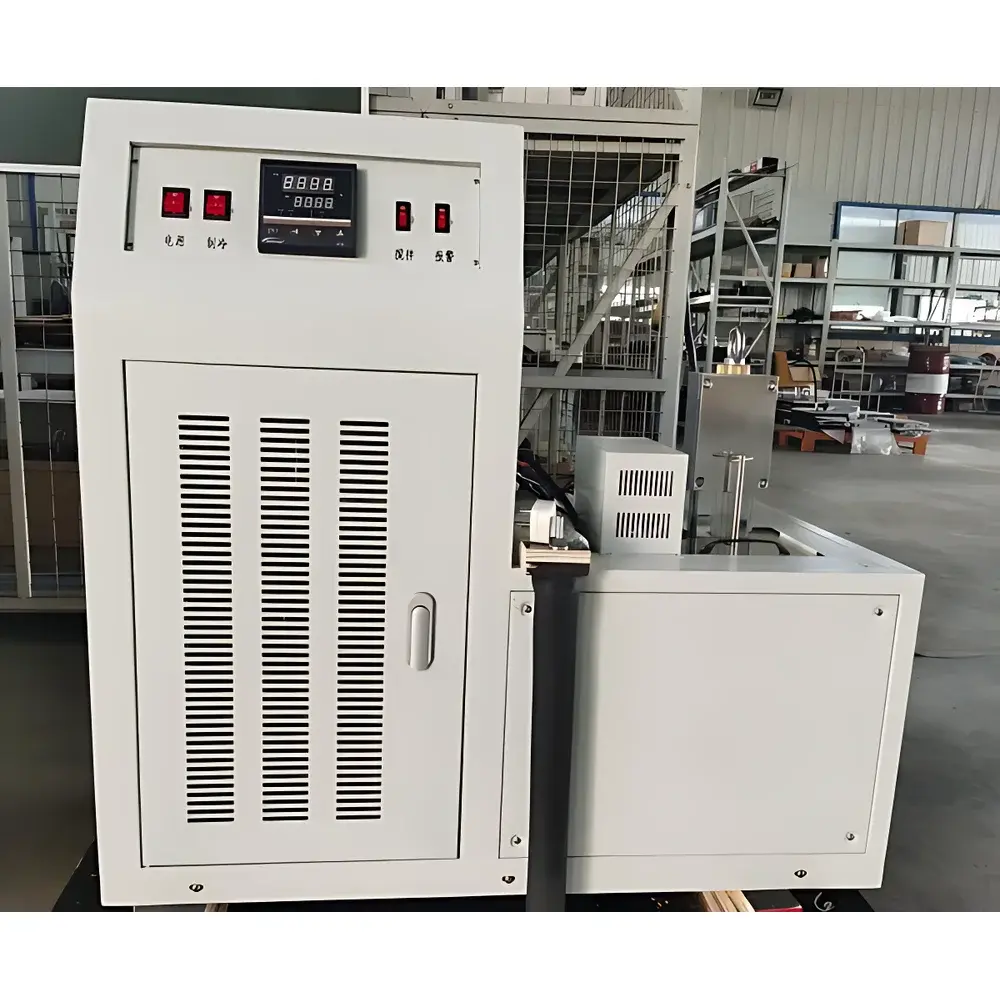
TianYuan TY-5003 Rubber Low-Temperature Brittleness Tester
| Brand | TianYuan |
|---|---|
| Origin | Jiangsu, China |
| Manufacturer Type | Direct Manufacturer |
| Model | TY-5003 |
| Temperature Control Range | −70 °C |
| Temperature Stability During Test | ±0.5 °C within 3 min |
| Cooling Medium | Ethanol or other non-freezing liquid |
| Chamber Dimensions (W×H×D) | 720×1380×700 mm |
| Internal Bath Dimensions (L×H×W) | 200×140×100 mm |
| Stirring Motor Power | 15 W |
| Power Supply | 220–240 V AC, 50 Hz, 2 kW |
| Impact Velocity | 2.0 ± 0.2 m/s |
| Minimum Impact Energy per Specimen | 3.0 J |
| Specimen Size | 25.0 ± 0.5 mm (L) × 6.0 ± 0.5 mm (W) × 2.0 ± 0.2 mm (T) |
| Compliance | GB/T 1682–2014, GB/T 5470–2008, ISO 812:2006, ASTM D2137–1994 |
Overview
The TianYuan TY-5003 Rubber Low-Temperature Brittleness Tester is a precision-engineered cryogenic impact testing system designed to determine the brittle transition temperature of vulcanized rubber and elastomeric materials under standardized mechanical shock conditions. It operates on the principle of single-specimen impact testing in a thermally stabilized bath, where specimens are cooled to progressively lower temperatures and subjected to a controlled vertical impact at a defined velocity (2.0 ± 0.2 m/s) and minimum kinetic energy (≥3.0 J). The brittle temperature—defined as the highest temperature at which a specimen exhibits visible fracture or cracking upon impact—is determined through iterative testing across a calibrated thermal gradient. This method provides quantitative, reproducible data essential for material qualification, formulation development, and low-temperature performance validation in automotive, aerospace, cable, and sealing applications.
Key Features
- Double-stage cascade refrigeration system with imported compressors, enabling stable operation down to −70 °C with minimal thermal drift
- High-uniformity cooling bath with forced convection via a 15 W stirring motor, ensuring <±0.5 °C temperature stability over 3-minute test intervals
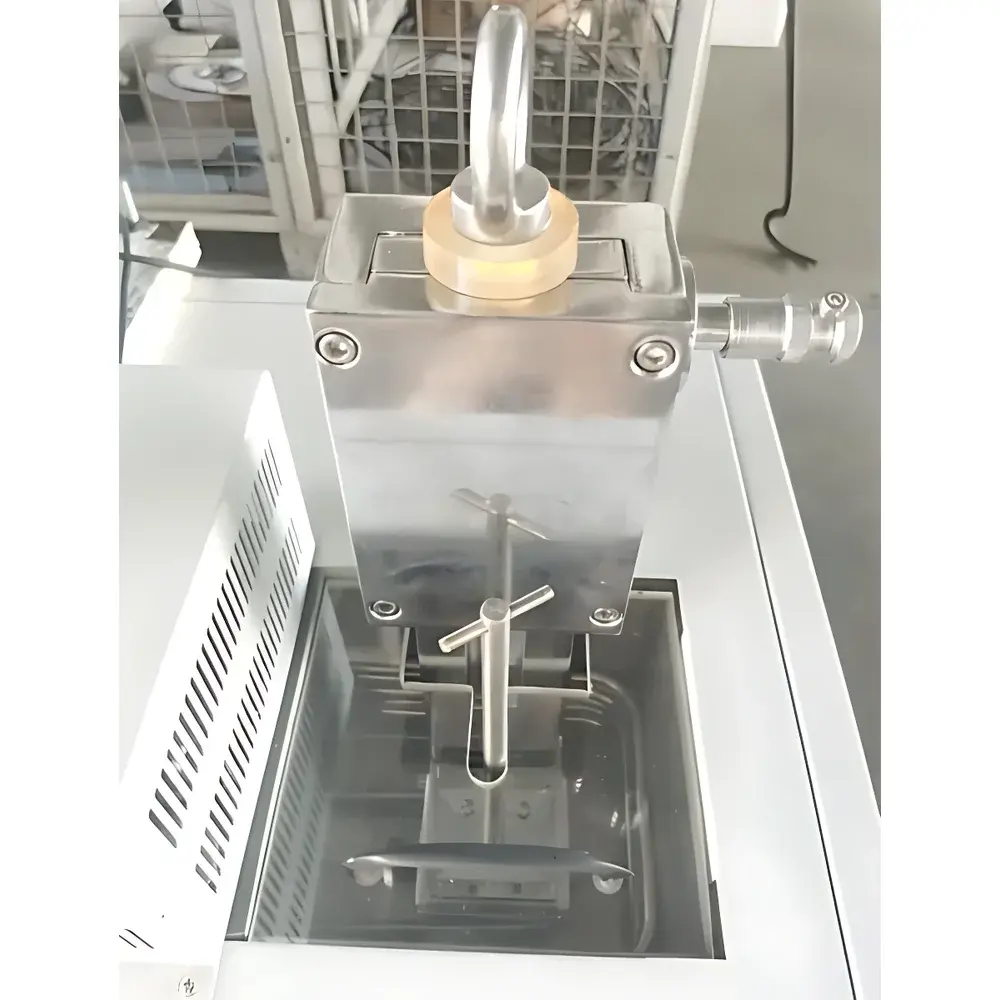
- Single-specimen cantilever clamping mechanism engineered for rigid, deformation-free fixation—designed to meet the mechanical constraints specified in GB/T 1682–2014 and ISO 812:2006
- Spring-loaded impact hammer with self-locking release mechanism, delivering repeatable impact velocity and energy without manual timing dependency
- Integrated digital temperature controller and elapsed-time timer, supporting pre-set freeze duration (3.0 ± 0.5 min) and synchronized actuation
- Robust stainless-steel cold bath chamber (200 × 140 × 100 mm internal volume) compatible with ethanol or industrial antifreeze media
- Full compliance with ambient thermal management requirements: side-panel ventilation access ensures optimal compressor heat dissipation at 23–25 °C ambient
Sample Compatibility & Compliance
The TY-5003 accommodates standard rectangular specimens measuring 25.0 ± 0.5 mm in length, 6.0 ± 0.5 mm in width, and 2.0 ± 0.2 mm in thickness—prepared from vulcanized rubber sheets or molded parts following surface finishing per GB/T 1682–2014. It supports comparative evaluation of compound variants, polymer blends, and filled elastomers. The instrument conforms to multiple international test standards: GB/T 1682–2014 (single-specimen method), GB/T 5470–2008 (plastic impact embrittlement temperature), ISO 812:2006 (rubber and thermoplastic elastomers), and ASTM D2137–1994 (flexible polymer and coated fabric embrittlement point). Its design supports GLP-aligned documentation workflows, including traceable temperature logging, operator-defined test sequences, and manual result annotation—facilitating audit readiness for quality control laboratories operating under ISO/IEC 17025 or ICH Q5A frameworks.
Software & Data Management
The TY-5003 operates as a hardware-controlled benchtop instrument without embedded software or network connectivity. All operational parameters—including setpoint temperature, freeze duration, and impact timing—are configured manually via front-panel digital controllers. Temperature readings are continuously displayed on an integrated PID controller with ±0.1 °C resolution. For regulatory environments requiring electronic records, users may integrate external calibrated data loggers (e.g., compliant with FDA 21 CFR Part 11 Annex 11) to capture time-stamped bath temperature profiles during qualification runs. Test outcomes—brittle temperature determination, pass/fail status per specimen, and observed fracture morphology—are recorded manually in laboratory notebooks or LIMS-compatible spreadsheets, consistent with GMP Annex 11 and ISO 17025 clause 7.5.2 requirements for result traceability.
Applications
- Formulation screening of synthetic rubbers (SBR, NBR, EPDM, CR) and thermoplastic elastomers (TPEs) for low-temperature service envelopes
- Quality assurance of rubber components in automotive suspension bushings, brake hoses, and engine mounts
- Validation of cold-weather performance for wire & cable jacketing compounds and railway elastomeric pads
- Comparative assessment of plasticizer efficiency and filler dispersion effects on low-temperature ductility
- Supporting ASTM D2137-based specification compliance for military-grade flexible polymers and coated textiles
- Research into cryo-mechanical failure mechanisms in elastomer nanocomposites and bio-based rubber analogs
FAQ
What is the lowest achievable test temperature?
The TY-5003 achieves a minimum operating temperature of −70 °C using cascade refrigeration; actual test range depends on ambient conditions, coolant selection, and thermal load.
Can multiple specimens be tested simultaneously?
No—the instrument is configured for single-specimen testing per cycle, in strict accordance with GB/T 1682–2014 and ISO 812:2006 methodology.
Is ethanol the only acceptable cooling medium?
Ethanol is recommended for its low viscosity and wide liquid-phase range; alternatives must be non-corrosive, non-reactive with rubber, and maintain fluidity below −70 °C (e.g., methanol/ethanol blends or commercial antifreeze formulations validated per ASTM D1384).
How is temperature uniformity verified during calibration?
Users perform bath mapping using NIST-traceable PT100 probes at ≥3 spatial points (center + corners) over 3 minutes at target temperatures (−40 °C, −60 °C); deviation must remain ≤±0.5 °C.
Does the system include automated data export capability?
No—the TY-5003 is a stand-alone electromechanical tester. Digital data acquisition requires third-party logging hardware interfaced via analog voltage output or RS-485 (optional adapter required).






