
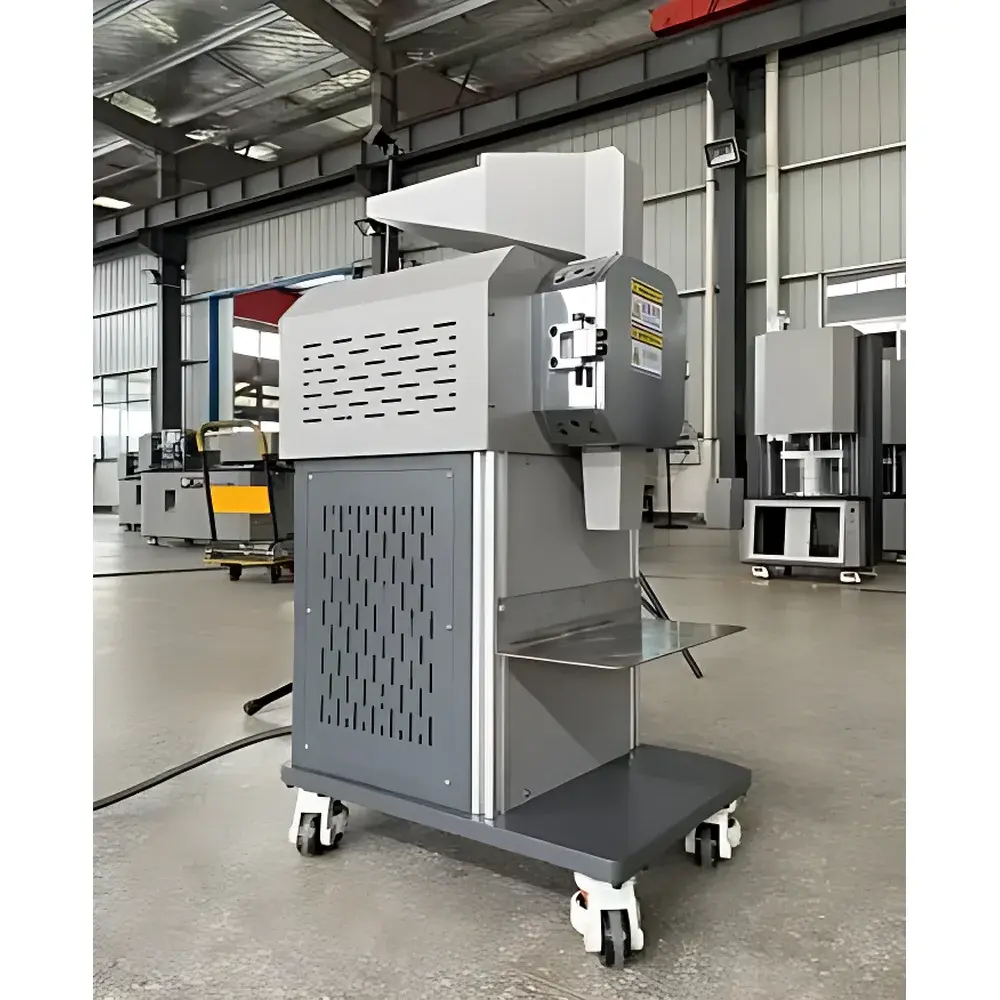
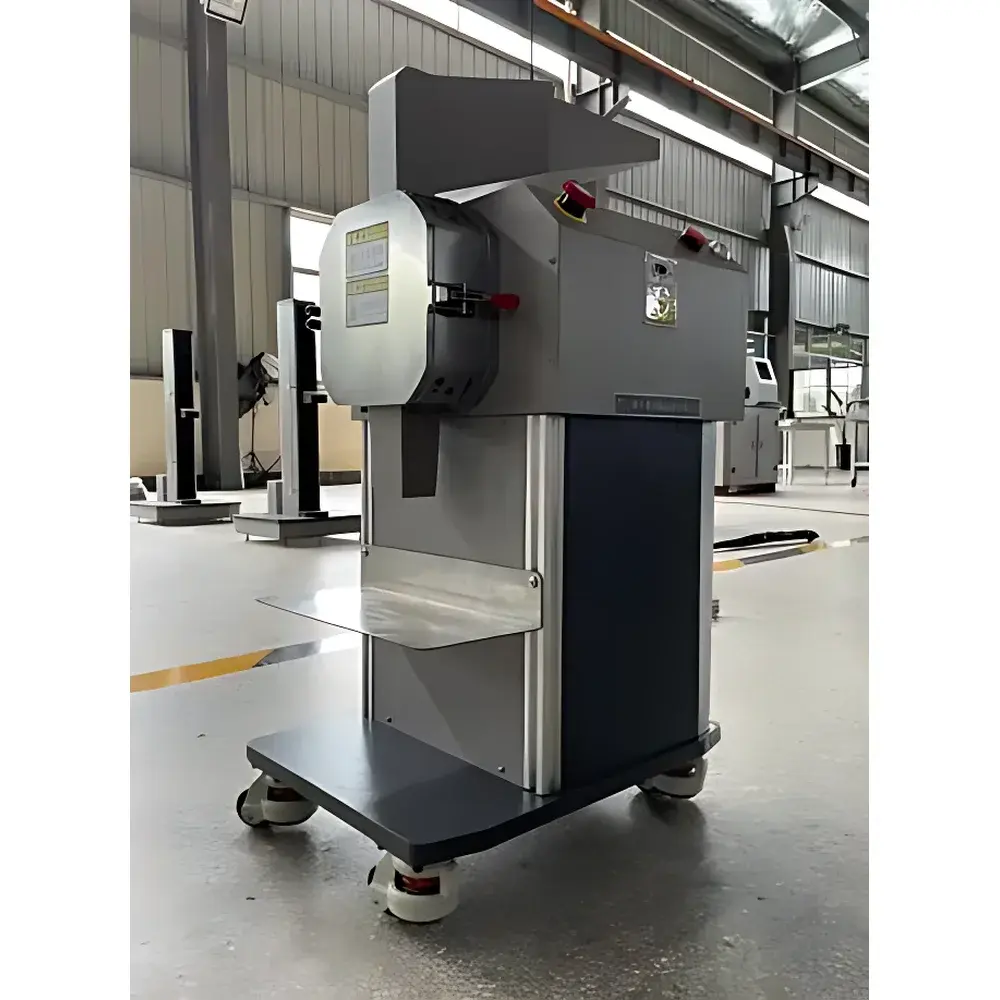
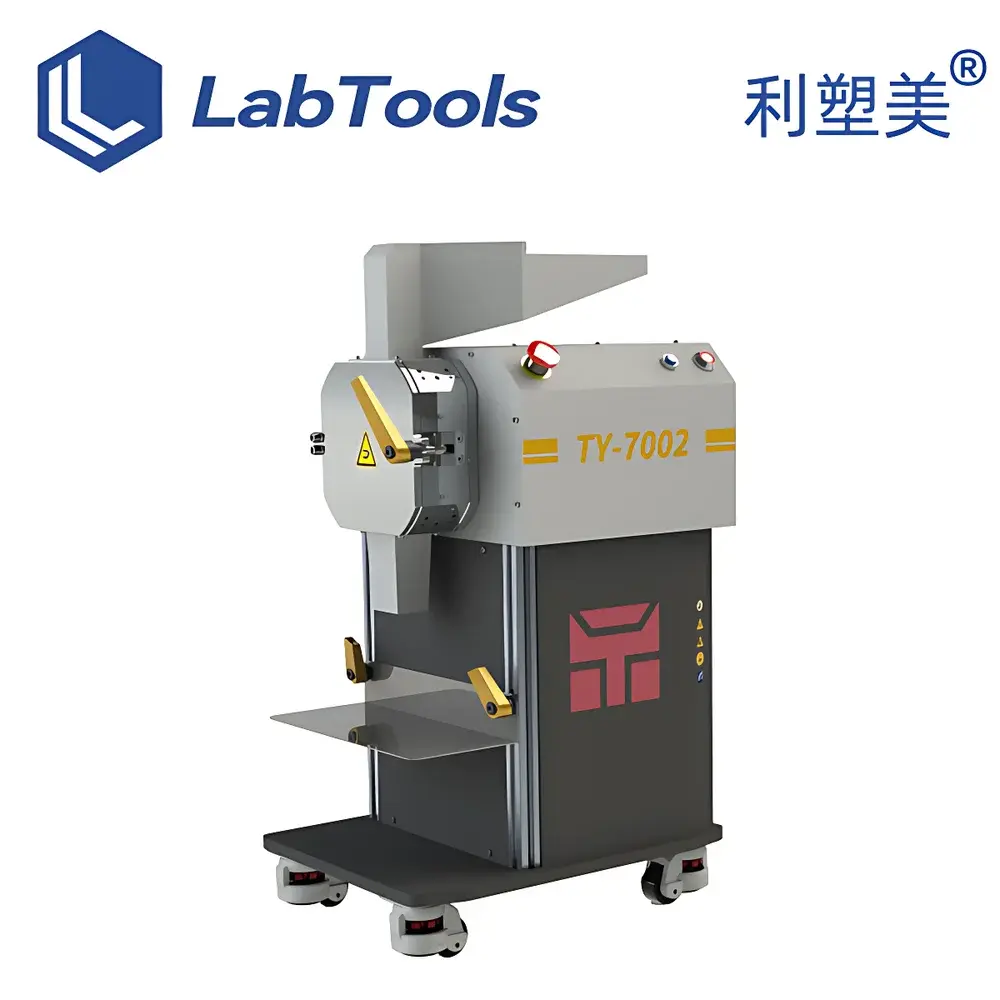
TianYuan LabTools TY-7002 Benchtop Laboratory Crusher
| Brand | TianYuan |
|---|---|
| Origin | Jiangsu, China |
| Manufacturer Type | Direct Manufacturer |
| Country of Origin | China |
| Model | TY-7002 |
| Instrument Type | Benchtop Crusher |
| Sample Suitability | Soft to Semi-Rigid Materials (e.g., plastic sprues, rubber scraps, botanicals) |
| Feed Size | < 10 cm |
| Output Particle Size | 6–10 mm (adjustable via interchangeable carbon steel sieve screens) |
| Batch Capacity | 300 g |
| Motor Power | 2.2 kW |
| Voltage Input | 380 V three-phase or 220 V single-phase (with integrated converter) |
| Crushing Chamber | Φ160 mm × 70 mm depth |
| Rotor Speed | Variable (via Delixi frequency inverter) |
| Fixed Blades | 4 pcs |
| Rotating Blades | 3 pcs |
| Blade Material | Alloy steel |
| Blade Type | Flat plate design |
| Hopper Material | Powder-coated mild steel |
| Collection Tray Support | 304 stainless steel |
| Frame Construction | Welded carbon steel base |
| Dimensions (W×D×H) | 380 × 510 × 860 mm |
| Net Weight | 95 kg |
Overview
The TianYuan LabTools TY-7002 is a compact, high-torque benchtop crusher engineered for controlled size reduction of soft to semi-rigid laboratory-scale materials. Designed around a robust rotor-stator cutting principle—where rotating flat alloy steel blades intersect with fixed counter-blades within a confined cylindrical chamber—the TY-7002 achieves consistent particle sizing through mechanical shearing and impact forces. Its sealed, low-volume crushing chamber (Φ160 mm × 70 mm) minimizes sample retention and cross-contamination, making it suitable for applications requiring material traceability, such as QC testing of polymer regrind, botanical pre-processing prior to extraction, or recycling trials of high-value engineering plastics. Unlike industrial hammer mills, the TY-7002 operates at lower rotational speeds with precisely engineered blade geometry, reducing thermal degradation and fines generation—critical when processing heat-sensitive polymers or fragile organic matrices.
Key Features
- Benchtop footprint (380 × 510 × 860 mm) with integrated heavy-duty castor wheels (Fuma-type) for stable repositioning within fume hoods or shared lab spaces
- 2.2 kW high-efficiency motor (Wannan Motor Co.) delivering sustained torque under variable load conditions; compatible with both 380 V three-phase and 220 V single-phase supply via internal voltage conversion circuitry
- Interchangeable carbon steel sieve screens (6 mm, 8 mm, and 10 mm aperture options) mounted downstream of the crushing zone to define final output gradation
- Cutting assembly comprising three dynamically balanced rotating blades and four stationary blades—both fabricated from hardened alloy steel for extended service life and dimensional stability
- Collection system featuring a 304 stainless steel support tray and powder-coated mild steel hopper, compliant with basic corrosion resistance requirements for non-aggressive organic and polymeric feedstocks
- Integrated Delixi frequency inverter enabling stepless speed control (typically 1,500–3,000 rpm), allowing optimization of throughput vs. particle uniformity trade-offs
Sample Compatibility & Compliance
The TY-7002 is validated for use with soft thermoplastics (e.g., ABS, PP sprues), elastomeric compounds, dried plant tissues, and low-density foams. It is not intended for fibrous, highly abrasive (e.g., mineral ores), or moisture-rich (>15% w/w) feedstocks. While not certified to ISO/IEC 17025 or ASTM D2000 for accredited testing, its mechanical design adheres to general laboratory equipment safety standards (GB/T 2893.1 for color coding, GB 5226.1 for electrical safety). The unit meets CE-equivalent electromagnetic compatibility (EMC) and low-voltage directive thresholds per Chinese national standards (GB 4824, GB 16836), and may be incorporated into GLP-aligned workflows where instrument qualification (IQ/OQ) is performed by end users per internal SOPs.
Software & Data Management
The TY-7002 operates as a standalone electromechanical device without embedded firmware or digital connectivity. All operational parameters—including run time, speed setpoint, and batch count—are manually recorded. For laboratories implementing electronic lab notebooks (ELN) or LIMS integration, external timers or programmable logic controllers (PLCs) may be interfaced via dry-contact relay outputs (optional accessory). No data logging, audit trail, or 21 CFR Part 11 compliance features are included; users requiring regulatory-grade documentation must implement external validation protocols and manual logbook entries per ISO/IEC 17025 clause 7.7.
Applications
- Preparation of polymer regrind for melt flow index (MFI) or tensile property analysis per ASTM D1238 and ISO 1133
- Size reduction of dried herbal samples prior to Soxhlet extraction or HPLC sample preparation
- Controlled fragmentation of prototype plastic components for failure mode analysis
- On-site recycling of lab-generated plastic waste streams to reduce disposal costs and support sustainability reporting
- Feeding intermediate-sized particles into downstream analytical instruments (e.g., FTIR pellet presses, XRF sample cups) where >6 mm fragments impede homogenization
FAQ
Can the TY-7002 process wet or frozen samples?
No. Feed material must be air-dried and free of surface moisture to prevent clogging and blade adhesion.
Is the sieve screen adjustable during operation?
No. Screen replacement requires full shutdown, removal of the collection tray assembly, and manual fastener loosening—intended for pre-run configuration only.
What maintenance intervals are recommended?
Blade sharpening or replacement every 200–300 operating hours depending on feed hardness; lubrication of motor bearings every 6 months using ISO VG 32 mineral oil.
Does the unit include overload protection?
Yes. Integrated thermal overcurrent relay disconnects power if motor winding temperature exceeds 130 °C, with manual reset required.
Can the TY-7002 be used in inert atmosphere gloveboxes?
Not without modification. Its standard enclosure is not gas-tight; electrical ingress protection rating is IP20, unsuitable for sealed anaerobic environments.
Related Products



