
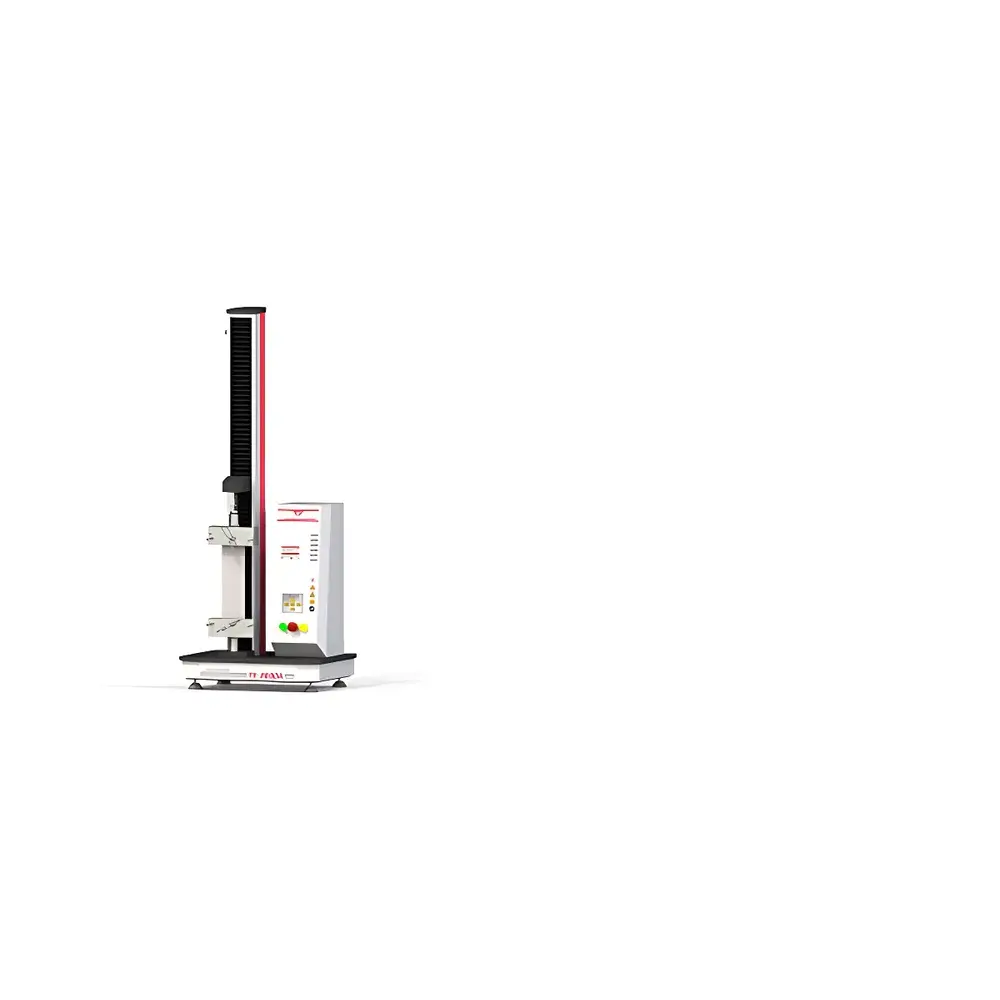
TianYuan TY-8000-A Series Single-Column Electronic Universal Testing Machine
| Brand | TianYuan |
|---|---|
| Origin | Jiangsu, China |
| Manufacturer Type | Manufacturer |
| Model | TY-8000-A |
| Instrument Type | Electronic Universal Testing Machine |
| Load Capacity | 5000 N |
| Load Accuracy | ≤ ±0.5% FS |
| Load Resolution | 1/300,000 |
| Force Measurement Range | 0.4–100% FS |
| Deformation Measurement Range | 0.2–100% FS |
| Force Control Rate Range | 0.01–5% FS/s |
| Deformation Control Rate Range | 0.02–5% FS/s |
| Displacement Resolution | 0.001 mm |
| Max Travel (excl. fixtures) | 1000 mm |
| Effective Width | 80 mm |
| Test Speed | 0.001–1000 mm/min |
| Speed Accuracy | ≤ ±0.3% |
| Power Supply | 220 V AC, 500 W |
| Dimensions (W×D×H) | 550 × 400 × 1600 mm |
| Weight | 160 kg |
Overview
The TianYuan TY-8000-A Series Single-Column Electronic Universal Testing Machine is a precision-engineered electromechanical system designed for static mechanical property evaluation of metallic and non-metallic materials under controlled uniaxial loading conditions. Based on servo-controlled closed-loop actuation architecture, it implements fundamental mechanical testing principles—including tensile, compressive, flexural, shear, tear, peel, and puncture modes—according to standardized quasi-static deformation protocols defined in ISO 6892-1, ASTM E8/E21, GB/T 228.1, and EN 10002-1. Its single-column structural configuration provides optimized rigidity-to-footprint ratio for benchtop integration in quality control laboratories, R&D centers, and academic teaching environments where space efficiency and operational repeatability are prioritized without compromising metrological integrity.
Key Features
- High-performance AC servo motor drive system (Panasonic, Japan) coupled with planetary gear reducer (LIMIN, Taiwan) and preloaded ball screw transmission (CTK or TBI, Taiwan) ensures smooth, backlash-free force application and high positional fidelity.
- DSP + MCU dual-core digital closed-loop control architecture enables real-time synchronization of load, displacement, and strain channels with independent rate regulation for force, displacement, and deformation control modes.
- Multi-range force amplification (0.25× to 100×) and automatic range switching support seamless transition across low-force polymer characterization and high-load metallic specimen testing within a single test sequence.
- Integrated high-resolution optical encoder (Panasonic, Japan) delivers displacement resolution of 0.001 mm; compatible with clip-on extensometers (TianYuan-branded, compliant with GB/T 12160 Class 1) for direct strain measurement in modulus and yield analysis.
- Modular software platform supports dynamic curve plotting (Load vs. Displacement, Stress vs. Strain, Load vs. Time, etc.), post-test reanalysis, statistical reporting, and export to Excel-compatible formats with full audit trail capability.
- Compliant with electromagnetic compatibility (EMC) and electrical safety standards per IEC 61000-4 and GB/T 2611, ensuring stable operation in shared laboratory infrastructure.
Sample Compatibility & Compliance
The TY-8000-A accommodates specimens up to 1000 mm in travel length and 80 mm effective width between column and actuator axis—suitable for standard tensile bars (ASTM E8), dog-bone coupons (ISO 527), film strips (ASTM D882), elastomer dumbbells (ISO 37), and composite laminates (ASTM D3039). It meets mechanical verification requirements per GB/T 16491-2008 (equivalent to ISO 7500-1 Class 0.5), GB/T 16825.1 (verification of force measurement systems), and supports traceable calibration against national metrology standards. Full compliance with GLP documentation practices—including user-defined test templates, electronic signatures, and time-stamped raw data logs—is supported through optional 21 CFR Part 11–compliant software modules.
Software & Data Management
The TianYuan proprietary testing software operates under Windows OS and provides intuitive workflow navigation from test setup to report generation. Real-time graphical display includes synchronized multi-channel overlays, auto-scaling axes, and customizable annotation layers. All raw acquisition data (1 kHz sampling rate) is stored in binary format with metadata embedding (operator ID, environmental conditions, calibration date, fixture type). Post-processing functions include modulus calculation via secant/tangent methods, yield point determination (0.2% offset, ISO 6892-1 Annex B), elongation at break interpolation, and hysteresis loop analysis for cyclic loading sequences. Export options include CSV, XLSX, PDF, and image-based reports with embedded calibration certificates and uncertainty statements.
Applications
This system serves as a primary mechanical characterization tool across industries including automotive component suppliers (rubber bushings, plastic brackets), medical device manufacturers (sutures, catheter tubing), packaging material developers (BOPP films, aluminum foils), and academic polymer science labs. Typical use cases include: tensile strength and elongation validation per ASTM D638; compression modulus of foams (ASTM D3574); peel adhesion of pressure-sensitive tapes (ASTM D903); flexural properties of thermosets (ASTM D790); and cyclic fatigue behavior under low-frequency displacement control (0.1–5 Hz). Its modular design allows future expansion with environmental chambers, video extensometry, or acoustic emission sensors.
FAQ
What international standards does the TY-8000-A support out-of-the-box?
It natively implements test routines aligned with ASTM E8, ISO 6892-1, GB/T 228.1, DIN 50125, and JIS Z 2241, with parameter presets and reporting templates preconfigured for each.
Is third-party calibration certification available?
Yes—factory calibration is performed using NIST-traceable load cells and certified reference standards; optional UKAS-accredited calibration certificates can be arranged through authorized regional service partners.
Can the system integrate with LIMS or MES platforms?
Via TCP/IP and OPC UA interfaces, the controller supports bidirectional data exchange with laboratory information management systems and manufacturing execution systems for automated result ingestion and compliance archiving.
What maintenance intervals are recommended for long-term accuracy?
Annual verification of force and displacement transducers is advised; ball screw lubrication and encoder alignment checks should be performed every 6 months under continuous operation (≥8 hrs/day).
Does the software meet FDA 21 CFR Part 11 requirements?
Standard software includes audit trail logging and electronic signature functionality; full Part 11 compliance requires activation of the validated software package with role-based access control and electronic record retention policies.



