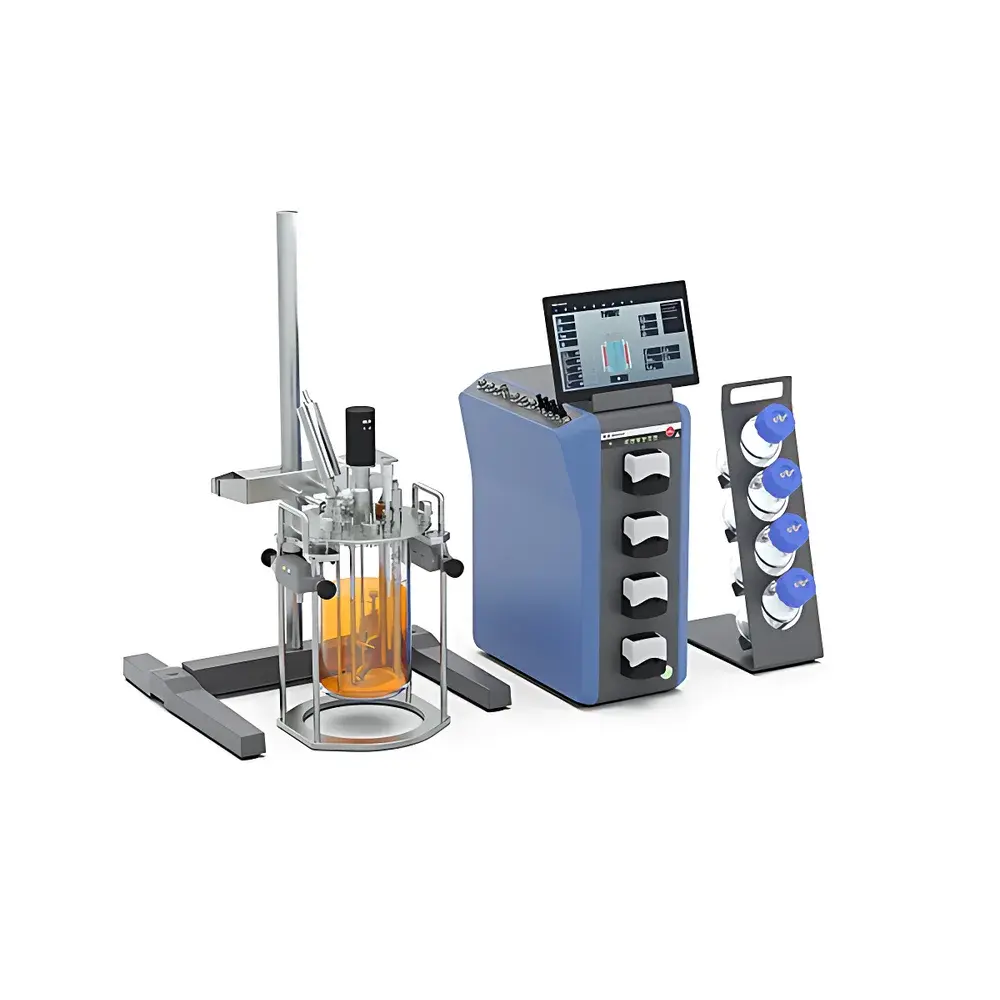
IKA HABITAT ferment Advanced Laboratory Fermenter
| Brand | IKA |
|---|---|
| Origin | Germany |
| Manufacturer | IKA Works GmbH & Co. KG |
| Type | Integrated Control Tower Fermenter System |
| Vessel Capacity | 0.5–10 L |
| Aeration | Four Independent Mass Flow Controlled Gas Lines (Air, O2, N2, CO₂) |
| pH Control Range | 0–14 pH |
| Accuracy | ±0.02 pH |
| Dissolved Oxygen (DO) Control Range | 0–200 % saturation |
| Accuracy | ±0.3 % sat |
| Temperature Control Range | 0–100 °C |
| Accuracy | ±0.2 °C |
| Stirring | Chaotic Mixing Mode + Standard Profile/Cascade Modes |
| Speed Range | 1–2200 rpm |
| Reversibility | Yes |
| Peristaltic Pumps | 4 × Watson-Marlow 114DV heads (Acid, Base, Antifoam, Feed) |
| Flow Range | 1–270 mL/min |
| Data Management | 32 GB internal storage, Ethernet, USB, RS232, Wi-Fi, FDA 21 CFR Part 11-compliant software option available |
| Compliance | Designed for GLP/GMP-aligned workflows |
Overview
The IKA HABITAT ferment is a fully integrated, modular laboratory-scale fermenter system engineered for precision bioprocess development in academic research labs, biopharma R&D, and industrial microbiology facilities. Based on proven Couette-type stirred-tank reactor architecture, it employs a dual-mode agitation system—combining conventional PID-regulated impeller rotation with patented Chaotic Mixing dynamics—to achieve superior homogeneity, reduced shear stress, and enhanced mass transfer in viscous or shear-sensitive cultures (e.g., mammalian cells, filamentous fungi, or high-density bacterial fermentations). The system comprises two core components: a compact control tower housing all actuators, sensors, and electronics; and interchangeable vessel assemblies (single-wall or double-jacketed glass vessels, 0.5–10 L working volume), enabling seamless transition between fermentation, cell culture, and photobioreactor configurations via optional LED illumination modules and thermostat integration.
Key Features
- Modular & Scalable Architecture: Separation of control tower and vessel allows flexible configuration—vessels sterilized independently via autoclave (up to 135 °C), while the control tower remains operational between runs.
- Chaotic Mixing Technology: Dynamically modulates impeller speed and direction using deterministic chaos algorithms to eliminate dead zones and improve oxygen transfer efficiency (kLa) without increasing mechanical stress on sensitive biomass.
- Four-Channel Precision Gas Delivery: Independent thermal mass flow controllers (MFCs) for air, O₂, N₂, and CO₂ deliver stable, repeatable gas blending from 0.1 to 20,000 cc/min, supporting strict DO setpoint control and pH-stat/gas-stat strategies.
- Quadruple Watson-Marlow Peristaltic Pumps: Fully reversible, calibrated pumps with silicone tubing (ID 0.5–4.8 mm) enable precise acid/base titration, antifoam dosing, feed addition, and harvest—all programmable with ramp profiles and event-triggered logic.
- Integrated Thermal Management: Compatible with IKA HRC 2 series thermostats for jacketed vessels or internal heating blankets (250 W) for single-wall operation—both delivering ±0.2 °C temperature stability across 0–100 °C.
- Touch-Enabled Tablet Interface: 10.4″ Android-based tablet with intuitive, icon-driven UI provides real-time visualization of all process variables, trend graphs, alarm logs, and calibration history—accessible remotely via Ethernet or Wi-Fi.
Sample Compatibility & Compliance
The HABITAT ferment supports diverse biological systems including aerobic/anaerobic bacteria (e.g., E. coli, Bacillus), yeasts (S. cerevisiae), filamentous fungi (Aspergillus, Penicillium), and microalgae. Its sensor suite—including pH, DO, temperature, level, and foam detection—is validated per ISO 15197 and USP for critical parameter monitoring. Optional CO₂, conductivity, and turbidity sensors extend analytical capability without external hardware. The system meets electrical safety standards IEC 61010-1 and environmental protection class IP20. For regulated environments, the FDA 21 CFR Part 11-compliant software package provides full audit trail, role-based access control, electronic signatures, and secure data export compliant with ALCOA+ principles.
Software & Data Management
The embedded firmware supports three operational modes: batch, fed-batch, and continuous/perfusion. All control logic—including cascade loops (e.g., DO → stirrer speed → gas composition), profile-based ramps, and event-driven actions—is configured via drag-and-drop workflow builder. Raw sensor data, actuator states, and user annotations are timestamped and stored locally (32 GB SSD) with automatic backup to network drives. Calibration procedures for pH, DO, and temperature follow ISO/IEC 17025 traceable protocols, with step-by-step prompts and auto-recorded metadata (operator ID, buffer lot, ambient conditions). Export formats include CSV, PDF reports, and OPC UA-compatible streams for integration into MES/LIMS platforms.
Applications
- Strain screening and media optimization under controlled DO/pH/temperature gradients
- Process characterization for scale-up studies (QbD-compliant design space mapping)
- Production of recombinant proteins, enzymes, organic acids, and bioactive metabolites
- Microbial consortia cultivation requiring dynamic gas switching (e.g., syntrophic methanogenesis)
- Teaching bioreactor fundamentals in undergraduate and graduate bioprocessing curricula
- Phototrophic cultivation when equipped with optional LED light panels (HABITAT photo ferment variant)
FAQ
Can the HABITAT ferment operate under sterile conditions?
Yes—the vessel assembly is autoclavable at 121 °C for 20 min; all wetted parts (tubing, sensors, gaskets) are certified for repeated sterilization cycles.
Is remote monitoring supported?
Yes—via Ethernet or Wi-Fi, users can access live data, adjust setpoints, and review historical trends using any web-enabled device running Chrome, Edge, or Safari.
What validation documentation is provided?
IKA supplies Factory Acceptance Test (FAT) reports, IQ/OQ templates aligned with GAMP5, and sensor calibration certificates traceable to NIST standards.
How is mixing efficiency quantified?
Chaotic Mixing performance is characterized by dimensionless mixing time (θm/τ) and power input per unit volume (P/V), both measurable via dissolved oxygen step-change experiments per ASTM D5128.
Are single-use vessels supported?
Yes—the control tower includes dedicated interfaces for disposable bioreactor bags (0.5–5 L), with compatibility verified for major suppliers including Sartorius, Thermo Fisher, and Pall.