
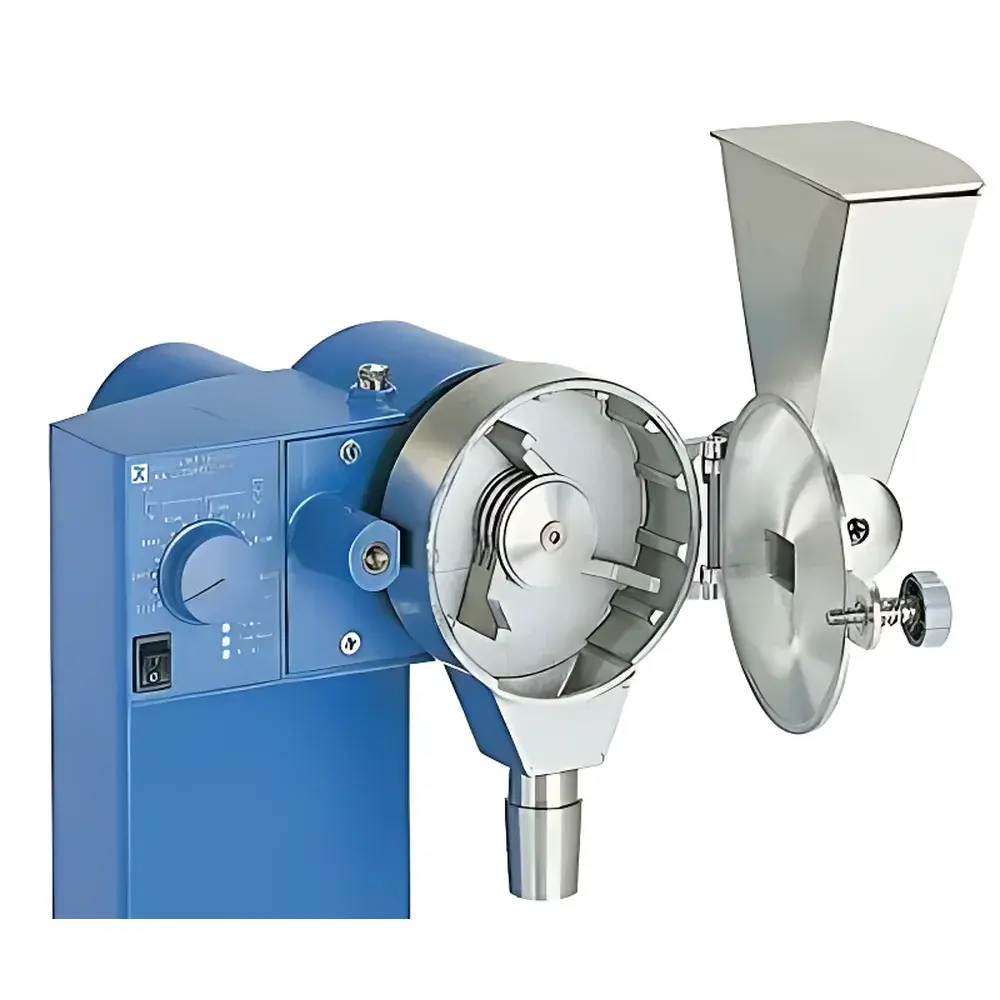
IKA MF 10.2 Impact Grinding Head
| Brand | IKA |
|---|---|
| Origin | Germany |
| Manufacturer | IKA Werke GmbH & Co. KG |
| Type | Impact Grinding Head for Laboratory Milling Systems |
| Model | MF 10.2 |
| Application | Dry grinding of brittle, hard materials (e.g., minerals, construction aggregates) |
| Max. Feed Hardness | 6 Mohs |
| Max. Feed Size | <10 mm |
| Output Particle Size Range | 0.01–0.5 mm (screen-dependent) |
| Typical Final Output Size | <0.25 mm (with standard 0.25 mm sieve) |
| Grinding Chamber Material | Stainless Steel 1.4308 (AISI 304 equivalent) |
| Max. Peripheral Speed | 34 m/s |
| Cooling Option | Dry ice cooling compatible |
| Dimensions (W × D × H) | 320 × 450 × 300 mm |
| Weight | 2.942 kg |
| Compliance | CE-marked, designed per EN 61000-6-2/6-4 and EN 60204-1 |
Overview
The IKA MF 10.2 Impact Grinding Head is a precision-engineered component designed for integration into IKA’s modular laboratory milling systems—specifically the M20 universal mill platform. It operates on the principle of high-speed impact comminution: material introduced into the grinding chamber is subjected to repeated collisions with rapidly rotating impact elements (rotor pins) and the hardened stainless-steel chamber walls. This mechanism enables efficient size reduction of brittle, inorganic, and moderately hard samples without significant thermal degradation—particularly when dry ice cooling is applied. The device is not a standalone grinder but a replaceable grinding head optimized for reproducible, batch-controlled particle size distribution in analytical sample preparation workflows. Its design prioritizes mechanical robustness, operator safety, and compatibility with regulated laboratory environments where traceability and process consistency are essential.
Key Features
- High-energy impact comminution at peripheral speeds up to 34 m/s, ensuring rapid and uniform particle size reduction
- Grinding chamber constructed from corrosion-resistant stainless steel 1.4308 (equivalent to AISI 304), certified for chemical inertness and cleanability
- Interchangeable sieve inserts (sold separately) enabling precise control over final particle size—standard configurations support apertures from 0.01 mm to 0.5 mm
- Dry ice cooling capability integrated into the chamber design, permitting cryogenic grinding of heat-sensitive or thermoplastic materials
- Modular mounting interface compatible exclusively with IKA M20 base units, supporting quick tool-free head exchange for method flexibility
- CE-compliant electromagnetic compatibility (EN 61000-6-2/6-4) and functional safety architecture (EN 60204-1) for use in ISO/IEC 17025-accredited laboratories
Sample Compatibility & Compliance
The MF 10.2 is validated for dry grinding of inorganic, brittle solids with a Mohs hardness ≤6—including limestone, gypsum, ceramic shards, concrete aggregates, ores, and pharmaceutical excipients. It is unsuitable for fibrous, elastic, or highly ductile materials (e.g., polymers, rubber, biological tissue). Sample feed must be pre-sieved to ensure particles remain below 10 mm; oversized input risks rotor imbalance and non-uniform attrition. Final output is gravity-fed through the selected sieve and collected in standardized NS 29 threaded containers (DIN 12451), facilitating seamless transfer to subsequent analysis steps such as XRD, SEM-EDS, or elemental assay. The unit conforms to EU Machinery Directive 2006/42/EC and supports GLP/GMP-aligned documentation practices via traceable parameter logging when used with IKA’s Labworldsoft™ control software.
Software & Data Management
While the MF 10.2 itself is a mechanical grinding head without embedded electronics, it functions as a calibrated subsystem within IKA’s digitally enabled M20 platform. When paired with an M20 base unit equipped with Labworldsoft™ v4.0 or later, operators can log and audit grinding parameters—including runtime, rotor speed (if variable-speed drive is installed), cooling status, and sieve identification—via timestamped electronic records. These entries comply with FDA 21 CFR Part 11 requirements for electronic signatures and audit trails when deployed in regulated QC/QA environments. Raw data export (CSV/Excel) supports integration into LIMS and statistical process control (SPC) frameworks.
Applications
- Preparation of homogenized mineralogical standards for X-ray fluorescence (XRF) and inductively coupled plasma (ICP) analysis
- Size reduction of construction materials prior to sieve analysis (ASTM C136, EN 933-1)
- Production of representative sub-samples from heterogeneous geological cores or slag batches
- Cryogenic grinding of temperature-sensitive ceramics or battery electrode materials for BET surface area measurement
- Routine QC grinding of raw materials in cement, metallurgy, and refractory manufacturing facilities
FAQ
Is the MF 10.2 suitable for wet grinding?
No. It is engineered exclusively for dry grinding applications. Liquid introduction may cause rotor imbalance, chamber corrosion, or motor overload.
Can I use non-IKA sieves with this grinding head?
Only IKA-certified NS 29-compatible sieve inserts are recommended to maintain dimensional tolerance, sealing integrity, and grinding efficiency.
What maintenance is required between runs?
After each use, the grinding chamber and rotor must be disassembled, cleaned with ethanol or isopropanol, and inspected for wear using IKA’s visual wear gauge (Order No. 3021000). Lubrication is not required—the rotor bearings are sealed for life.
Does the MF 10.2 meet ISO 17025 calibration requirements?
As a mechanical component, it does not require calibration—but its performance verification (e.g., particle size distribution repeatability per ISO 13320) must be conducted using NIST-traceable reference materials and documented per laboratory SOPs.
Is dry ice cooling mandatory?
No. It is optional and application-dependent—primarily used when minimizing thermal alteration or preventing agglomeration of fine powders is critical.



