
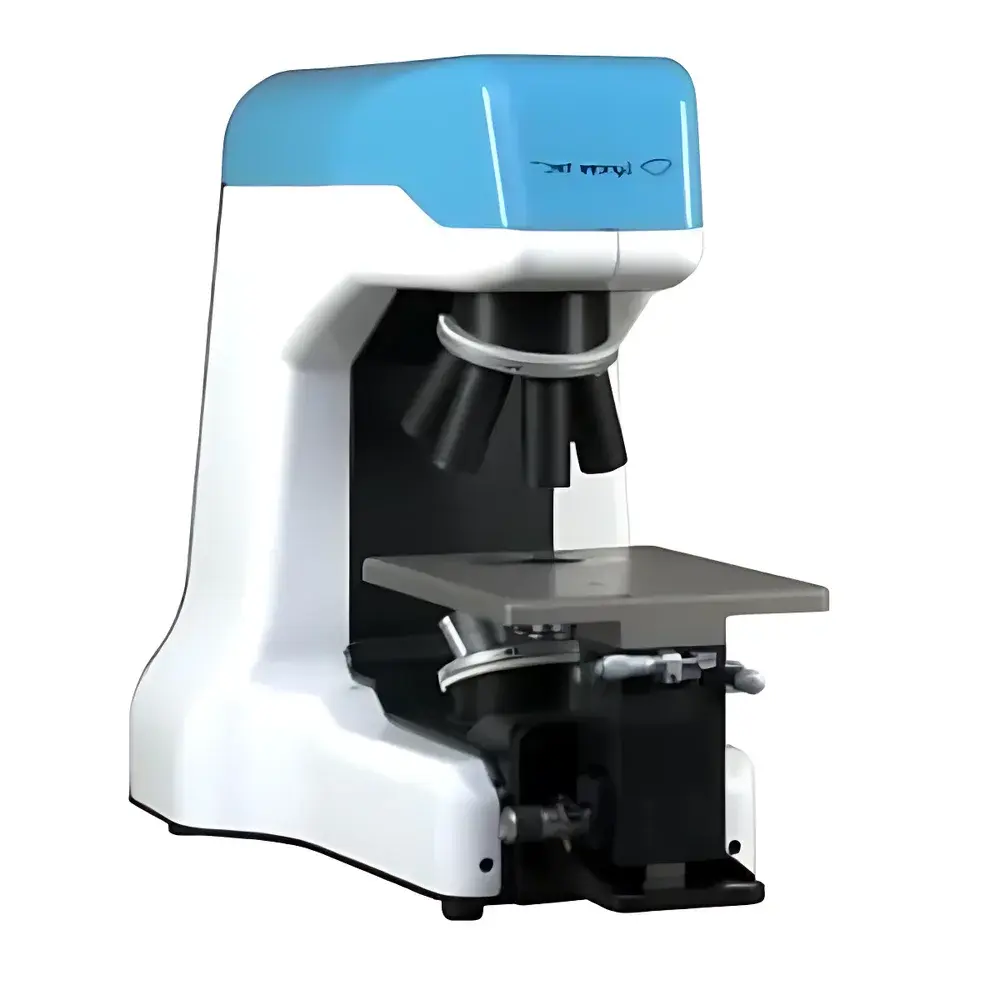
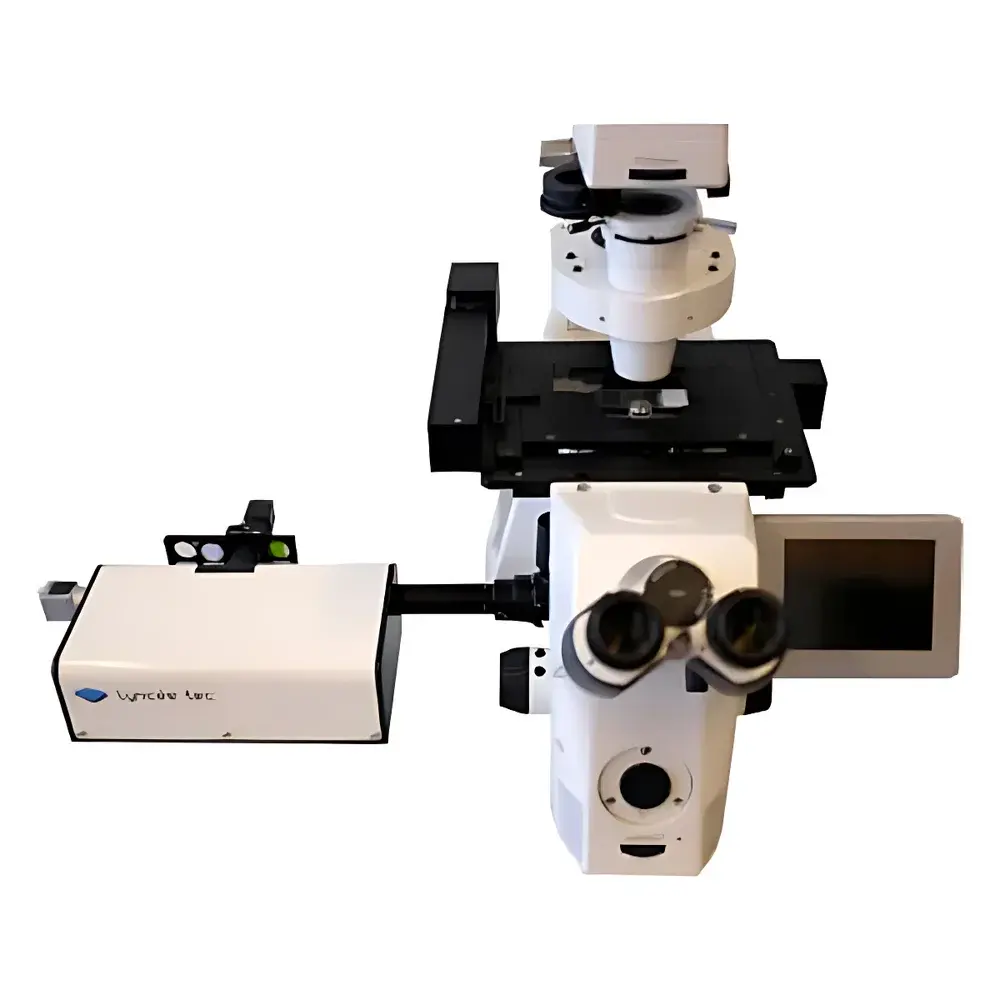
Lyncee Tec DHM-T1000 / DHM-T2100 Transmission Digital Holographic Microscope
| Brand | Lyncee Tec |
|---|---|
| Origin | Switzerland |
| Model | DHM-T1000 / DHM-T2100 |
| Imaging Speed | 190 fps |
| Type | Transmission-mode Digital Holographic Microscope |
| Application Domain | Quantitative Live-Cell Imaging, Biophysical Metrology, Transparent Sample Characterization |
Overview
The Lyncee Tec DHM-T1000 and DHM-T2100 are transmission-mode digital holographic microscopes (DHM) engineered for label-free, quantitative, real-time 4D imaging of living cells and optically transparent materials. Unlike conventional brightfield or fluorescence microscopy, these instruments operate on the principle of laser interferometry: a coherent light beam is split into object and reference arms; interference between the beams reconstructs both amplitude and phase information of transmitted light in a single shot. This enables direct, non-invasive quantification of optical path difference (OPD), which correlates linearly with cellular dry mass, thickness, and refractive index distribution—without staining, photobleaching, or phototoxicity. Designed for high temporal fidelity and nanoscale axial sensitivity (<5 nm vertical resolution), the system captures dynamic subcellular processes—including membrane fluctuations, organelle translocation, and mitotic progression—at up to 190 frames per second, making it suitable for time-resolved biophysical analysis under physiological conditions.
Key Features
- Single-shot, full-field quantitative phase imaging (QPI) with no mechanical scanning or z-stacking required
- Label-free, non-contact measurement preserving native cell physiology over extended observation periods
- Dual-wavelength capability (DHM-T2100): simultaneous acquisition at two discrete laser wavelengths (e.g., 532 nm and 660 nm) to decouple thickness and refractive index contributions, enabling absolute dry mass calculation independent of shape assumptions
- Monochromatic configuration (DHM-T1000): optimized for high-speed morphological monitoring of adherent cells, suspension cultures, and homogeneous transparent materials (e.g., polymer films, microfluidic channels)
- Real-time 4D reconstruction (x, y, z, t): volumetric phase maps updated at 190 Hz, supporting millisecond-scale dynamics analysis
- Integrated temperature and CO2 control compatibility for long-term live-cell experiments in standard incubator environments
- Robust optical architecture compliant with ISO 10110-7 for wavefront stability and vibration-insensitive design
Sample Compatibility & Compliance
The DHM-T series is validated for use with standard glass-bottom Petri dishes, multi-well plates (6–96-well), and custom microfluidic chambers. It accommodates samples ranging from isolated bacteria (≥0.5 µm lateral feature size) to confluent epithelial monolayers and 3D spheroids (up to 200 µm thick). All measurements adhere to metrological traceability principles outlined in ISO/IEC 17025. Phase data output conforms to FAIR (Findable, Accessible, Interoperable, Reusable) principles, and raw hologram files are stored in open-format TIFF stacks with embedded metadata (including wavelength, exposure time, magnification, and calibration coefficients). The system supports audit-ready operation under GLP and GMP frameworks when paired with optional electronic lab notebook (ELN) integration and 21 CFR Part 11-compliant user access controls.
Software & Data Management
Acquisition and analysis are managed via Lyncee Tec’s proprietary Koala software, which provides real-time hologram reconstruction, automated segmentation, and kinetic parameter extraction—including dry mass kinetics, volume evolution, membrane fluctuation spectra (via temporal power spectral density), and 4D bacterial trajectory mapping. Batch processing pipelines support export of calibrated phase maps (in nm OPD), time-series statistics (CSV, MATLAB .mat), and publication-ready TIFF/PNG sequences. Koala integrates with Python and MATLAB APIs for custom algorithm development, and supports DICOM-SR export for cross-platform biomedical data exchange. All processing steps are logged with timestamped, immutable audit trails, including operator ID, parameter settings, and version-controlled reconstruction algorithms.
Applications
- Quantitative monitoring of drug-induced cytotoxicity and recovery kinetics via dry mass loss/gain rates
- High-throughput screening of nanoparticle internalization using phase contrast enhancement without contrast agents
- Long-term tracking of single-cell growth, division asymmetry, and senescence markers in primary cultures
- 4D bacterial motility analysis—including flagellar-driven swimming trajectories, run-and-tumble statistics, and surface adhesion dynamics
- Mechanical phenotyping of red blood cells and cancer cells via membrane fluctuation amplitude and frequency distribution
- Characterization of hydrogel swelling kinetics, thin-film uniformity, and micro-optical element quality control
FAQ
How does DHM differ from conventional phase contrast or differential interference contrast (DIC) microscopy?
DHM delivers absolute, quantitative phase values (in nanometers of optical path difference) rather than qualitative contrast enhancements. It requires no condenser alignment, offers inherent Z-sectioning without hardware focus scanning, and provides built-in calibration traceability.
Can the DHM-T2100 resolve intracellular organelles without staining?
Yes—subcellular structures such as nucleoli, mitochondria, and lipid droplets are resolved based on intrinsic refractive index gradients, provided their lateral dimensions exceed the diffraction-limited resolution (~350 nm at 532 nm) and exhibit sufficient OPD contrast (>2 nm).
Is the system compatible with inverted microscope stands from other manufacturers?
The DHM-T modules are designed as standalone transmission platforms but can be integrated with select inverted research-grade microscopes via C-mount or fiber-coupled input ports upon consultation with Lyncee Tec engineering support.
What level of environmental stability is required for optimal performance?
Vibration isolation is recommended for sub-5 nm axial repeatability; operation on a standard optical table with passive damping achieves <1 nm RMS noise over 10-second acquisitions. Temperature drift compensation is embedded in Koala software for ambient fluctuations up to ±1°C/h.





