
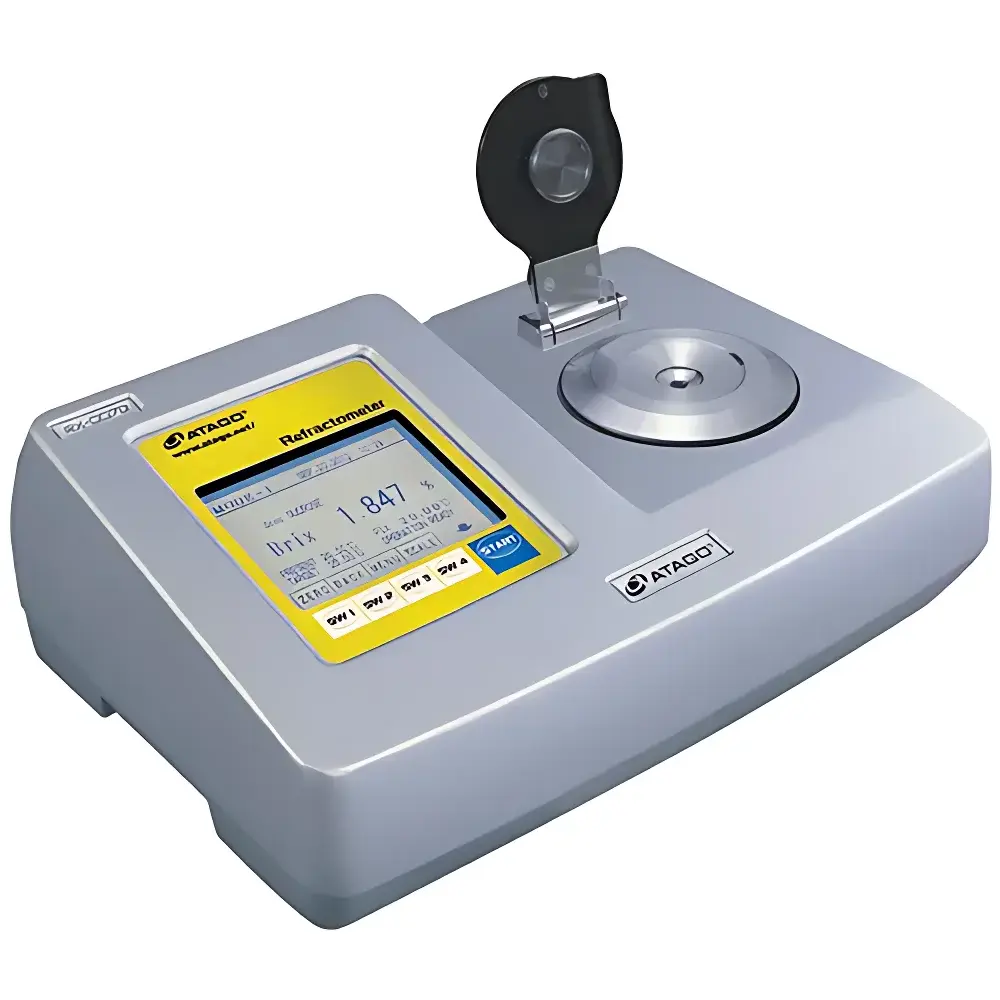
ATAGO RX-007α Low-Concentration Automatic Digital Refractometer
| Brand | ATAGO |
|---|---|
| Origin | Japan |
| Model | RX-007α |
| Type | Benchtop Refractometer |
| Temperature Control | Yes |
| Digital Display | Yes |
| Refractive Index Range | 1.330150–1.341500 |
| Brix Range | 0.000–5.000% |
| Refractive Index Accuracy | ±0.000010 |
| Brix Accuracy | ±0.005% |
| Temperature Control Range | 15–25°C (auto-adjusted per ambient) |
| Temperature Accuracy | ±0.05°C |
| Refractive Index Resolution | 0.000001 |
| Brix Resolution | 0.001% |
| Temperature Resolution | 0.01°C |
| Sample Prism | Optical Glass |
| Sample Well Material | SUS316 Stainless Steel |
| Interface | RS-232C |
| Power Supply | AC 100–240 V, 50–60 Hz |
| Power Consumption | 65 VA |
| Dimensions | 37 × 26 × 14 cm |
| Weight | 6.7 kg (main unit only) |
Overview
The ATAGO RX-007α Low-Concentration Automatic Digital Refractometer is a precision optical instrument engineered for high-accuracy measurement of refractive index and Brix concentration in dilute aqueous solutions—specifically optimized for samples with concentrations ≤5.000%. Based on the fundamental principle of Snell’s law, the instrument determines refractive index by measuring the critical angle of total internal reflection at the prism–sample interface. Its optical architecture incorporates a high-stability LED light source, temperature-compensated optical path, and a precisely ground optical glass prism, enabling trace-level detection sensitivity required for low-concentration applications such as unsweetened tea beverages, low-Brix functional waters, surfactant formulations, corrosion inhibitors, and mild aqueous process additives. The RX-007α operates under automatic temperature control (ATC), maintaining thermal equilibrium within ±0.05°C across its dynamically adjusted control range (15–25°C, dependent on ambient conditions), thereby eliminating manual correction and ensuring metrological consistency compliant with ISO 21748 and ASTM D1218 standards for refractometric analysis.
Key Features
- Ultra-high resolution: 0.000001 refractive index units (nD) and 0.001% Brix, enabling detection of minute compositional shifts in near-pure water matrices.
- Automated Peltier-based temperature control with real-time monitoring and dynamic setpoint adaptation to ambient conditions—no external chiller or bath required.
- Corrosion-resistant sample well fabricated from electropolished SUS316 stainless steel, suitable for mildly aggressive aqueous agents including amine-based surfactants and organic acid inhibitors.
- Dual-mode calibration support: factory-default Brix scale (based on sucrose standard) plus up to 30 user-defined calibration curves for non-sucrose solutes (e.g., glycerol, ethanol, sodium lauryl sulfate).
- RS-232C serial interface for direct integration into LIMS or laboratory automation workflows; optional digital printer support for GLP-compliant hardcopy records.
- Compliance-ready firmware architecture supporting audit trails, user access levels, and timestamped measurement logs—aligned with FDA 21 CFR Part 11 data integrity requirements when paired with validated software.
Sample Compatibility & Compliance
The RX-007α is validated for use with low-viscosity, optically clear, non-scattering aqueous solutions exhibiting minimal suspended solids or turbidity (50 mPa·s). The instrument meets CE marking requirements for electrical safety (EN 61010-1) and electromagnetic compatibility (EN 61326-1). Its measurement methodology aligns with ISO 21748:2017 (Guidance for the evaluation of measurement uncertainty) and supports traceability to NIST-traceable sucrose reference standards.
Software & Data Management
Data output is natively supported via RS-232C serial protocol using ASCII-formatted commands (e.g., “READ”, “TEMP”, “CAL”). When connected to a host PC running ATAGO’s optional WinCT-Refracto software (v3.2+), users gain access to automated report generation, statistical process control (SPC) charting, multi-sample batch logging, and export to CSV/XLSX formats. All measurements are time-stamped and associated with operator ID, sample ID, and environmental temperature—enabling full auditability for GLP and GMP environments. The firmware stores calibration history, system diagnostics, and error logs internally for ≥10,000 entries, with overwrite protection enabled upon configuration lock.
Applications
- Quality control of zero-sugar ready-to-drink (RTD) tea beverages during blending and final fill, verifying consistency of natural extract concentration without added sucrose.
- In-process monitoring of surfactant concentration in metalworking fluid formulations, ensuring optimal wetting and emulsification performance prior to deployment.
- Stability testing of aqueous anti-corrosion coatings, where minor changes in inhibitor concentration directly correlate with electrochemical protection efficacy.
- R&D screening of novel humectants or solubilizers in cosmetic toners and oral care rinses, where Brix deviation <±0.01% reflects formulation repeatability.
- Academic research in colloid science and interfacial chemistry, quantifying critical micelle concentration (CMC) transitions through precise refractive index inflection point detection.
FAQ
What is the minimum detectable Brix change the RX-007α can resolve?
The instrument resolves Brix differences down to 0.001%, with measurement repeatability of ±0.005% under controlled temperature conditions.
Can the RX-007α measure ethanol–water mixtures?
Yes—when calibrated using a user-defined ethanol/water scale; however, accuracy is optimized for concentrations ≤5% v/v due to refractive index nonlinearity at higher ethanol levels.
Is cleaning validation documented for SUS316 sample wells?
ATAGO provides material certification (EN 10204 3.1) for the SUS316 well; cleaning protocols using 70% isopropanol followed by deionized water rinse are validated for carryover <0.002% residual solute.
Does the RX-007α comply with pharmacopeial methods?
While not explicitly listed in USP or Ph. Eur. 2.2.2, its performance parameters satisfy the instrumental requirements for refractometric assays referenced in those monographs when operated under validated conditions.
How often does the optical prism require recalibration?
The factory-calibrated prism requires no routine recalibration; annual verification against certified refractive index standards (e.g., NIST SRM 1797) is recommended for regulated environments.




