
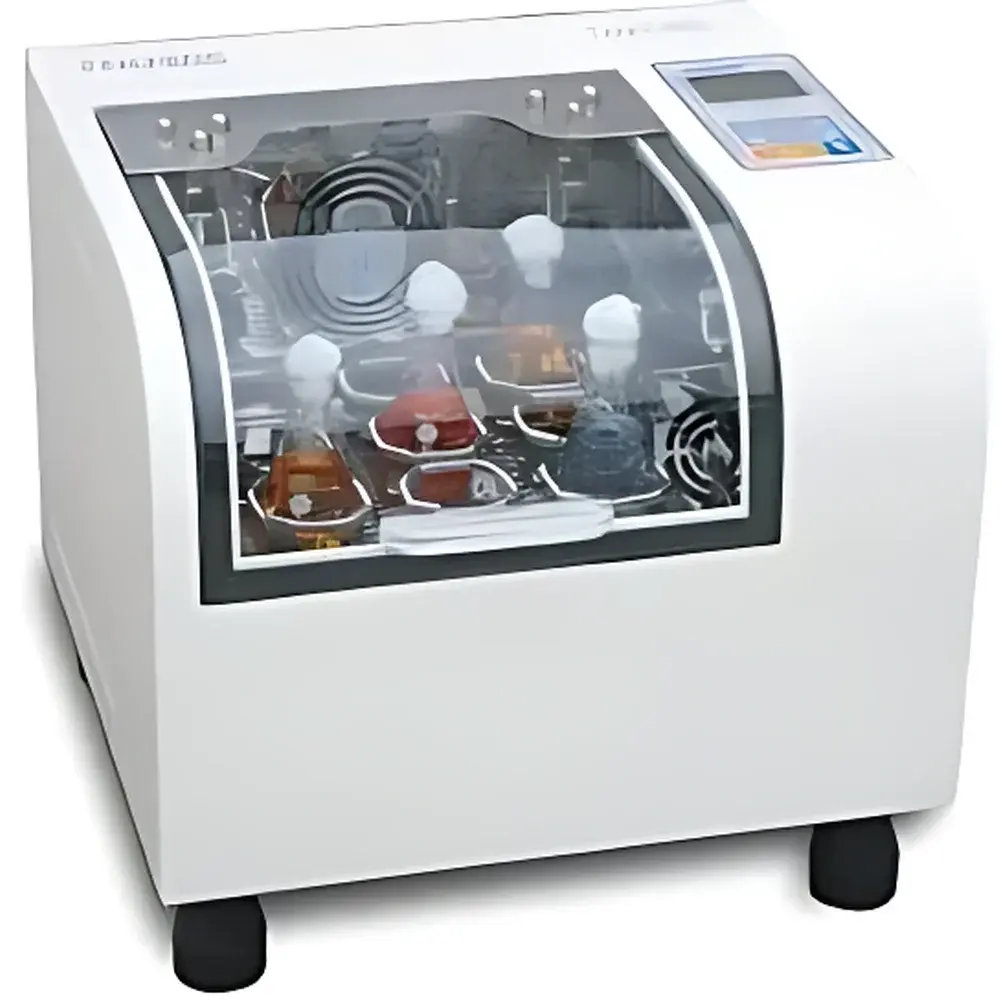
Zhicheng ZWY-103D Mini High-Speed Orbital Shaker with Multi-Amplitude Control
| Origin | Shanghai, China |
|---|---|
| Manufacturer Type | Authorized Distributor |
| Origin Category | Domestic (China) |
| Model | ZWY-103D |
| Price | Upon Request |
| Max Speed | 30–600 rpm |
| Amplitude Range | Φ0–50 mm (infinitely adjustable) |
| Temperature Range | Ambient +5°C to 60°C |
| Temp. Resolution | 0.1°C |
| Temp. Stability | ≤±0.1°C at 37°C |
| Temp. Uniformity | ≤±1°C at 37°C |
| Timer Range | 0–500 h |
| Platform Size | 280 × 220 mm |
| Chamber Volume | 34 L |
| Internal Dimensions | 360 × 340 × 280 mm |
| External Dimensions | 440 × 410 × 390 mm |
| Net Weight | 31 kg |
| Power | 280 W |
| Input | AC 220 V, 50/60 Hz |
Overview
The Zhicheng ZWY-103D Mini High-Speed Orbital Shaker is an engineered solution for precise, reproducible orbital agitation in life science laboratories requiring controlled oxygen transfer, uniform suspension, and gentle yet effective mixing of biological samples. It operates on the principle of eccentric cam-driven orbital motion—generating a consistent circular trajectory across the platform surface—with digitally regulated speed and continuously variable amplitude (Φ0–50 mm). This dual-parameter control enables users to decouple rotational frequency (30–600 rpm, ±1 rpm accuracy) from mechanical displacement, allowing optimization of dissolved oxygen (DO) levels in microbial cultures, suspension cell lines, or enzymatic reaction mixtures without compromising sample integrity. Unlike fixed-amplitude shakers, the ZWY-103D’s multi-amplitude architecture supports both low-speed, high-displacement regimes (e.g., 60 rpm @ 45 mm for aerobic bacterial growth) and high-speed, low-displacement regimes (e.g., 550 rpm @ 8 mm for dense yeast fermentations), all while maintaining thermal stability (±0.1°C at 37°C) via PID-controlled forced-air convection.
Key Features
- Eccentric cam-based orbital drive system delivering smooth, non-resonant motion with zero carbon brush wear and maintenance-free operation
- Infinitely adjustable amplitude (Φ0–50 mm) synchronized with speed control to independently tune shear stress and mass transfer efficiency
- PID microprocessor controller with real-time environmental scanning for adaptive thermal regulation and dynamic load compensation
- Backlit LCD display showing setpoints and real-time values for speed, amplitude, temperature, and timer—fully encrypted to prevent unauthorized parameter changes
- Soft-start acceleration circuitry ensuring gradual ramp-up to target speed, eliminating mechanical shock during initiation—critical for fragile cultures or low-volume assays
- Overtemperature protection with independent thermal cutoffs for chamber and motor; audible/visual alarm triggers at ≥65°C cabinet temperature or motor surface >90°C
- Power failure recovery function: automatically resumes pre-interruption settings—including speed, amplitude, temperature, and remaining time—upon grid restoration
- Electrostatically coated steel chassis with tempered glass front window and ergonomic streamline housing compliant with ISO 13485-informed lab equipment design principles
Sample Compatibility & Compliance
The ZWY-103D accommodates standard culture vessels including Erlenmeyer flasks (up to 250 mL × 5), test tubes (50 mL × 9 or 100 mL × 9), and microplate carriers (optional adapter). Its platform geometry (280 × 220 mm) and uniform airflow pattern support homogeneous thermal distribution per ISO 20387:2018 Annex C guidelines for biobanking equipment validation. The unit meets IEC 61010-1:2010 safety requirements for laboratory electrical equipment and incorporates hardware-level safeguards aligned with GLP-compliant workflows—including audit-trail-capable parameter logging (via optional RS-232/USB interface), locked configuration modes, and traceable calibration points for speed and temperature. While not FDA 21 CFR Part 11 certified out-of-box, its encrypted parameter storage and non-volatile memory enable integration into validated systems under GMP Annex 11 frameworks when paired with compliant data acquisition software.
Software & Data Management
The embedded controller stores up to 10 user-defined protocols with full recall capability, eliminating repetitive setup. Optional PC connectivity (RS-232 or USB) enables remote monitoring, real-time data export (.csv), and batch protocol deployment using Zhicheng’s LabShake Manager v3.x software—compatible with Windows 10/11 and supporting automated report generation per ISO/IEC 17025 documentation standards. All parameter changes are timestamped and logged locally; firmware updates preserve historical calibration records and do not overwrite user-defined programs. The system supports external relay triggers for synchronized incubator or bioreactor events, facilitating multi-device experimental sequences in fermentation process development.
Applications
This shaker is routinely deployed in applications demanding tight coupling between hydrodynamic conditions and metabolic activity: aerobic cultivation of Escherichia coli, Bacillus subtilis, and recombinant Pichia pastoris; suspension culture of CHO and HEK293 cells; hybridization kinetics in molecular diagnostics; enzyme kinetic assays requiring continuous mixing; and small-scale bioprocess screening where DO modulation directly influences product titer and byproduct formation. Its compact footprint (440 × 410 × 390 mm) and 34 L chamber volume make it suitable for benchtop use in BSL-2 cabinets or shared core facilities—particularly where space-constrained incubator-shaker integration is required.
FAQ
What is the maximum flask capacity supported on the platform?
The standard platform holds up to five 250 mL Erlenmeyer flasks, nine 100 mL flasks, or nine 50 mL flasks—arranged to maintain center-of-mass balance at all operating speeds and amplitudes.
Does the unit include temperature calibration certification?
Factory calibration certificates (traceable to NIST standards) are available upon request; field recalibration is supported via two-point adjustment using certified PT100 reference probes.
Can amplitude be adjusted during operation?
Yes—amplitude is fully adjustable in real time without pausing the run, enabling dynamic DO tuning during mid-log phase transitions.
Is the shaker compatible with CO₂-enriched environments?
No—the chamber is not gas-tight; for CO₂-sensitive applications, external humidified CO₂ incubators with integrated orbital platforms are recommended.
What maintenance intervals are specified for the motor and drive assembly?
Zero scheduled maintenance is required—the brushless AC induction motor and sealed eccentric cam mechanism are rated for >20,000 hours of continuous operation under nominal load conditions.



