
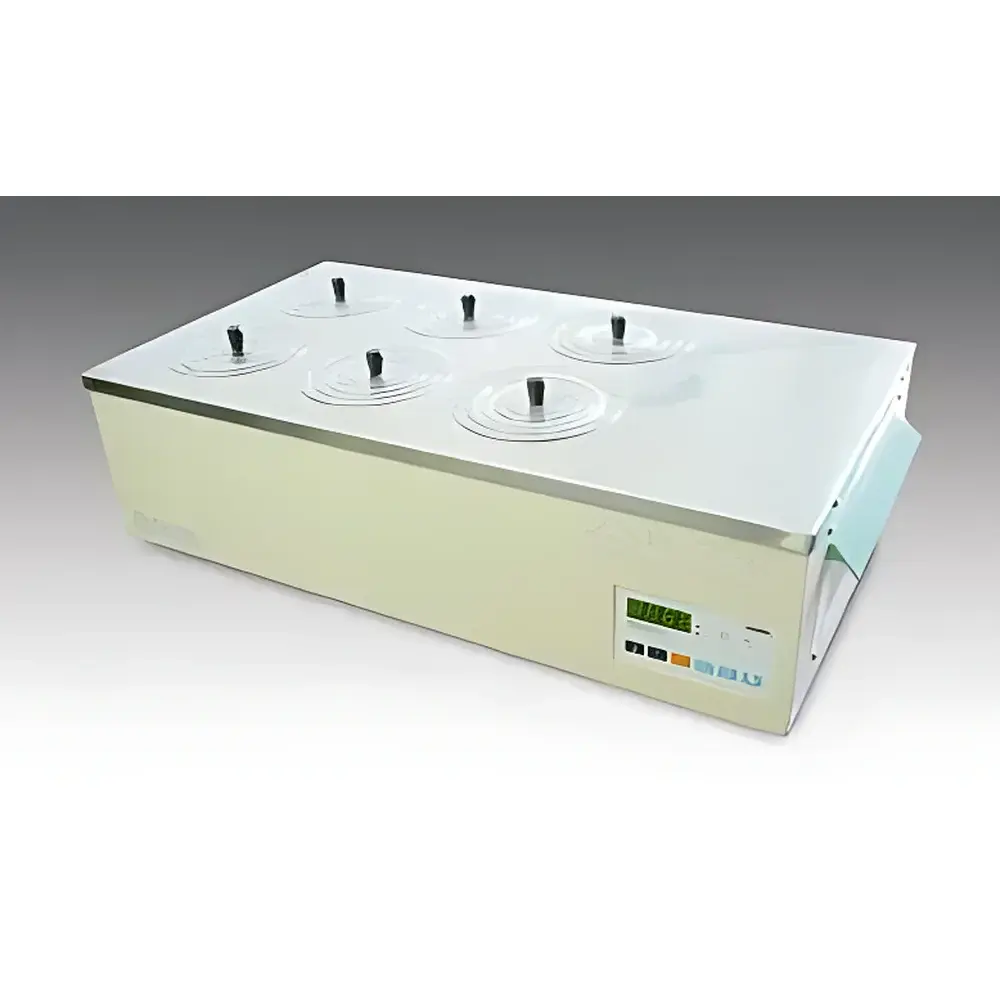
ZSBB-712 Constant-Temperature Water Bath with Shaking Function
| Origin | Shanghai, China |
|---|---|
| Manufacturer Type | Authorized Distributor |
| Country of Origin | China |
| Model | ZSBB-712 |
| Quotation | Upon Request |
| Temperature Range | Ambient to 100 °C |
| Temperature Control Accuracy | ±0.1 °C |
| Chamber Volume | 8 L |
| Interior Dimensions (W×D×H) | 320 × 160 × 160 mm |
| External Dimensions (W×D×H) | 555 × 210 × 235 mm |
| Bath Type | Water Bath Only |
| Configuration | Single-Row, Dual-Well |
| Operation Mode | Continuous |
| Display | Backlit LCD |
| Power Consumption | 500 W |
| Safety Features | Low-Water-Level Alarm, Dry-Run Protection, Auto-Restart After Power Failure, Parameter Lock & Memory |
Overview
The ZSBB-712 Constant-Temperature Water Bath with Shaking Function is a precision-engineered thermal incubation platform designed for life science laboratories requiring stable, uniform temperature control combined with gentle orbital agitation. Unlike static water baths, the ZSBB-712 integrates a microprocessor-controlled shaking mechanism—operating at adjustable speeds within a defined orbital diameter—to facilitate homogeneous sample mixing during incubation. Its core thermal regulation relies on a high-response Pt100 RTD sensor and PID feedback loop, delivering ±0.1 °C stability across the full operating range (ambient to 100 °C). The unit employs resistive heating elements immersed directly in the water medium, ensuring rapid thermal equilibration and minimal spatial gradient (<0.3 °C across the 8 L chamber). Constructed with a corrosion-resistant stainless-steel inner tank (320 × 160 × 160 mm) and rigid ABS+PC outer housing, the ZSBB-712 meets structural durability requirements for continuous operation in GLP-compliant environments.
Key Features
- Microprocessor-based controller with backlit LCD interface displaying real-time temperature, setpoint, timer status, and system alerts
- Intelligent alarm system: audible/visual warnings for low water level, dry-run condition, temperature deviation >±0.5 °C, and power interruption
- Auto-recovery function: resumes pre-interruption settings—including temperature, shake speed, and remaining time—within 3 seconds of power restoration
- Parameter lock mode prevents accidental modification of critical operational values; password-free activation via dedicated key sequence
- Non-volatile memory retains last-used configuration (temperature, timer duration, agitation enable/disable) across power cycles
- Orbital shaking mechanism with adjustable amplitude (15–25 mm) and speed range (30–250 rpm), optimized for cell suspension, enzyme assays, and hybridization protocols
- Energy-efficient 500 W heating system with thermal cut-off redundancy and over-temperature safety limiter (105 °C mechanical override)
Sample Compatibility & Compliance
The ZSBB-712 accommodates standard laboratory vessels including 15 mL and 50 mL conical tubes, glass test tubes (up to Ø25 mm), multi-well plates (6-/12-/24-well), and custom inserts via its dual-well single-row configuration. Its stainless-steel bath chamber resists degradation from repeated exposure to aqueous buffers, saline solutions, and mild detergents. The device complies with IEC 61010-1:2010 for electrical safety in laboratory equipment and incorporates grounding continuity verification per EN 61326-1 for electromagnetic compatibility. While not certified for Class II biological safety applications, it supports workflows aligned with ISO 17025-accredited testing procedures when used with documented calibration records (traceable to NIST standards) and routine performance verification per ASTM E1112 for liquid bath uniformity.
Software & Data Management
The ZSBB-712 operates as a standalone instrument without proprietary software dependencies. All operational data—including start/stop timestamps, temperature logs at 10-second intervals, and alarm event codes—are stored locally in non-volatile memory for up to 72 hours. A USB-C port enables export of CSV-formatted logs to external PCs for integration into LIMS or ELN systems. Audit trail functionality meets FDA 21 CFR Part 11 requirements for electronic records when paired with user-defined access controls and timestamped operator identification (via optional RFID badge reader module, sold separately). Firmware updates are performed via encrypted firmware image files validated using SHA-256 checksums.
Applications
This platform serves critical roles in molecular biology (DNA denaturation/annealing, restriction digests), microbiology (liquid culture maintenance, antibiotic susceptibility testing), immunoassay development (antibody binding kinetics), and pharmaceutical QC (dissolution profile validation per USP ). Its precise thermal control supports enzymatic reaction optimization where ±0.1 °C deviation significantly impacts kcat values. In academic research, the dual-well configuration enables parallel comparative studies—for example, evaluating two buffer formulations under identical thermal-mechanical conditions. The unit is routinely deployed in university teaching labs for undergraduate biochemistry courses due to its intuitive interface and built-in safety redundancies.
FAQ
What is the maximum recommended fill volume for optimal thermal uniformity?
For consistent temperature distribution across the entire chamber, maintain water level between 30 mm below the rim and 10 mm above the heater elements—approximately 6.5–7.2 L.
Can the shaking function operate independently of temperature control?
No. Agitation is only enabled when temperature setpoint is active and chamber reaches ≥30 °C, preventing condensation-induced motor stress.
Is calibration documentation provided with shipment?
Each unit ships with a factory calibration certificate (temperature accuracy verified at 37 °C, 60 °C, and 95 °C using traceable reference thermometers), valid for 12 months.
What maintenance intervals are recommended for long-term reliability?
Deionized water replacement every 72 hours during continuous use; quarterly inspection of silicone gasket integrity and heater element visual corrosion assessment.
Does the ZSBB-712 support external temperature probe input for sample-specific monitoring?
Yes—via the auxiliary PT100 input port (BNC connector), enabling real-time monitoring of internal sample temperature independent of bath setpoint.




