
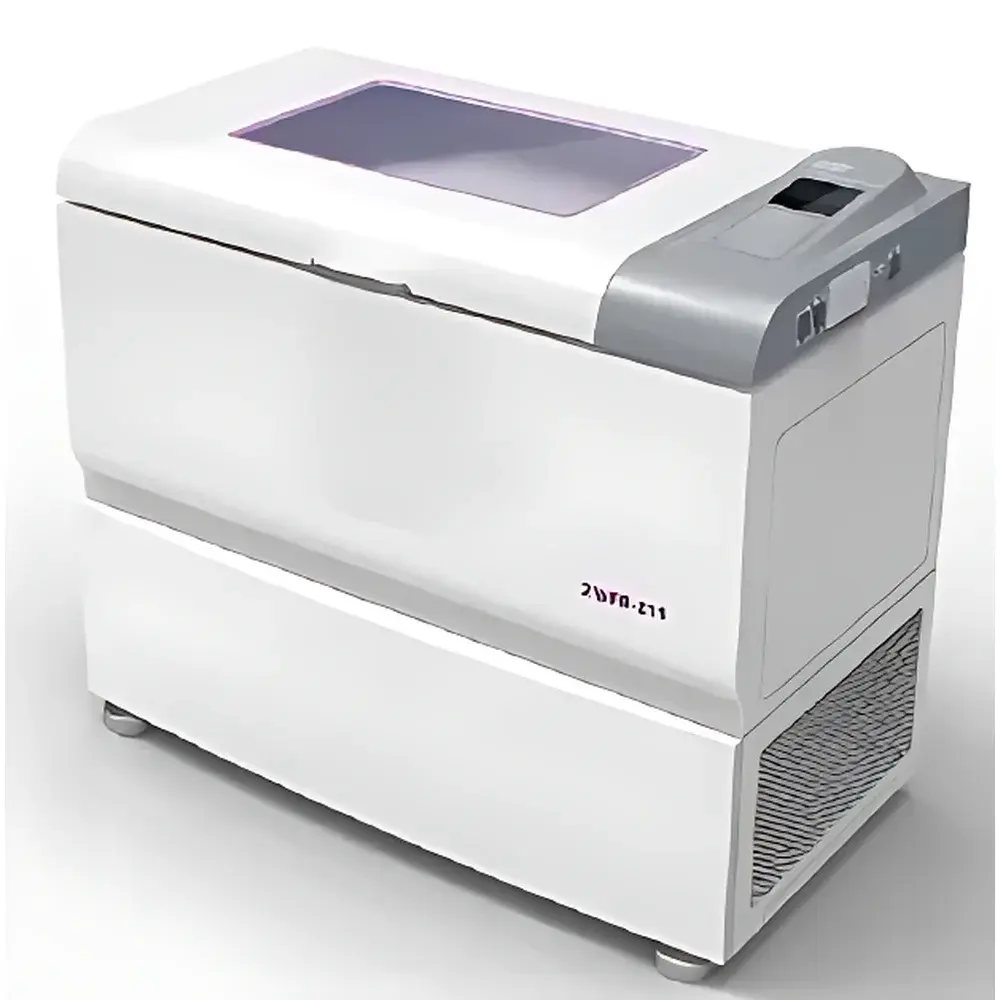
Zhicheng ZWFR-211 Horizontal Reciprocating Shaker with 4.3″ Full-Color Touchscreen
| Brand | Zhicheng |
|---|---|
| Origin | Shanghai, China |
| Manufacturer Type | OEM Manufacturer |
| Product Category | Domestic |
| Model | ZWFR-211 |
| Instrument Type | Reciprocating Shaker |
| Display | 4.3″ TFT LCD (480×272, 65K-color) Touchscreen |
| Control System | PID Microprocessor with Environmental Scan Algorithm |
| Temperature Range | 4–60 °C |
| Temp. Resolution | 0.1 °C |
| Temp. Uniformity | ≤±1 °C @ 37 °C |
| Temp. Stability | ≤±0.1 °C @ 37 °C |
| Oscillation Mode | Horizontal Reciprocating |
| Drive Mechanism | Orbital Track Drive |
| Speed Range | 30–240 rpm |
| Speed Accuracy | ±1 rpm |
| Stroke Adjustment | 0–50 mm, Continuously Variable |
| Chamber Volume | 275 L |
| Shelf Dimensions | 870 × 530 mm |
| Internal Chamber | 975 × 565 × 500 mm |
| External Dimensions | 1230 × 760 × 1120 mm |
| Net Weight | 213 kg |
| Power Supply | AC 220 V, 50/60 Hz |
| Power Consumption | 1380 W |
| Cooling Method | Air-Cooled R134a Refrigeration System with Frost-Free Operation |
| Programmability | 9-Stage / 18-Step Program (Each Segment: 0–999.9 min |
| Safety Features | Dual Independent Over-Temp Protection, Door-Safety Interlock, Leakage Current Protection, Motor Overload Cut-off, Emergency Thermal Fuse, Speed Deviation Alarm, Auto-Recovery After Power Failure |
| Data Interface | RS-232 Serial Port + Embedded Thermal Printer |
| Compliance | Designed to meet general laboratory safety requirements per IEC 61010-1 |
Overview
The Zhicheng ZWFR-211 Horizontal Reciprocating Shaker is an engineered platform for precise, reproducible, and programmable incubation of biological samples under controlled thermal and mechanical conditions. It operates on the principle of horizontal linear oscillation—distinct from orbital or rotary motion—delivering uniform shear stress across large-format culture vessels such as flasks, bottles, and multi-well plates. This mode of agitation supports optimal oxygen transfer and suspension homogeneity in viscous or high-density cultures, making it particularly suitable for aerobic microbial fermentation, hybridization protocols, and enzymatic reaction kinetics where consistent mechanical input is critical. The unit integrates a microprocessor-controlled PID algorithm with real-time environmental scanning, enabling dynamic compensation for ambient fluctuations and load-dependent thermal inertia. Its forced-air convection system, coupled with a frost-free R134a refrigeration module, ensures stable sub-ambient operation down to 4 °C without condensation buildup—a key requirement for long-duration low-temperature assays.
Key Features
- 4.3-inch full-color TFT touchscreen (480 × 272 resolution, 65K color depth) with intuitive icon-based navigation and animated status feedback
- 9-stage, 18-step programmable logic supporting ramp-hold profiles, temperature gradients, cyclic repetition (up to 99 loops), and stepwise speed transitions
- Dual independent over-temperature protection: primary electronic cut-off plus mechanical backup thermal fuse
- Comprehensive safety architecture including door interlock shutdown, earth-leakage circuit interruption, motor overload detection, and real-time speed deviation alarm
- Embedded thermal printer with time/date stamping for GLP-compliant record generation; RS-232 interface for external data logging and remote configuration
- Continuously adjustable stroke amplitude (0–50 mm) and speed range (30–240 rpm), calibrated to ±1 rpm accuracy
- Robust stainless-steel chamber interior (975 × 565 × 500 mm) with reinforced aluminum alloy shelf (870 × 530 mm, 275 L total volume)
- Auto-recovery function retains all user-defined parameters and resumes interrupted programs after power loss
Sample Compatibility & Compliance
The ZWFR-211 accommodates standard laboratory vessels up to 5 L capacity—including Erlenmeyer flasks (up to 3 L), Fernbach bottles, and stacked cell culture stacks—without compromising thermal uniformity or oscillation fidelity. Its horizontal reciprocating motion minimizes vortex formation while maximizing surface-area-to-volume interaction, reducing foaming and shear-induced cell damage in sensitive eukaryotic cultures. The system complies with IEC 61010-1 for electrical safety in laboratory equipment and incorporates design elements aligned with ISO/IEC 17025 documentation expectations: parameter encryption, audit-trail-capable print logs, and non-volatile memory for method preservation. While not certified to FDA 21 CFR Part 11 out-of-the-box, its timestamped output and password-protected configuration support validation pathways for regulated environments when paired with appropriate SOPs.
Software & Data Management
Operation is managed entirely through the onboard HMI, eliminating dependency on external PCs. All programs—including temperature ramps, speed profiles, dwell times, and safety thresholds—are stored in non-volatile memory with user-level access control. The embedded thermal printer produces hard-copy records containing program ID, start/stop timestamps, setpoints, actual readings (temperature, rpm), and alarm events—each line sequentially numbered and time-stamped to the second. RS-232 connectivity enables integration with LIMS or custom SCADA systems using ASCII protocol; no proprietary drivers are required. Parameter recall, calibration offset storage (e.g., speed correction factors), and clock synchronization are retained across power cycles, ensuring continuity in multi-day experiments.
Applications
This shaker serves as a core platform in academic, clinical, and industrial life science labs conducting temperature-sensitive dynamic assays. Typical use cases include: bacterial and yeast fermentation under controlled aeration; DNA hybridization in stringent buffer conditions; protein expression in autoinduction media; enzyme immobilization studies requiring uniform substrate mixing; tissue dissociation pre-processing; and stability testing of biopharmaceutical formulations across thermal gradients. Its wide temperature span (4–60 °C) and programmable cycling also support circadian rhythm modeling in cell lines and accelerated degradation studies compliant with ICH Q1A(R3) guidelines.
FAQ
Does the ZWFR-211 support validation documentation for GMP environments?
Yes—the embedded printer generates traceable, time-stamped logs, and all operational parameters are stored with retention across power interruptions. When combined with site-specific IQ/OQ protocols and change-control procedures, it meets foundational requirements for equipment qualification.
Can multiple temperature and speed profiles be stored simultaneously?
Up to 20 fully defined programs (each with up to 9 stages) can be saved in internal memory, accessible via numeric ID or descriptive naming.
Is refrigerant maintenance required during normal operation?
No—the R134a system is sealed and designed for maintenance-free, frost-free operation over the rated service life.
What is the maximum flask size supported on the single-tier platform?
Standard configurations accommodate two 3 L Fernbach flasks or four 2 L Erlenmeyer flasks with adequate clearance for heat exchange and motion stability.
How is temperature uniformity verified across the chamber?
Uniformity is validated per ASTM E145 Annex A4 using nine-point mapping at 37 °C; results consistently demonstrate ≤±1 °C deviation across the working volume.




