
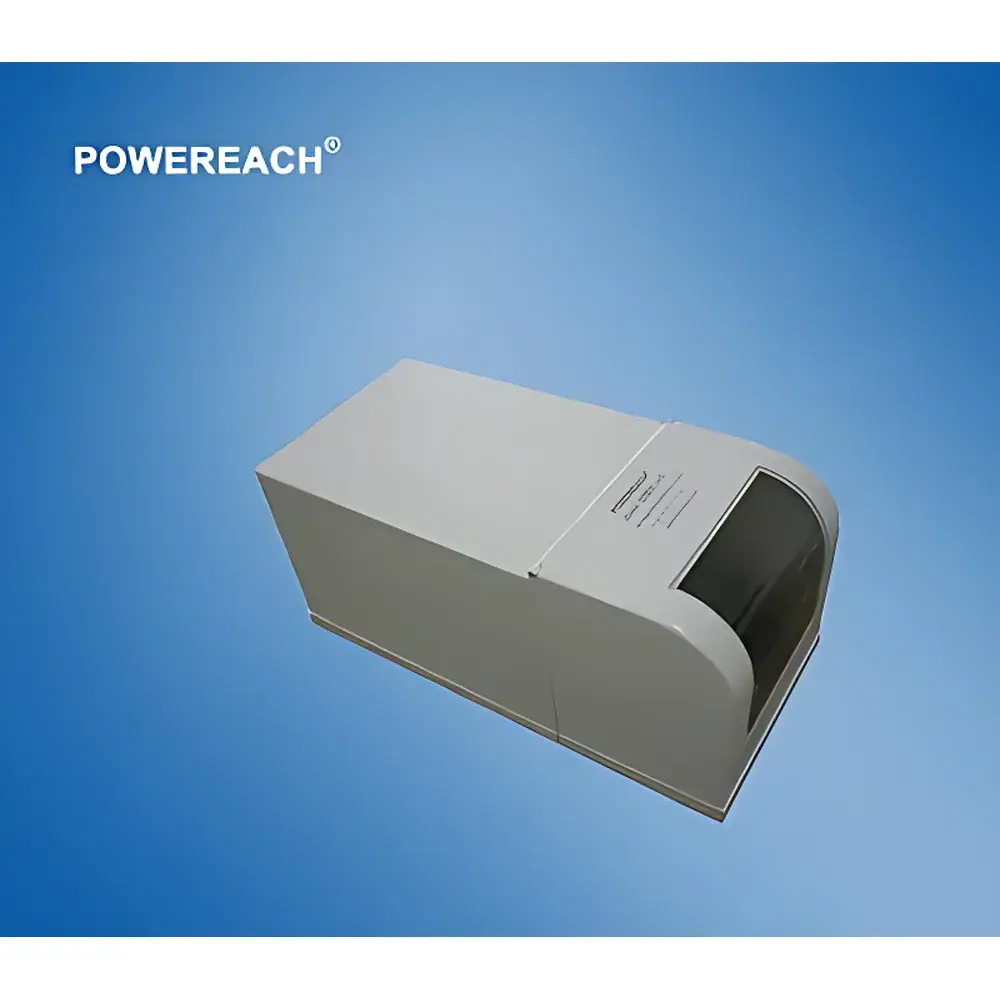
JS94J2M Zeta Potential Analyzer (Microelectrophoresis Instrument)
| Origin | Beijing, China |
|---|---|
| Manufacturer Type | Distributor |
| Origin Category | Domestic |
| Model | JS94J2M |
| Price Range | USD 7,000–14,000 |
| Zeta Potential Range | ±3000 mV |
| pH Range | 2.0–12.0 (extended operation up to 1.6–13.0) |
| Operating Temperature | 5–35 °C |
| pH Resolution | 0.1 |
| Temperature Resolution | 0.1 °C |
| Accuracy | ≤5% |
| Repeatability | ≤5% |
| Particle Size Range | 0.1–10 µm |
| Solvent Compatibility | Aqueous and non-aqueous dispersions |
| Optical System | Semiconductor-based blue/green LED illumination (low-power, <100 µW), 1200× digital magnification |
| Electrophoretic Cell | Integrated Ag/Pt/Ti electrodes in 0.5 cm-thick borosilicate glass cuvette |
| Voltage Control | Adjustable DC/low-frequency AC bias, polarity reversal time: 0.30–1.20 s adjustable |
| Sampling Time | 3–10 s per measurement |
| Data Acquisition | Dual-directional grayscale image capture (4 frames), real-time temperature compensation |
Overview
The JS94J2M Zeta Potential Analyzer is a microelectrophoresis instrument engineered for precise determination of electrophoretic mobility and surface charge potential (Zeta potential) of colloidal particles and droplets in dispersed systems. It operates on the principle of laser-assisted microelectrophoresis: under a controlled electric field, charged particles migrate at velocities proportional to their surface potential; these motions are optically tracked using a high-magnification, low-thermal-load semiconductor illumination system. The instrument calculates Zeta potential via the Henry equation (with Smoluchowski or Hückel approximation applied based on particle size and medium conductivity), enabling quantitative characterization of interfacial electrokinetic behavior in both aqueous and non-aqueous media. Designed specifically for laboratories requiring robust performance across diverse solvent systems—including polar organic solvents where higher field strengths are necessary—the JS94J2M supports fundamental research into colloidal stability, surface functionalization, and interfacial reaction kinetics.
Key Features
- Integrated electrophoretic cell with precision-machined 0.5 mm-thick borosilicate glass cuvette and embedded Ag/Pt/Ti alloy electrodes—engineered for minimal polarization, stable current density, and long-term reproducibility.
- Optimized optical path featuring short-wavelength blue/green LED illumination (≤100 µW output), eliminating thermal drift and enabling clear visualization of sub-micron particles down to 0.1 µm.
- Computer-controlled bidirectional imaging system capturing four synchronized grayscale frames at 1200× effective magnification, with automatic focus alignment via integrated crosshair calibration on a motorized XYZ stage.
- Programmable voltage source with polarity reversal timing adjustable from 0.30 to 1.20 seconds, minimizing electrode polarization while maintaining measurement speed (3–10 s per acquisition).
- Real-time environmental monitoring: built-in Pt100 temperature probe and calibrated pH sensor feed continuous corrections into Zeta calculation algorithms, ensuring traceable compliance with ISO 13099-2:2012 and ASTM D7825-14 standards.
- Low sample consumption (0.5 mL per test), rapid cell cleaning protocol, and modular electrode assembly reduce operational downtime and cross-contamination risk.
Sample Compatibility & Compliance
The JS94J2M accommodates a broad range of dispersion media—including water, ethanol, isopropanol, toluene, and ethyl acetate—making it suitable for formulations in pharmaceutical suspensions, pigment dispersions, nanocellulose gels, and polymer latexes. Its extended pH range (1.6–13.0) and temperature tolerance (5–35 °C) support studies under aggressive chemical conditions. All measurements adhere to internationally recognized frameworks: data processing follows the methodology outlined in ISO 13099 (Parts 1–3) for colloid characterization; electrophoretic cell design meets the geometric constraints defined in ASTM D7825 for microelectrophoretic instruments. While not inherently 21 CFR Part 11 compliant, audit trails, user access logs, and raw image archiving can be implemented via third-party LIMS integration for GLP/GMP environments.
Software & Data Management
Bundled Windows-native software provides full control over acquisition parameters, real-time image preview, automated frame selection, and batch processing of mobility-to-Zeta conversion using selectable dielectric constant and viscosity inputs. Each dataset includes embedded metadata: timestamp, temperature, pH, applied voltage, reversal interval, and instrument serial number. Export formats include CSV (for statistical analysis in JMP or Python), TIFF (raw image sequences), and PDF reports with embedded calibration certificates. Software supports multi-user configuration with role-based permissions (operator, supervisor, administrator), and optional add-ons enable trend analysis across time-series experiments and export to ELN platforms via REST API.
Applications
- Formulation optimization in cosmetics (e.g., emulsion stability assessment of oil-in-water systems)
- Surface charge mapping during nanoparticle functionalization in drug delivery R&D
- Process validation of mineral flotation reagents in extractive metallurgy
- Quality control of inkjet pigment dispersions in printed electronics manufacturing
- Teaching laboratory use for undergraduate physical chemistry and materials science courses
- Environmental colloidal transport modeling using soil leachate or wastewater slurry samples
FAQ
What dispersion media are compatible with the JS94J2M?
Aqueous buffers, alcohols (methanol, ethanol, IPA), hydrocarbons (toluene, xylene), and esters (ethyl acetate) are supported. Viscosity should remain below 20 cP for reliable electrophoretic mobility tracking.
Can the instrument measure Zeta potential of solid surfaces?
No—it is designed exclusively for dispersed phase analysis (particles, droplets, vesicles). Solid substrate Zeta requires streaming potential or electro-osmosis modules not included in this configuration.
Is temperature control external or internal?
The unit includes an integrated Pt100 probe for ambient temperature monitoring and algorithmic compensation, but does not feature active Peltier cooling/heating. Users must maintain sample temperature externally (e.g., via circulating bath or climate-controlled lab environment).
How is calibration verified?
Calibration is performed using NIST-traceable polystyrene latex standards (e.g., Duke Scientific 3000A series). Daily verification checks are recommended prior to critical measurements; full recalibration is advised every 6 months or after electrode replacement.
Does the software support IQ/OQ documentation?
Yes—standard installation includes electronic templates aligned with ASTM E2500 and ICH Q9 guidelines. Custom validation packages (including URS, FDS, and test protocols) are available upon request for regulated environments.



