
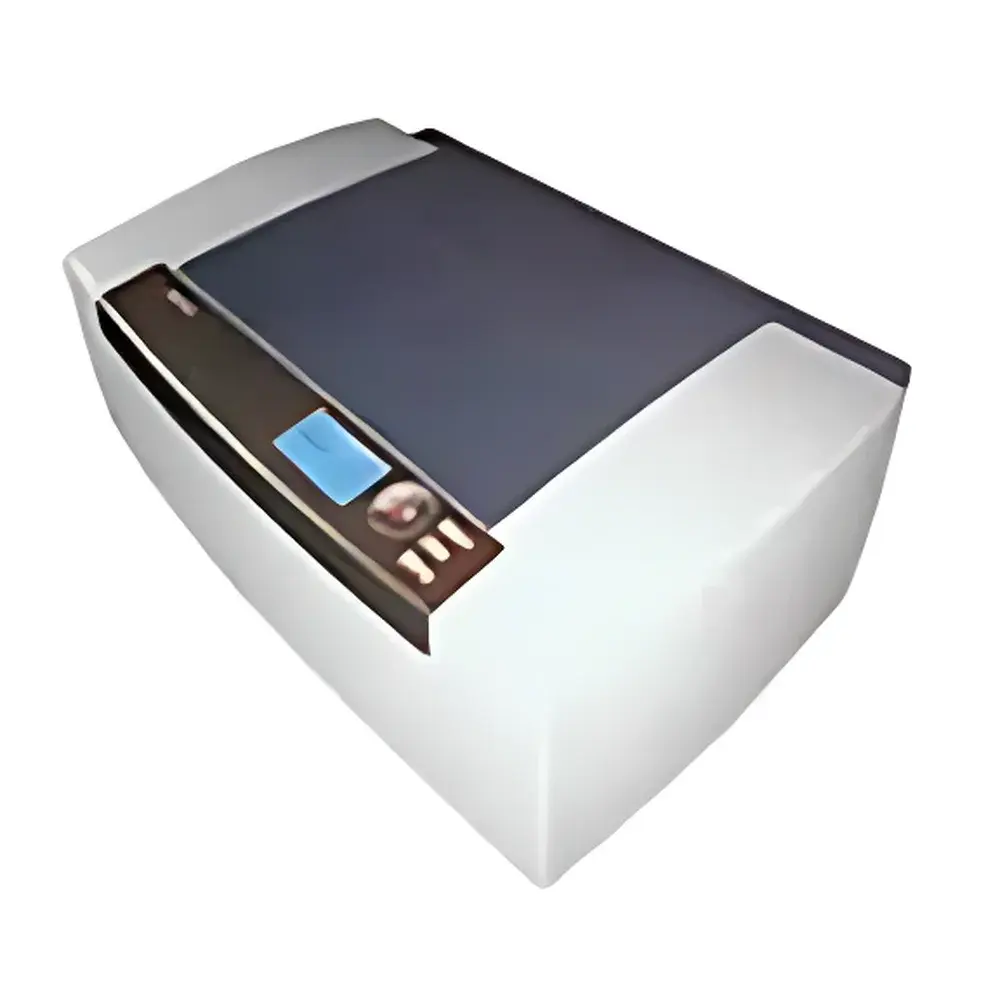
ET1200 Infrared Spectrophotometric Oil Analyzer
| Origin | Beijing, China |
|---|---|
| Manufacturer Type | Authorized Distributor |
| Origin Category | Domestic (China) |
| Model | ET1200 |
| Price Range | USD 7,000 – 14,000 |
| Instrument Type | Benchtop Laboratory Analyzer |
| Measurement Principle | Infrared Absorption Spectrophotometry (Triple-Wavelength Method at 3030 cm⁻¹, 2960 cm⁻¹, 2930 cm⁻¹) |
| Measurement Range | 0–1000 mg/L (as oil in water) |
| Detection Limit | 0.2 mg/L (in CCl₄ extract) |
| Accuracy | ±5% of reading |
| Resolution | 0.1 ppm |
| Measurement Frequency | 10 measurements per minute |
| Wavenumber Range | 3400–2400 cm⁻¹ |
| Wavenumber Accuracy | ±2 cm⁻¹ |
| Repeatability | RSD < 3% |
| Output Interface | RS-232 |
| Power Supply | 220 V ±10%, 50 Hz |
| Dimensions | 500 × 380 × 220 mm |
| Weight | 15 kg |
| Operating Temperature | 5–35 °C |
| Compliance | GB/T 16488–1996 |
Overview
The ET1200 Infrared Spectrophotometric Oil Analyzer is a benchtop laboratory instrument engineered for precise quantification of total petroleum hydrocarbons (TPH), animal and vegetable oils, and airborne油烟 (cooking oil fumes) in aqueous and gaseous matrices. It operates on the principle of infrared absorption spectrophotometry, specifically implementing the triple-wavelength differential method standardized in GB/T 16488–1996 — measuring absorbance at 3030 cm⁻¹ (aromatic C–H stretch), 2960 cm⁻¹ (asymmetric CH₃ stretch), and 2930 cm⁻¹ (asymmetric CH₂ stretch). This spectral fingerprinting enables selective detection of hydrocarbon functional groups while minimizing interferences from alcohols, ketones, or esters. The system employs a thermally stabilized optical path with a high-efficiency diffraction grating driven by a precision stepper motor, ensuring long-term wavelength reproducibility and minimal mechanical drift. Designed for regulatory compliance workflows, the ET1200 supports both standalone operation and computer-integrated data acquisition, making it suitable for routine monitoring in environmental laboratories, wastewater treatment facilities, and industrial hygiene programs.
Key Features
- Triple-wavelength IR measurement mode compliant with GB/T 16488–1996 for petroleum and biogenic oil quantification in water and air samples.
- Standalone operation capability: full measurement sequence—including zero calibration, sample scanning, and concentration calculation—executed without external PC connection.
- Integrated temperature compensation algorithm that dynamically corrects for thermal drift across the 5–35 °C operating range, maintaining measurement stability without manual recalibration.
- Automated multi-read sampling: performs up to 10 consecutive absorbance readings per sample, computes mean value and standard deviation, and displays RSD in real time.
- Zero-point memory function: retains baseline offset after initial zeroing; eliminates repeated CCl₄ exposure during sequential analysis, enhancing operator safety and workflow efficiency.
- Optical architecture featuring domestically sourced high-transmittance CaF₂ optics and a low-noise photodiode detector optimized for the 2400–3400 cm⁻¹ mid-IR region.
- RS-232 serial interface for bidirectional communication with LIMS or custom data logging software; supports ASCII-formatted output of absorbance, transmittance, and concentration values.
Sample Compatibility & Compliance
The ET1200 is validated for use with liquid-phase extracts prepared using carbon tetrachloride (CCl₄) or alternative non-toxic solvents meeting EPA Method 1664 or ISO 9377-2 equivalency criteria. It accommodates standard 10-mm pathlength quartz cuvettes and supports direct analysis of air filter extracts following NIOSH Method 5042 protocols. All performance specifications—including detection limit (0.2 mg/L in CCl₄ extract), linearity (R² > 0.999 over 0–1000 mg/L), and repeatability (RSD < 3%)—are verified per GB/T 16488–1996 Annex B and aligned with ISO/IEC 17025 technical requirements for testing laboratories. The instrument undergoes 100% final inspection per GB/T 2828.1 (AQL II) sampling plans, with critical optical and electronic subassemblies subjected to incoming inspection under ISO 9001:2015-controlled procedures.
Software & Data Management
When connected to a host PC via RS-232, the ET1200 supports comprehensive spectral acquisition, calibration curve generation (linear, quadratic, or polynomial), and batch report export in CSV format. Software modules include automated background subtraction, peak integration, and spectral library matching for qualitative organic compound screening. Audit trail functionality records user ID, timestamp, calibration parameters, and raw absorbance values — supporting GLP-compliant documentation and traceability. While not natively 21 CFR Part 11 compliant, the system can be integrated into validated environments through third-party electronic lab notebook (ELN) platforms that provide digital signature and change-control layers.
Applications
- Regulatory monitoring of petroleum hydrocarbons in surface water, groundwater, and effluent discharges per national environmental standards.
- Quantitative analysis of edible oil contamination in municipal wastewater and food processing plant outfalls.
- Occupational hygiene assessment of cooking oil fume concentrations in commercial kitchens and food service facilities.
- Research-grade FTIR-like scanning for structural characterization of organic contaminants in environmental samples.
- Quality control of solvent purity and extraction efficiency in analytical chemistry laboratories.
- Method validation studies requiring trace-level hydrocarbon detection with documented uncertainty budgets.
FAQ
What extraction solvents are compatible with the ET1200?
Carbon tetrachloride (CCl₄) is the reference solvent specified in GB/T 16488–1996; however, alternatives such as hexane, cyclohexane, or fluorinated solvents meeting ASTM D7066–18 spectral transparency requirements may be used with appropriate method validation.
Can the ET1200 measure dissolved vs. emulsified oil separately?
No — the instrument reports total extractable hydrocarbons as a single concentration value. Fractionation requires prior physical separation (e.g., centrifugation, filtration, or acidification) followed by independent analysis.
Is temperature calibration required before each analysis?
No — the built-in temperature compensation algorithm continuously adjusts for ambient thermal fluctuations; only initial zero calibration with blank solvent is needed before sample batches.
Does the ET1200 support ASTM D7066 or ISO 9377-2 methods?
It is not pre-configured for these standards, but its spectral resolution, wavenumber accuracy, and measurement range meet the core instrumental requirements outlined in both methods; method adaptation requires user-defined calibration protocols.
What maintenance is required for long-term optical stability?
Annual verification of wavenumber accuracy using polystyrene film reference and periodic cleaning of cuvette holder optics with spectroscopic-grade methanol; no lamp replacement is required within the first 5 years of operation.
Related Products







