
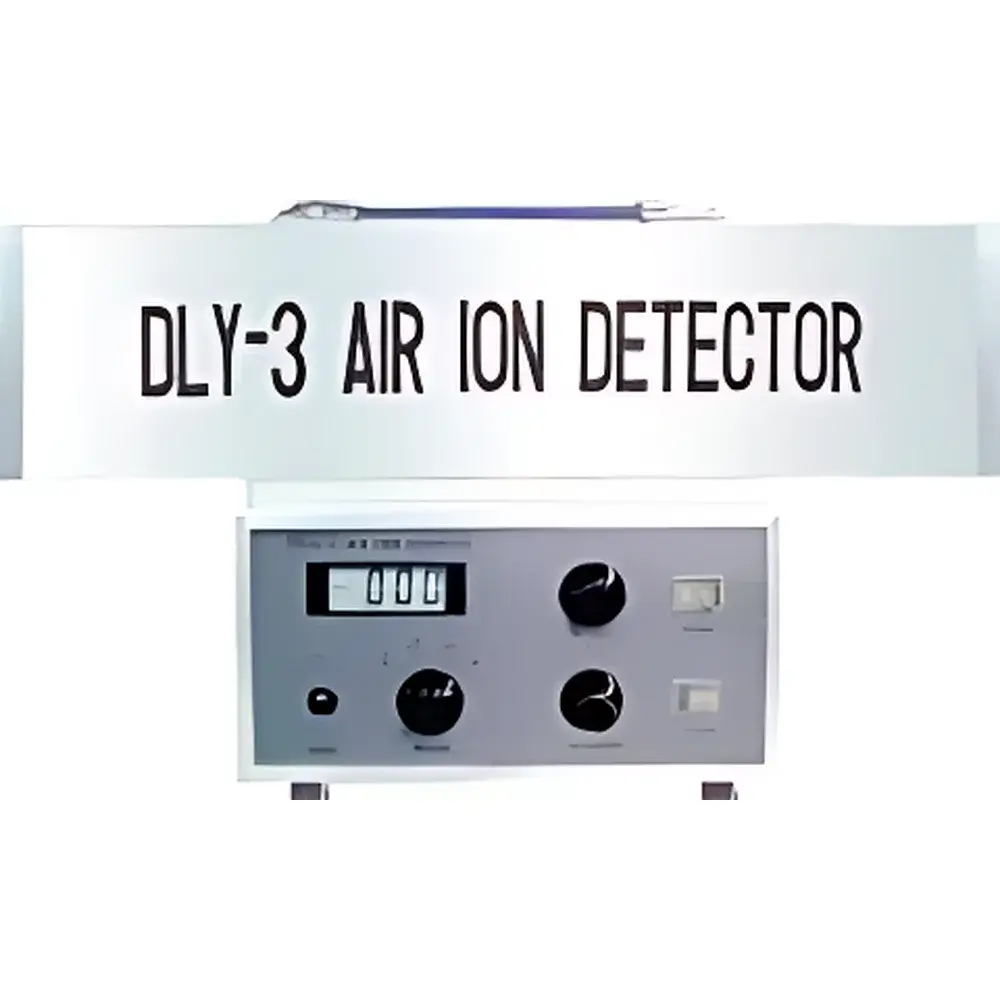
DLY-3 Air Negative Ion Concentrator Analyzer
| Origin | Beijing, China |
|---|---|
| Manufacturer Type | Authorized Distributor |
| Origin Category | Domestic (PRC) |
| Model | DLY-3 |
| Price Range | USD 2,800 – 7,000 |
| Ion Concentration Range | 10–1.999×10⁹ ions/cm³ |
| Resolution | 10 ions/cm³ |
| Ion Mobility Ranges | 1.0 / 0.4 / 0.15 cm²/V·s (3-step selectable) |
| Air Sampling Velocity | 180 cm/s |
| Response Time Constant | ~15 s |
| Accuracy | ±10% for concentration and mobility |
| Power Supply | DC 14.4 V (rechargeable sealed battery) or AC 220 V / 110 V (optional) |
| Operating Environment | −0 to +40 °C, ≤90% RH (short-term operation permitted above 90% RH) |
Overview
The DLY-3 Air Negative Ion Concentrator Analyzer is a precision electrostatic measurement instrument engineered for quantitative assessment of unipolar and bipolar air ion concentrations in ambient and controlled environments. It operates on the validated parallel-plate air ion collector principle—originally advanced by air ionization researcher Dr. Beckett and refined through Wesix design methodology. The core sensing element features a gold-plated ion collector electrode, which significantly enhances charge collection efficiency and long-term stability under variable humidity conditions. Unlike corona-based or Gerdien-tube alternatives, the DLY-3 employs a constant-flow, drift-field configuration that ensures consistent ion migration and minimizes space-charge distortion. Its real-time output displays ion density directly in units of ions per cubic centimeter (ions/cm³) via a high-contrast LCD interface—eliminating post-processing assumptions common in indirect spectroscopic or current-integration methods. Designed for field-deployable reliability, the unit integrates a hermetically sealed, maintenance-free rechargeable battery system compatible with both 220 V AC mains and 12 V automotive power sources—enabling continuous operation during mobile environmental surveys, forest canopy studies, or indoor air quality audits.
Key Features
- Gold-plated parallel-plate ion collector optimized for high charge-transfer efficiency and corrosion resistance in humid environments (up to 90% RH, short-term tolerance beyond)
- Three-step selectable ion mobility range (1.0, 0.4, and 0.15 cm²/V·s) enabling discrimination between small, medium, and large cluster ions—critical for differentiating natural atmospheric ions from those generated by commercial ionizers or HVAC systems
- Fixed air sampling velocity of 180 cm/s, maintained via calibrated axial fan and laminar flow channeling—ensuring reproducible volumetric throughput independent of ambient pressure fluctuations
- Real-time LCD display with 10 ions/cm³ resolution and full-scale range spanning 10 to 1.999 × 10⁹ ions/cm³—supporting detection of background atmospheric levels (~100–2,000 ions/cm³) as well as high-output generator outputs (>10⁷ ions/cm³)
- Robust aerospace-grade aluminum alloy enclosure—lightweight (≤1.8 kg), IP54-rated for dust and splash resistance, and thermally stabilized for operation across −0 to +40 °C
- Calibration traceable to internationally recognized reference standards; conforms to ISO 16000-21 (Indoor air — Part 21: Determination of air ions using the parallel-plate collector method)
Sample Compatibility & Compliance
The DLY-3 is designed for direct, non-destructive analysis of ambient air without filtration, pre-concentration, or chemical conditioning. It accommodates both stationary and mobile sampling configurations—including tripod mounting, handheld survey mode, and vehicle-integrated deployment. The instrument meets essential requirements for environmental monitoring under national and international frameworks: it supports data integrity protocols aligned with GLP principles, includes manual calibration logging for audit readiness, and delivers measurements compliant with ISO 16000-21 and Chinese Environmental Monitoring Standard HJ 618-2011. While not inherently 21 CFR Part 11–compliant (as it lacks electronic signature and audit trail functionality), its analog-digital hybrid architecture permits integration into validated laboratory information management systems (LIMS) via optional RS-232 or USB-to-serial adapters for regulated research applications.
Software & Data Management
The DLY-3 operates as a stand-alone analyzer with embedded firmware—no proprietary PC software is required for basic operation. However, optional data logging modules (sold separately) enable time-stamped CSV export of ion concentration, mobility setting, temperature, and relative humidity at user-defined intervals (1 s to 60 min). Raw output adheres to ASCII-delimited format compatible with MATLAB, Python (pandas), and Excel for statistical trend analysis, Pearson correlation with PM₂.₅ or VOC datasets, or spatial mapping in GIS platforms. Firmware updates are delivered via microSD card and include enhanced low-signal noise suppression algorithms for sub-100 ions/cm³ measurements—particularly valuable in cleanroom or high-altitude baseline studies.
Applications
- Environmental science: Long-term monitoring of negative ion dynamics in forests, waterfalls, coastal zones, and urban green spaces
- Indoor air quality (IAQ) assessment: Verification of ionizer performance in hospitals, schools, and office buildings per WHO IAQ guidelines
- Medical and physiological research: Correlation studies between ambient ion concentrations and autonomic nervous system response, respiratory function, or sleep architecture
- Product development: Performance validation of consumer-grade air purifiers, HVAC-integrated ion generators, and wearable ion emitters
- Educational laboratories: Hands-on instruction in atmospheric electricity, gas-phase ion chemistry, and sensor physics at undergraduate and graduate levels
FAQ
Does the DLY-3 measure both positive and negative ions simultaneously?
No—it operates in polarity-selective mode. Users must manually configure the collector bias voltage to measure either positive or negative ions in a given session.
Is factory recalibration required annually?
Yes. Annual traceable recalibration against NIST-traceable ion sources is recommended to maintain ±10% accuracy; calibration certificates include uncertainty budgets per ISO/IEC 17025.
Can the DLY-3 be used indoors near electronic equipment?
Yes, but electromagnetic shielding (included as standard) must be engaged when operating within 1 m of switching power supplies, RF transmitters, or variable-frequency drives.
What is the minimum detectable ion concentration?
The theoretical lower limit is 10 ions/cm³, though practical detection threshold under typical field conditions is ~50 ions/cm³ due to inherent atmospheric noise and airflow turbulence.
Is the gold-plated collector replaceable in the field?
Yes—the collector assembly is modular and user-serviceable using standard Torx tools; replacement kits include pre-aligned gaskets and torque-spec fasteners.
Related Products







