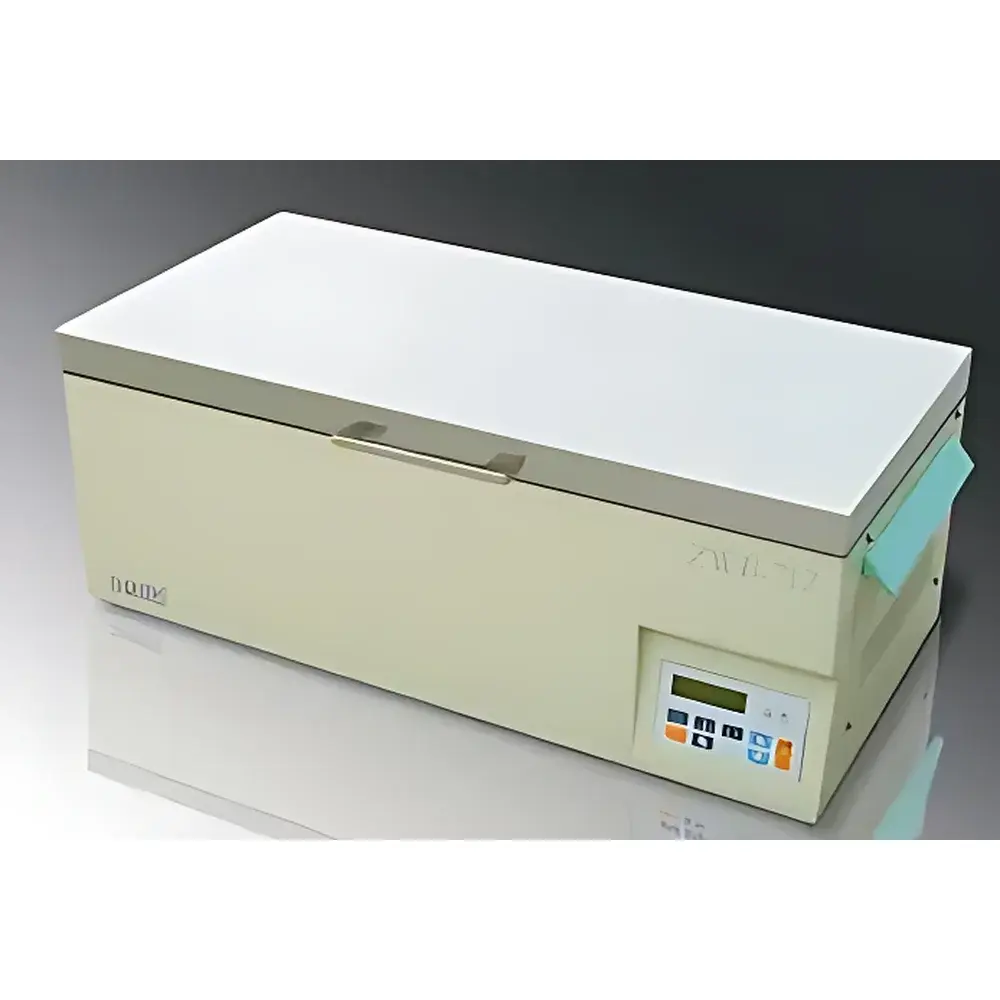
ZSXH-625 Circulating Water Bath Incubator
| Origin | Shanghai, China |
|---|---|
| Manufacturer Type | Authorized Distributor |
| Origin Category | Domestic (China) |
| Model | ZSXH-625 |
| Quotation | Available Upon Request |
| Temperature Range | Ambient to 65 °C |
| Temperature Stability | ±0.1 °C |
| Chamber Volume | 25 L |
| Interior Dimensions (W×D×H) | 400 × 320 × 200 mm |
| Exterior Dimensions (W×D×H) | 655 × 395 × 295 mm |
| Circulation System | Integrated Pump |
| Display | Backlit LCD |
| Power Consumption | 2000 W |
| Operation Mode | Continuous |
| Low-Level & Dry-Run Protection | Yes |
| Timer Range | Up to 100 h |
| Control Logic | Microprocessor-Based with Password Lock & Auto-Restart on Power Recovery |
Overview
The ZSXH-625 Circulating Water Bath Incubator is a precision-engineered thermal management system designed for stable, uniform temperature control in life science and bioengineering applications requiring consistent aqueous thermal environments. Operating on the principle of forced convection via an integrated circulation pump, it maintains homogeneous temperature distribution throughout the 25 L chamber—critical for enzymatic assays, cell culture pre-incubation, reagent equilibration, and sample conditioning prior to downstream analytical workflows. Unlike static water baths, its active circulation minimizes thermal gradients (<0.2 °C spatial deviation across the chamber under steady-state conditions), ensuring high reproducibility across replicates and extended experimental durations. The unit is rated for continuous operation within an ambient-to-65 °C range, with a certified stability of ±0.1 °C at setpoint—meeting routine calibration requirements for ISO/IEC 17025-accredited laboratories performing method validation under GLP or internal QC protocols.
Key Features
- Microprocessor-based controller with real-time environmental scanning logic and audible/visual alarm outputs for fault detection
- Backlit LCD interface displaying both setpoint and real-time bath temperature with 0.1 °C resolution
- High-response platinum resistance thermometer (PT100-class) sensor embedded in the circulation path for rapid feedback control
- Auto-restart functionality upon power restoration—resumes original setpoint, timer, and operational mode without manual intervention
- Parameter lockout via user-defined password to prevent unauthorized modification of critical settings
- Persistent memory retention for all user configurations, eliminating repetitive setup between sessions
- Dual safety interlocks: ultrasonic low-water level detection and dry-run prevention circuitry compliant with IEC 61000-4-11 immunity standards
- 100-hour programmable timer supporting unattended overnight or multi-shift experiments
- Ergonomic, corrosion-resistant stainless steel interior (304 grade) and powder-coated steel exterior with streamlined industrial design
Sample Compatibility & Compliance
The ZSXH-625 accommodates standard laboratory vessels including glass beakers (up to 2 L), polypropylene centrifuge tubes, PCR tube racks, and custom immersion fixtures—enabled by its open-top bath architecture and adjustable support grid. Its temperature uniformity profile has been verified per ASTM E1112 (Standard Practice for Calibration of Liquid-Bath Temperature Controllers) using NIST-traceable probe arrays. While not classified as a medical device, the unit supports workflows aligned with USP Analytical Instrument Qualification and satisfies foundational hardware requirements for Annex 11-compliant environments when integrated into validated SOPs. It is CE-marked for EMC and LVD compliance (2014/30/EU and 2014/35/EU) and conforms to RoHS 2011/65/EU material restrictions.
Software & Data Management
The ZSXH-625 operates as a standalone instrument with no proprietary software dependency; however, its analog voltage output (0–5 V DC proportional to measured temperature) enables integration with third-party data acquisition systems (e.g., LabVIEW, MATLAB, or SCADA platforms) for time-stamped logging and trend analysis. Optional RS-485 Modbus RTU interface (available upon request) supports remote parameter readout and basic control via PLC or centralized lab management systems. All alarm events—including low water, overtemperature, and power interruption—are latched and displayed with timestamped status codes, fulfilling audit trail prerequisites for FDA 21 CFR Part 11–governed environments when paired with compliant electronic record systems.
Applications
- Pre-equilibration of restriction enzymes, ligases, and polymerases prior to molecular cloning workflows
- Controlled denaturation and renaturation studies in protein biochemistry
- Thermal activation of heat-shock proteins in bacterial transformation protocols
- Stabilization of immunoassay reagents and antibody conjugates during assay development
- Calibration verification of thermocouples and infrared thermometers against traceable references
- Supporting ASTM D5296 (gel permeation chromatography) solvent bath requirements
- Environmental simulation for accelerated stability testing of biologics under ICH Q1A(R3) guidelines
FAQ
What is the maximum recommended operating temperature for continuous use?
The ZSXH-625 is rated for sustained operation up to 65 °C. Exceeding this limit may compromise seal integrity and accelerate evaporation-induced concentration drift in aqueous buffers.
Can the unit maintain temperature uniformity with partial fill volume?
Yes—its circulation pump and optimized baffle geometry ensure ≤0.3 °C deviation across the working zone even at 30% fill level (7.5 L), provided the load does not obstruct flow paths.
Is external calibration supported?
The PT100 sensor is field-calibratable using a certified reference thermometer and standard two-point adjustment procedure documented in the technical manual.
Does the device meet GMP documentation requirements?
It provides essential hardware-level traceability (serial-numbered calibration certificate, factory test report); full GMP compliance requires integration into site-specific IQ/OQ protocols and periodic performance verification per your quality system.
What maintenance intervals are recommended?
Biannual inspection of pump impeller clearance, annual descaling with citric acid solution (pH 3–4), and quarterly verification of alarm thresholds using independent metrology equipment.