
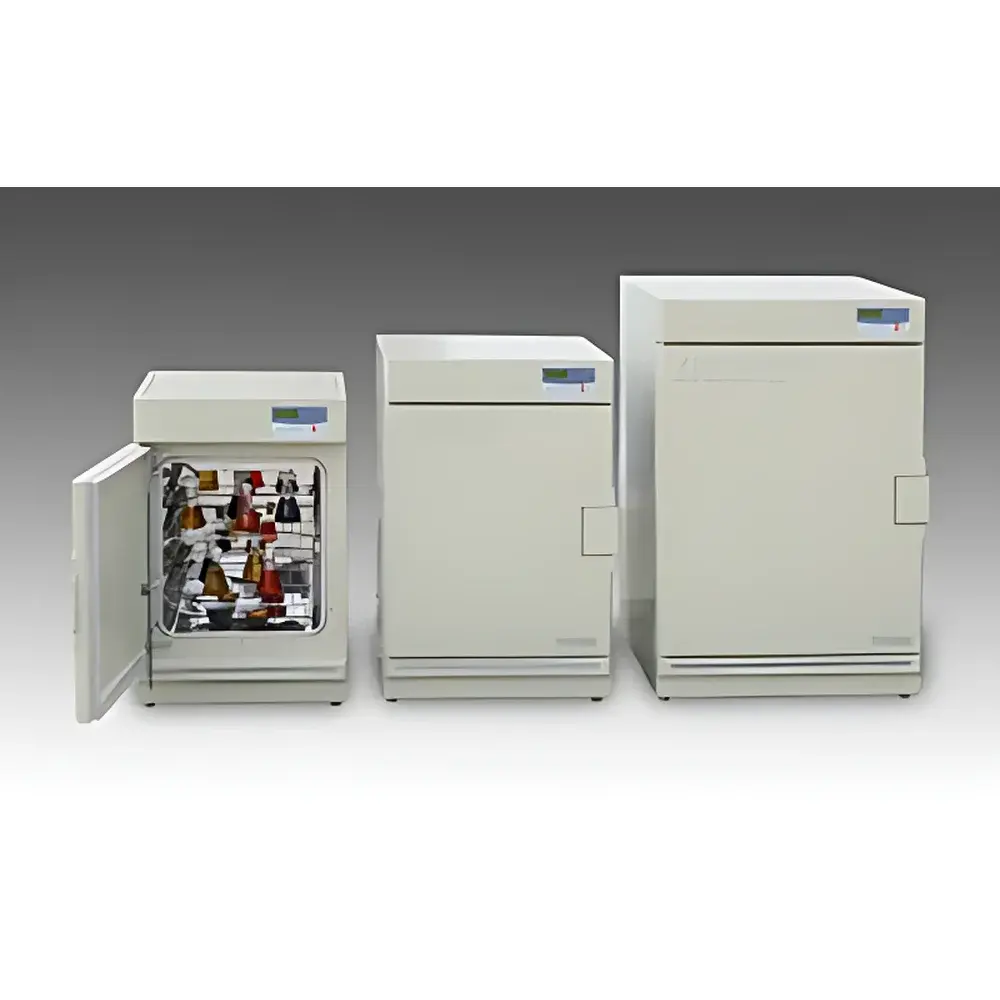
ZWY-113H6F High-Throughput Parallel Synthesis Shaker by ZHONGXIAN
| Key Features | 6 independent temperature zones |
|---|---|
| Temperature range | ambient to 200 °C |
| Temperature accuracy | ±0.1 °C |
| Oscillation speed | 50–300 rpm |
| Programmable timer | 0–500 h |
| Max. power consumption | 2560 W |
| Power supply | 220 V / 50 Hz |
| Dimensions (W×D×H) | 530 × 525 × 330 mm |
| Reaction block size | 142 × 152 × 6 mm |
| Sample capacity | Φ28 mm × 6 positions or Φ17/Φ15 mm × 12 positions |
Overview
The ZWY-113H6F High-Throughput Parallel Synthesis Shaker is an engineered platform for controlled, multi-condition chemical synthesis in life science and fine chemical research laboratories. It operates on the principle of simultaneous, independently regulated thermal and mechanical agitation—combining precise conductive heating, active liquid-circulated temperature control, and orbital shaking to enable reproducible reaction kinetics across multiple parallel vessels. Unlike conventional single-zone shakers, this instrument implements a modular architecture with six physically isolated temperature zones, each equipped with dedicated Peltier-based or resistive heating elements, individual PT100-sensed feedback loops, and independent fluidic pathways for uniform thermal distribution. Designed for combinatorial chemistry, catalyst screening, and reaction optimization workflows, it supports both open-vessel (e.g., reflux-capable configurations) and sealed-tube formats under defined thermal and mixing conditions—making it suitable for applications ranging from early-stage route scouting to stability assessment under accelerated conditions.
Key Features
- Six fully independent temperature zones with real-time PID-controlled regulation (ambient to 200 °C, ±0.1 °C accuracy)
- Orbital shaking at adjustable speeds from 50 to 300 rpm, ensuring homogeneous suspension and interfacial mass transfer across all reaction vessels
- Modular reaction block system accommodating interchangeable plates: Φ28 mm × 6, Φ17 mm × 12, or Φ15 mm × 12 configurations—optimized for vial, tube, or microplate compatibility
- Integrated single-channel water circulation loop enabling stable thermal equilibration and optional external chiller integration (cooling capability down to 80 °C)
- Programmable 9-segment, 18-step temperature ramping profile (optional accessory), supporting complex thermal protocols such as gradient heating or stepwise annealing
- Onboard digital timer with 0–500 h range and automatic shutdown, facilitating unattended overnight or multi-day experiments
- RS232 serial interface compliant with standard laboratory communication protocols for remote monitoring, data logging, and synchronized control via third-party software
- “Plug-and-play” modular design: thermal blocks, controllers, and shaker base are mechanically and electrically decoupled for rapid reconfiguration and serviceability
Sample Compatibility & Compliance
The ZWY-113H6F accommodates a broad range of vessel types—including borosilicate glass tubes, stainless steel reactors, and polypropylene vials—across standardized diameters and heights. Its reaction blocks conform to common labware footprints, allowing direct use with commercially available screw-cap or septum-sealed containers. The instrument meets CE marking requirements for electromagnetic compatibility (EMC Directive 2014/30/EU) and low-voltage safety (LVD Directive 2014/35/EU). While not certified for hazardous area operation, its enclosed heating elements and overtemperature cutoffs align with IEC 61010-1:2010 safety standards for laboratory equipment. For GLP/GMP-aligned environments, audit-ready operation is supported through optional timestamped thermal printouts and RS232 data export compatible with validated LIMS or ELN systems.
Software & Data Management
The device operates autonomously via its front-panel interface but integrates natively with Windows-based host software via RS232. This software provides live temperature and rpm visualization, event-triggered data capture, and export in CSV format for downstream analysis in MATLAB, Python (Pandas), or statistical platforms such as JMP or Minitab. All logged parameters—including zone-specific setpoints, actual temperatures, oscillation status, and elapsed time—are time-stamped with millisecond resolution. When paired with the optional embedded thermal printer, users may configure periodic snapshot printing (e.g., every 15 minutes) for hard-copy traceability—a feature frequently referenced during internal QA audits or method validation per USP and ISO/IEC 17025:2017 requirements.
Applications
- Rapid screening of catalytic systems (e.g., hydrogenation, cross-coupling, asymmetric epoxidation) under varied thermal and mixing conditions
- Optimization of synthetic routes—including solvent selection, stoichiometry, and residence time—using Design of Experiments (DoE) frameworks
- Forced degradation and accelerated stability studies per ICH Q1A(R2) guidelines
- Preparation of homogeneous solid dispersions and co-crystal slurries requiring precise thermal-mechanical input
- Dissolution profiling of poorly soluble APIs under controlled agitation and temperature gradients
- Library synthesis in medicinal chemistry, where parallel execution of 6 distinct reaction conditions reduces cycle time without compromising analytical fidelity
FAQ
What is the maximum operating temperature for each zone?
Each of the six zones can be independently set from ambient temperature up to 200 °C, with thermal stability maintained within ±0.1 °C under steady-state conditions.
Can different vessel types be used simultaneously across zones?
Yes—the modular block design permits installation of mixed-diameter inserts (e.g., Φ28 mm in Zone 1–3 and Φ15 mm in Zone 4–6), enabling heterogeneous reaction setups within a single run.
Is the instrument compatible with external chillers for sub-ambient operation?
The system supports external chiller integration via its single water circulation channel; however, minimum operational temperature is limited to 80 °C due to heater-cooler architecture constraints.
Does the RS232 interface support two-way communication?
Yes—commands for setpoint adjustment, start/stop control, and real-time parameter polling are supported, and firmware updates may be delivered via serial protocol.
How is calibration traceability maintained?
Each unit ships with a factory calibration certificate referencing NIST-traceable PT100 sensors; user-level verification is performed using calibrated reference thermometers inserted into designated test ports adjacent to each zone.





