
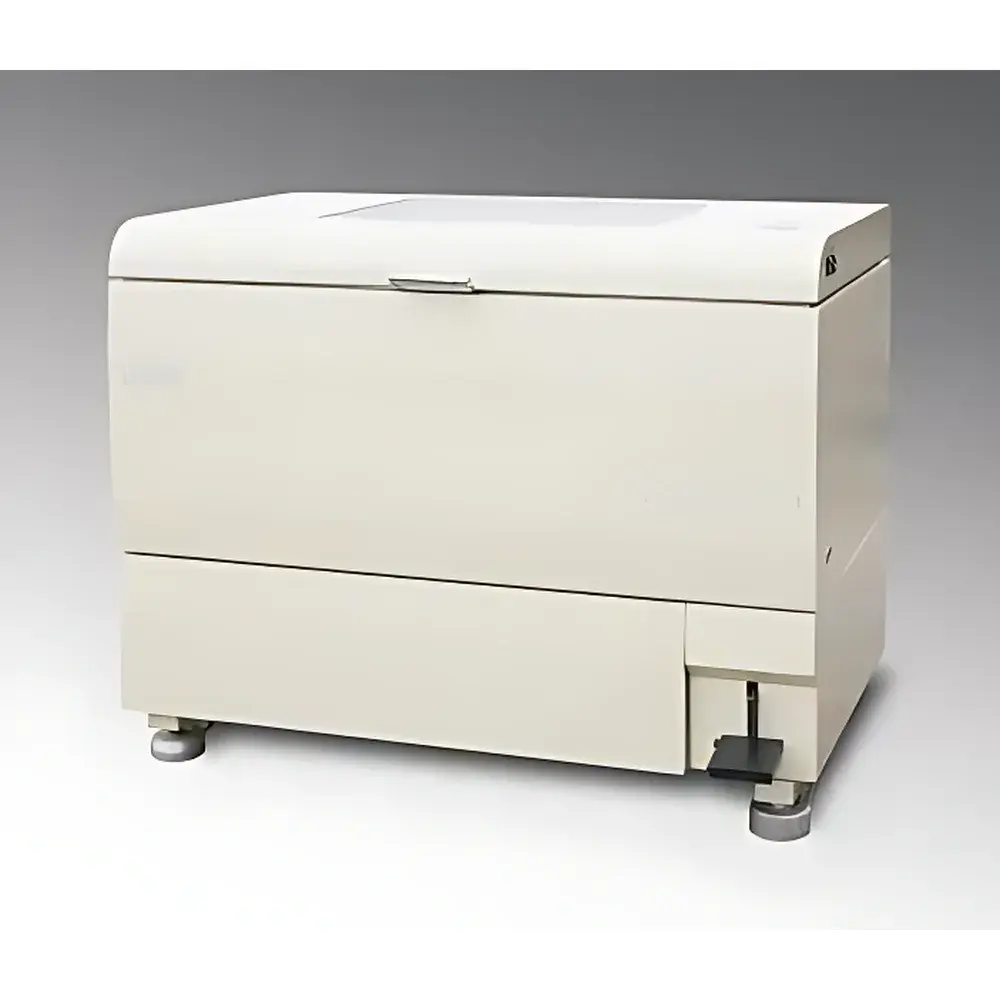
Zhongwei ZWY-A211D Horizontal Programmable Orbital Shaker
| Origin | Shanghai, China |
|---|---|
| Manufacturer Type | Authorized Distributor |
| Origin Category | Domestic (China) |
| Model | ZWY-A211D |
| Pricing | Available Upon Request |
| Control Algorithm | PID with Environmental Scan Microprocessor |
| Display | Backlit LCD |
| Air Circulation | Forced Convection |
| Oscillation Mode | Orbital (Circular) |
| Drive System | Multi-Dimensional Balanced Drive |
| Door Operation | Foot-Operated Hinged Access |
| Ambient Temp. Range | 5–25 °C |
| Temp. Control Range | 4–60 °C |
| Temp. Resolution | 0.1 °C |
| Temp. Stability | ≤ ±0.1 °C at 37 °C |
| Temp. Uniformity | ≤ ±1.0 °C at 37 °C |
| Speed Range | 30–300 rpm |
| Speed Accuracy | ±1 rpm |
| Orbit Diameter | Φ26 mm |
| Timer Range | 0–500 h |
| Programming Capacity | 6 segments / 12 steps |
| Printing | Integrated thermal micro-printer (embedded, real-time data output) |
| Cooling System | Air-cooled, R134a refrigerant, frost-free operation with auto-load modulation |
| Shelf Dimensions | 940 × 584 mm |
| Number of Shelves | 1 |
| Chamber Volume | 286 L |
| Interior Dimensions | 1005 × 655 × 435 mm |
| External Dimensions | 1260 × 830 × 1000 mm |
| Net Weight | 263 kg |
| Gross Weight | 313 kg |
| Max. Load Capacity | 100 mL × 82 |
| Power Consumption | 1340 W |
| Electrical Supply | AC 220 V, 50/60 Hz |
| Safety Certifications | Compliant with IEC 61010-1 (Laboratory Equipment), EN 61326-1 (EMC), and GB 4793.1 (Chinese Lab Safety Standard) |
Overview
The Zhongwei ZWY-A211D Horizontal Programmable Orbital Shaker is an engineered platform for precision-controlled, temperature-regulated orbital agitation in life science laboratories. Designed around a robust forced-convection thermal management system and a multi-dimensional balanced drive architecture, it delivers high reproducibility in microbial culture, protein expression, enzymatic assays, and cell-based studies where consistent oscillation kinetics and thermal homogeneity are critical. Its horizontal orbital motion—characterized by a 26 mm diameter circular trajectory—ensures uniform suspension of suspended cells or particulates without shear-induced damage, while the PID-controlled environmental scan microprocessor continuously monitors and adjusts heating, cooling, and motor output in real time to maintain setpoint fidelity within ±0.1 °C at 37 °C. Unlike vertical shakers, the horizontal orientation minimizes liquid splashing and improves volumetric scalability across large-capacity vessels (up to 5 L flasks), making it suitable for high-yield bioprocessing workflows under non-sterile or controlled-humidity conditions.
Key Features
- Programmable orbital control with 6-segment / 12-step capability, supporting complex temporal profiles including temperature ramps, repeated cycles, and stepwise speed transitions—each segment configurable up to 100 hours.
- Integrated thermal micro-printer for real-time logging of temperature, speed, elapsed time, and alarm events—data output compliant with GLP documentation requirements.
- Dual-safety thermal architecture: independent adjustable overtemperature protector + fixed-limit overheat cutoff, both certified to IEC 61010-1 Class II insulation standards.
- Foot-actuated door mechanism eliminates hand contact contamination risk during incubation; reinforced tempered glass viewport enables continuous visual monitoring without thermal disturbance.
- Self-diagnostic water-level sensing system with audible/visual alert and optional auto-refill interface—critical for extended-duration humidified runs.
- Brushless AC induction motor with constant-torque, wide-range speed regulation (30–300 rpm, ±1 rpm accuracy); no carbon brushes, zero maintenance over >20,000 operational hours.
- Power-fail recovery logic preserves all active parameters and resumes operation from the exact point of interruption upon grid restoration—essential for unattended overnight experiments.
- Electro-polished stainless-steel chamber interior and tray; static-dissipative powder-coated steel chassis; corrosion-resistant spring clamps and universal flask holders compatible with ISO-standard vessel geometries.
Sample Compatibility & Compliance
The ZWY-A211D accommodates standard laboratory glassware and bioreactor vessels ranging from 100 mL test tubes to 5 L Fernbach flasks, with load distribution optimized for orbital symmetry across its 940 × 584 mm platform. Its forced-air convection system ensures ≤ ±1.0 °C temperature uniformity throughout the 286 L chamber volume at 37 °C, meeting ASTM E1249-22 criteria for thermal consistency in biological incubators. All electrical subsystems conform to IEC 61010-1 (Safety Requirements for Electrical Equipment for Measurement, Control, and Laboratory Use) and EN 61326-1 (EMC for Laboratory Instruments). While not FDA 21 CFR Part 11–validated out-of-the-box, the embedded RS-232 interface supports external audit-trail-capable SCADA integration for GMP-aligned environments when paired with compliant data acquisition software.
Software & Data Management
No proprietary PC software is required for basic operation—the front-panel LCD provides full parameter access, real-time monitoring, and on-device programming. For advanced traceability, the RS-232 serial port enables connection to validated third-party laboratory information management systems (LIMS) or electronic lab notebooks (ELN). The embedded thermal printer outputs timestamped records containing setpoints, actual readings, deviation alerts, and system status flags—formatted for archival per ISO/IEC 17025 clause 7.5.1 (Control of Records). Password-protected parameter encryption and persistent memory retention (≥10 years without power) ensure integrity of method-critical configurations across instrument reboots or service interventions.
Applications
This shaker serves as a core platform in academic research labs studying bacterial growth kinetics (e.g., E. coli OD600 profiling), yeast fermentation optimization, mammalian cell suspension culture, phage propagation, and immunoassay plate agitation. In industrial QC settings, it supports USP & EP-compliant dissolution testing prep, media sterility validation, and stability-indicating assay development. Its programmable temperature ramping function is routinely applied in cold-shock protein expression protocols, while the foot-operated access and low-noise operation make it suitable for shared core facilities requiring minimal user training and maximal uptime reliability.
FAQ
Does the ZWY-A211D support CO₂ control or humidity regulation?
No—this model (A211D) is the base variant in the ZWY series and does not include CO₂ injection or active humidification modules. Those capabilities are available in the ZWY-C (humidity) and ZWY-D (CO₂ + humidity) configurations.
Is the printer output compatible with LIMS import formats?
The thermal printer generates human-readable ASCII text logs. For structured digital ingestion, use the RS-232 interface with custom or vendor-supported drivers that map serial telemetry to CSV or XML schema.
What is the maximum allowable ambient temperature for continuous operation?
The unit must be installed in environments maintained between 5 °C and 25 °C ambient. Operation outside this range may compromise refrigerant efficiency and long-term PID calibration stability.
Can multiple ZWY-A211D units be synchronized for parallel protocol execution?
No native master-slave synchronization exists. However, identical programs can be loaded individually via front-panel entry or RS-232 batch scripting using external control software.
Is the stainless-steel interior electropolished to ISO 15528 standards?
Yes—the chamber and tray surfaces meet ISO 15528:2018 specifications for electrochemical passivation and surface roughness (Ra ≤ 0.8 µm), ensuring resistance to biofilm adhesion and compatibility with alkaline cleaning agents used in cGMP cleanrooms.



