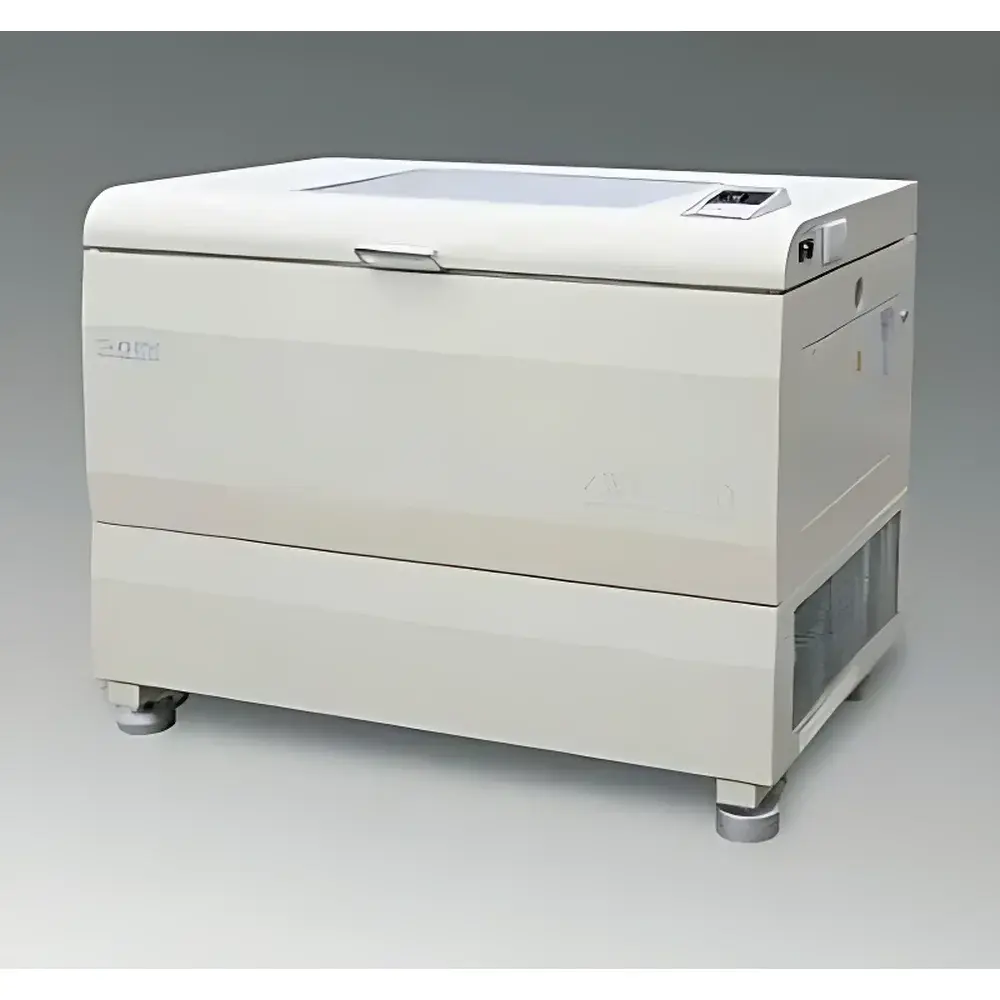
Zhicheng ZWYR-211C Horizontal Constant-Temperature Orbital Shaker with Touchscreen Color LCD
| Origin | Shanghai, China |
|---|---|
| Manufacturer Type | Authorized Distributor |
| Origin Category | Domestic (China) |
| Model | ZWYR-211C |
| Pricing | Upon Request |
| Temperature Range | 4–60 °C |
| Temp. Resolution | 0.1 °C |
| Temp. Stability | ≤±0.1 °C at 37 °C |
| Temp. Uniformity | ≤±1 °C at 37 °C |
| Orbit Speed | 30–300 rpm |
| Speed Accuracy | ±1 rpm |
| Orbit Diameter | Φ26 mm |
| Timer Range | 0–500 h |
| Chamber Volume | 256 L |
| Shelf Dimensions | 920 × 500 mm |
| Internal Dimensions | 975 × 565 × 465 mm |
| External Dimensions | 1200 × 740 × 1000 mm |
| Net Weight | 183 kg |
| Power Supply | AC 220 V, 50/60 Hz |
| Power Consumption | 1120 W |
| Refrigeration | Air-cooled, R134a, frost-free, auto-controlled cooling capacity |
| Programming | 6-segment / 12-step programmable ramp-and-hold protocol (each segment: 0–999.9 min |
| Safety Systems | Dual independent overtemperature cut-offs, door-open stop, leakage current protection, motor overload protection, compressor overheat protection, low-water-level auto-shutdown |
| Data Interface | RS-232 |
| Output | Embedded micro-printer |
| Construction | Electrophoretic coated steel exterior, mirror-polished stainless steel interior chamber, electropolished stainless steel tray and clamps |
| Drive | Brushless AC induction motor, constant torque across speed range |
| Acceleration Control | Soft-start circuitry for controlled ramp-up |
| Compliance | Designed to support GLP/GMP workflows |
Overview
The Zhicheng ZWYR-211C is a horizontally configured, refrigerated orbital shaker engineered for precision-controlled incubation of biological samples under tightly regulated thermal and mechanical conditions. It operates on the principle of continuous orbital motion—generating uniform, low-shear agitation ideal for suspension cultures, microbial growth, enzymatic assays, and hybridization protocols. Its integrated P.I.D. temperature control system, coupled with forced-air convection and an R134a-based refrigeration module, enables stable operation from 4 °C to 60 °C—covering both ambient-sensitive cold-adapted cultures and high-yield mesophilic fermentation. The unit’s large 256 L chamber accommodates volumetrically diverse configurations (up to 6 × 5000 mL flasks), while its Φ26 mm orbit diameter ensures optimal oxygen transfer without compromising cell viability. Designed for uninterrupted operation in regulated laboratory environments, the ZWYR-211C meets foundational requirements for reproducibility in life science research, QC microbiology, and bioprocess development.
Key Features
- Full-color capacitive touchscreen HMI with intuitive graphical interface, supporting multilingual (English-enabled) navigation and real-time animated status visualization
- 6-segment, 12-step programmable temperature and speed profile capability—enabling complex ramp-and-hold, stepwise gradient, and cyclic incubation protocols
- Dual independent overtemperature safeguards: adjustable mechanical overtemp limiter + digital PID-derived thermal cutoff, each with independent circuitry
- Intelligent water-level detection system with automatic power disengagement upon low coolant reservoir condition
- Brushless AC induction drive delivering consistent torque across full 30–300 rpm range; zero maintenance, no carbon dust contamination, and silent operation
- Soft-acceleration circuitry ensuring gradual ramp-up to set speed—minimizing shear-induced stress on sensitive cell suspensions or fragile agarose gels
- Electropolished stainless steel interior and tray; corrosion-resistant electrostatic powder-coated chassis; reinforced tempered glass viewing window
- Embedded micro-printer with RS-232 serial interface for timestamped, non-volatile output of runtime parameters, alarms, and setpoint logs
Sample Compatibility & Compliance
The ZWYR-211C supports standard Erlenmeyer flasks (250–5000 mL), culture tubes, multi-well plates (with optional adapter trays), and custom bioreactor vessels mounted on its 920 × 500 mm stainless steel platform. Its uniform airflow distribution and minimal thermal stratification (≤±1 °C at 37 °C) ensure batch consistency across all vessel positions. From a regulatory standpoint, the device incorporates design elements aligned with Good Laboratory Practice (GLP) and Good Manufacturing Practice (GMP) frameworks: parameter encryption prevents unauthorized configuration changes; event-driven alarm logging provides traceable audit trails; and time-stamped printouts satisfy basic documentation requirements per ISO/IEC 17025 and USP . While not certified as 21 CFR Part 11 compliant out-of-the-box, its architecture—including password-protected settings, immutable log records, and hardware-enforced write-protection on printed outputs—facilitates validation under internal SOPs.
Software & Data Management
The embedded firmware implements deterministic real-time control logic with millisecond-level sampling of temperature, speed, and safety interlocks. All operational parameters—including program sequences, calibration offsets, and alarm thresholds—are stored in non-volatile memory with battery-backed retention. The RS-232 port supports ASCII-based command-response communication for integration into centralized lab automation systems (e.g., LIMS or SCADA). The built-in micro-printer generates hard-copy records containing start/stop timestamps, deviation alerts (e.g., “Temp. Deviation >0.5°C @ 14:22:08”), and final cycle completion confirmation—critical for method verification and equipment qualification (IQ/OQ). Optional PC software (available separately) enables remote monitoring, historical trend analysis, and export to CSV for statistical process control (SPC) applications.
Applications
This shaker serves critical roles across academic, clinical, and industrial life science laboratories. In molecular biology, it maintains optimal conditions for plasmid amplification, phage propagation, and protein expression in liquid media. In pharmaceutical QC, it supports sterility testing per USP , antimicrobial efficacy assays (ASTM E2149), and stability-indicating dissolution kinetics. Bioprocess engineers utilize its programmable thermal ramps to simulate fed-batch temperature shifts during recombinant protein production. Environmental labs deploy it for BOD incubation (APHA 5210B) and microbial enumeration (ISO 6222), while food safety units rely on its precise 4 °C–30 °C range for pathogen enrichment (e.g., Salmonella pre-enrichment per ISO 6579-1). Its wide speed range and robust construction also accommodate high-density yeast propagation and mycelial culture in biotechnology R&D.
FAQ
Does the ZWYR-211C support validation documentation packages (e.g., IQ/OQ)?
Yes—Zhicheng provides configurable validation templates, factory calibration certificates (NIST-traceable reference sensors), and detailed hardware/software architecture diagrams to support user-led qualification.
Can the unit operate unattended overnight or over weekends?
Yes—the device features automatic restart after power interruption, programmable end-cycle actions (e.g., cooldown + shutdown), and redundant thermal safety circuits enabling safe extended operation.
Is the touchscreen interface available in English by default?
The HMI ships with Chinese as the primary language, but English localization is enabled via firmware update and supported in all menu layers, alarm messages, and printed reports.
What is the maximum flask loading weight per shelf?
The load rating is 25 kg uniformly distributed; this accommodates up to 6 × 5000 mL glass flasks with medium fill levels and standard clamping hardware.
How frequently does the unit require preventive maintenance?
No scheduled maintenance is required for the brushless motor or sealed refrigeration system; annual verification of temperature/speed accuracy using external metrology-grade probes is recommended for GLP compliance.
Related Products