
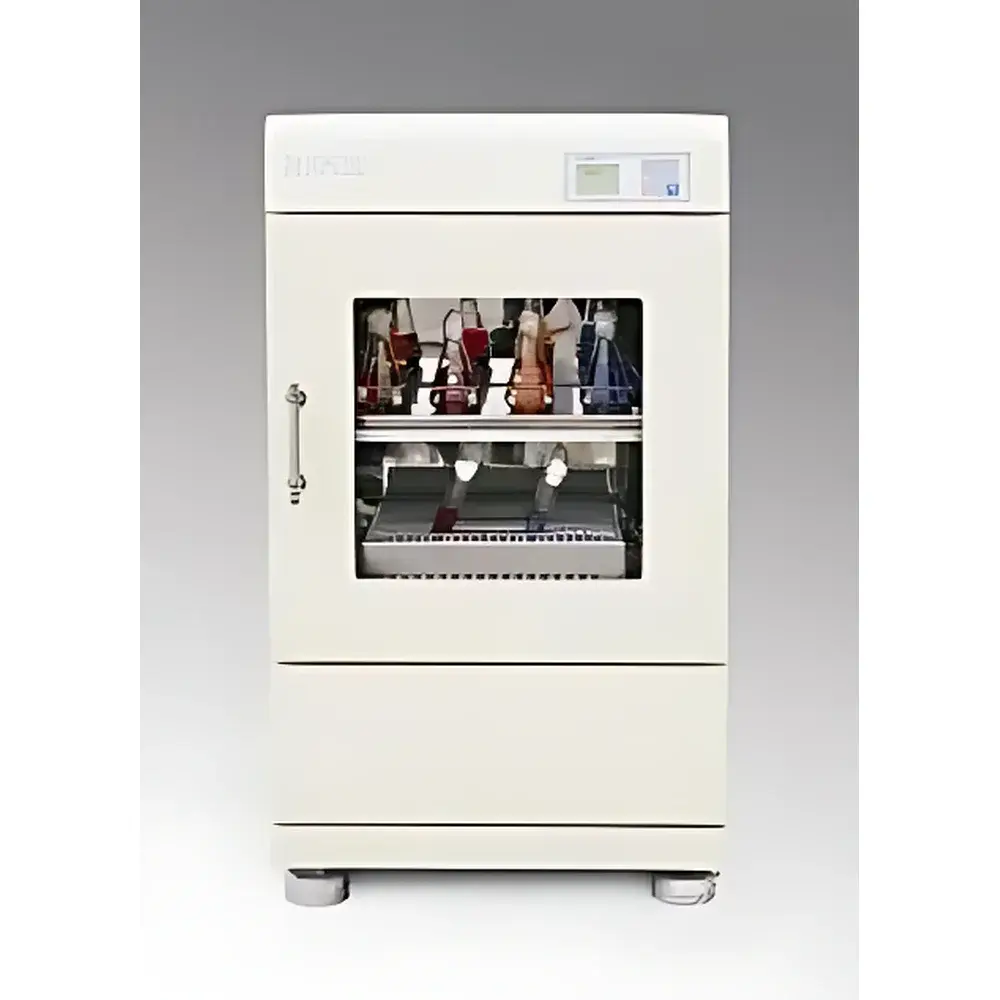
ZWY-1102C Dual-Layer Compact Temperature-Controlled Orbital Shaker
| Origin | Shanghai, China |
|---|---|
| Manufacturer Type | Authorized Distributor |
| Origin Category | Domestic (China) |
| Model | ZWY-1102C |
| Pricing | Available Upon Request |
| Control Method | PID Microprocessor-Based Environmental Scanning Controller |
| Display | Backlit LCD Screen |
| Air Circulation | Forced Convection |
| Oscillation Mode | Orbital (Circular) |
| Drive Mechanism | Multi-Dimensional Drive System |
| Door Configuration | Single Front Access Door |
| Ambient Temperature Range | 5–25 °C |
| Temperature Control Range | Room Temp +5 to 60 °C |
| Temperature Resolution | ±0.1 °C |
| Temperature Uniformity | ≤ ±1.0 °C (at 37 °C) |
| Temperature Stability | ≤ ±0.1 °C (at 37 °C) |
| Speed Range | 30–300 rpm |
| Speed Accuracy | ±1 rpm |
| Orbit Diameter | Φ26 mm |
| Timer Range | 0–500 h |
| Shelf Dimensions | 496 × 350 mm |
| Number of Shelves | 2 |
| Chamber Volume | 173 L |
| Interior Dimensions | 615 × 440 × 640 mm |
| External Dimensions | 720 × 630 × 1275 mm |
| Net Weight | 150 kg |
| Gross Weight | 175 kg |
| Max Capacity | 50 mL × 56 |
| Power Consumption | 600 W |
| Electrical Supply | AC 220 V, 50/60 Hz |
Overview
The ZWY-1102C Dual-Layer Compact Temperature-Controlled Orbital Shaker is an engineered solution for laboratories requiring precise, reproducible incubation and agitation under tightly regulated thermal conditions. Designed around orbital (circular) motion dynamics and forced convection airflow, this shaker delivers uniform temperature distribution and stable rotational kinetics across two independently accessible shelves—ideal for space-constrained environments where throughput and footprint efficiency are critical. Its microprocessor-based PID control architecture continuously monitors ambient fluctuations and dynamically adjusts heating output to maintain setpoint fidelity within ±0.1 °C at 37 °C, meeting foundational requirements for cell culture, microbial growth, enzymatic assays, and hybridization protocols. The unit operates within a functional ambient range of 5–25 °C and supports temperature setpoints from room temperature +5 °C up to 60 °C—making it suitable for mesophilic and thermotolerant applications without refrigeration.
Key Features
- Dual-layer vertical architecture with single front-access door—optimized for laboratory floor space efficiency while supporting up to 173 L total chamber volume.
- Orbital shaking mechanism with Φ26 mm orbit diameter and speed range of 30–300 rpm (±1 rpm accuracy), ensuring consistent mixing across flasks, tubes, and microplates.
- Forced convection system with strategically positioned air ducts and fan-assisted circulation for ≤±1.0 °C temperature uniformity (measured at 37 °C).
- Backlit LCD display showing real-time values for temperature, speed, timer, and system status—integrated with environmental scanning PID controller for adaptive thermal regulation.
- Programmable timer with 0–500 h range; auto-stop function with audible and visual alarm upon completion or fault detection.
- AC induction motor with brushless design, delivering constant torque across the full speed range—zero maintenance, extended service life, and low electromagnetic interference.
- Comprehensive safety suite: overtemperature alarm (with independent sensor), motor overheat protection, power-fail recovery, and parameter lockout to prevent accidental modification during operation.
- Electrostatically coated steel chassis, reinforced tempered glass viewing window, and ergonomic handle design aligned with ISO 13485-informed industrial ergonomics.
Sample Compatibility & Compliance
The ZWY-1102C accommodates standard laboratory vessels—including Erlenmeyer flasks (50–750 mL), test tubes, Petri dishes, and deep-well microplates—via its dual 496 × 350 mm stainless-steel shelves. Load configurations support up to 56 × 50 mL flasks or 18 × 750 mL flasks per shelf, enabling scalable workflow integration from benchtop screening to pilot-scale bioprocessing. While not certified for GMP manufacturing environments out-of-the-box, the instrument’s PID-controlled thermal stability, traceable parameter logging (via optional RS485/USB interface), and audit-ready operational logs align with GLP documentation expectations. It complies with IEC 61010-1:2010 for laboratory electrical equipment safety and meets EMC standards per EN 61326-1:2013. For regulated workflows, users may implement supplementary validation protocols per ASTM E2500 or USP to qualify performance for specific SOPs.
Software & Data Management
The ZWY-1102C operates via embedded firmware with no external PC dependency; however, optional communication modules (RS485 or USB-to-serial adapter) enable integration with laboratory information management systems (LIMS) or custom SCADA platforms. Logged parameters—including temperature setpoint, actual chamber temperature, speed, elapsed time, and alarm events—are timestamped and retainable for ≥30 days in non-volatile memory. When connected, data export supports CSV format for post-acquisition analysis in MATLAB, Python (Pandas), or Excel. Though native software is not FDA 21 CFR Part 11-compliant, the device supports manual electronic record generation compatible with ALCOA+ principles when paired with validated third-party data acquisition tools and procedural controls (e.g., user access tiers, change logs, electronic signatures).
Applications
This shaker serves core workflows in academic research, clinical diagnostics, and biopharmaceutical development. Typical use cases include aerobic bacterial culture (e.g., E. coli, Bacillus subtilis), yeast fermentation kinetics, mammalian suspension cell passaging, antigen-antibody binding assays, DNA ligation and restriction digest optimization, and solubility profiling of biologics under controlled agitation. Its thermal consistency and orbital precision also support QC testing in food microbiology (e.g., ISO 6887-1 enumeration), environmental water analysis (APHA 9215B), and raw material stability studies per ICH Q1A(R2). In teaching labs, the intuitive interface and robust construction support student-led experiments on growth kinetics, enzyme activity vs. temperature, and oxygen transfer rate modeling.
FAQ
Is the ZWY-1102C suitable for sterile cell culture applications?
It is designed for general-purpose incubation and agitation but lacks HEPA filtration or UV sterilization—sterile work requires integration with biosafety cabinets or laminar flow hoods.
Can the unit be validated for ISO/IEC 17025-compliant testing?
Yes—its thermal and mechanical performance can be qualified using standard protocols (e.g., ASTM E2234 for shakers); calibration certificates for temperature and speed sensors are available upon request.
Does it support remote monitoring or network connectivity?
Not natively—but optional RS485 or USB interfaces allow connection to local networks via gateway devices for centralized monitoring in multi-unit lab deployments.
What maintenance is required for long-term reliability?
The brushless AC motor requires no scheduled servicing; periodic cleaning of air intake filters and verification of door gasket integrity are recommended every 6 months.
Is there a protocol for IQ/OQ/PQ documentation support?
Standard factory test reports and user manuals provide foundational documentation; comprehensive qualification packages—including blank templates for Installation, Operational, and Performance Qualification—are available through authorized distributors upon project engagement.



