
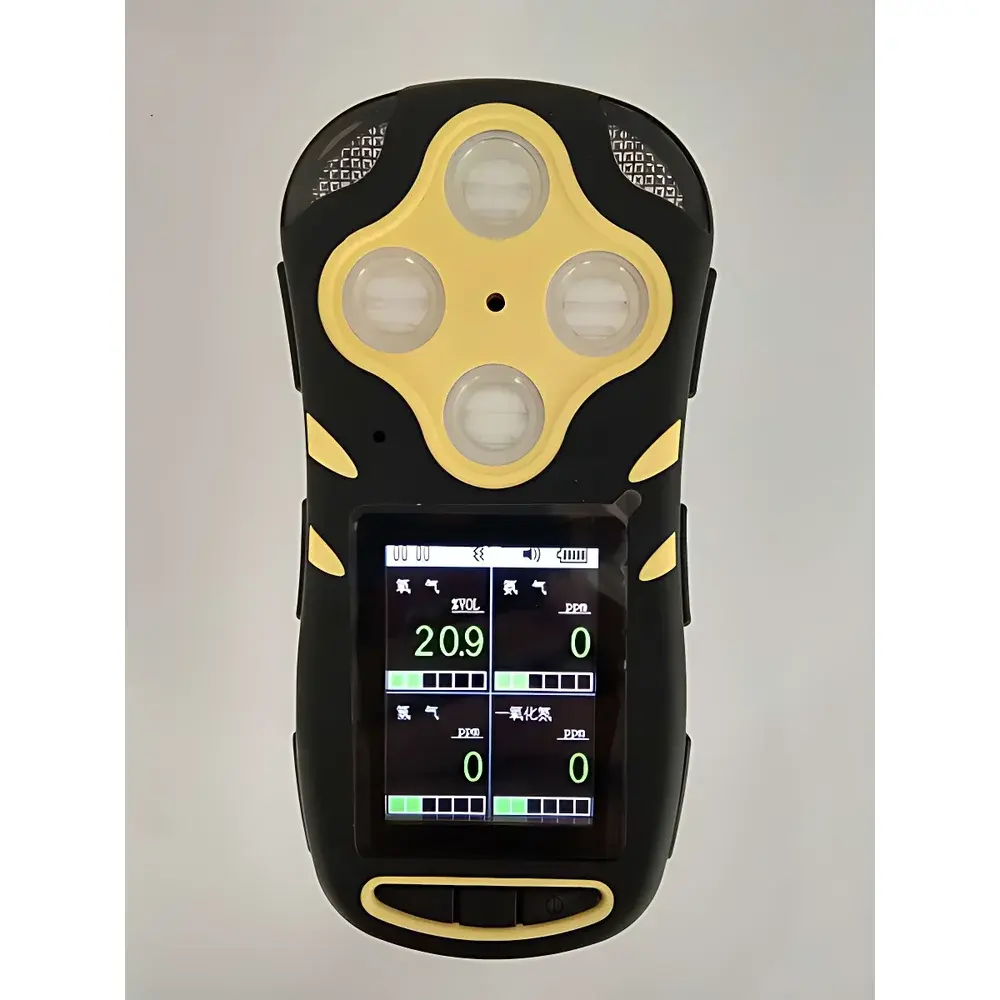
CD4(A) Multi-Gas Detector
| Origin | Beijing, China |
|---|---|
| Manufacturer Type | Distributor |
| Origin Category | Domestic |
| Model | CD4(A) |
| Price | Upon Request |
| Gas Detection Capabilities | O₂, NH₃, NO, H₂ |
| Detection Principle | Potentiostatic Electrolytic Sensors |
| Measurement Ranges | NO (0–250 ppm), O₂ (0.0–30.0 %vol), H₂ (0–1000 ppm), NH₃ (0.0–100 ppm) |
| Accuracy | NO (±10% of true value, 0–250 ppm), O₂ (±5% vol for 0.0–5.0%, ±3% FS for >5.0–30.0%), H₂ (±4 ppm for 0–100 ppm |
| Alarm Accuracy | NO (±1 ppm at 10 ppm setpoint), O₂ (±0.3% vol at 15.0% vol setpoint), H₂ (±1 ppm at 50 ppm setpoint), NH₃ (±1 ppm at 10 ppm setpoint) |
| Response Time (200 mL/min flow) | O₂ ≤35 s, NO ≤45 s, NH₃ ≤60 s, H₂ ≤60 s |
| Audible Alarm Level | ≥75 dB(A) at 1 m |
| Visual Alarm Visibility | ≥20 m in darkness |
| Battery Life | >10 h continuous operation |
| Dimensions & Weight | 135 × 60 × 20 mm / 200 g |
| Power Supply | Rechargeable Li-ion, nominal 7.2 V, max open-circuit voltage 8.0 V, max short-circuit current 2.5 A, operating current ≤120 mA |
| Ingress Protection | IP55 |
| Explosion Protection | Exib I Mb |
| Operating Temperature | −20 to +55 °C |
| Operating Humidity | 0–95% RH (non-condensing) |
| Housing Material | Antistatic ABS + PC soft-touch overmold |
| Sensor Lifespan | >2 years (O₂, NH₃, NO, H₂) |
| Certifications | MA (Mine Safety Mark), CNEx explosion-proof certification, third-party calibration and verification reports |
| Optional Features | Configurable data logging interval, USB interface for data download and report generation |
Overview
The CD4(A) Multi-Gas Detector is a compact, intrinsically safe portable instrument engineered for simultaneous real-time detection and quantification of four critical industrial and environmental gases: oxygen (O₂), ammonia (NH₃), nitric oxide (NO), and hydrogen (H₂). Designed in accordance with IEC 60079-0 and GB 3836 series standards for hazardous area instrumentation, the device employs potentiostatic electrolytic sensor technology — a mature, field-proven electrochemical method offering high selectivity, stable baseline performance, and minimal cross-sensitivity under variable ambient conditions. Its primary operational domain includes underground coal mine safety monitoring, confined space entry verification, chemical plant perimeter surveillance, wastewater treatment facility air quality assessment, and laboratory-scale gas release studies. The detector meets mandatory Chinese regulatory requirements for mine-used equipment (MA certification) and carries CNEx explosion-proof certification (Exib I Mb), confirming suitability for use in methane-air atmospheres classified as Zone 0/1 in mining environments.
Key Features
- Intrinsically safe design certified to Exib I Mb standard, enabling deployment in methane-rich underground mining zones without risk of ignition.
- TFT color LCD display with dual-language (English/Chinese) UI, supporting intuitive menu navigation and real-time parameter visualization.
- Triple-alert system: audible alarm (≥75 dB[A] at 1 m), bright LED visual indicator (blue pulsing status light), and tactile vibration feedback — ensuring reliable notification across noisy or low-visibility work environments.
- Configurable dual-stage alarm thresholds: users may define both low- and high-level alarm points independently for each gas channel, with full-scale adjustability across the entire measurement range.
- Integrated self-diagnostic routine at power-on: automatically verifies battery voltage, sensor integrity, buzzer functionality, and optical alarm output prior to measurement initiation.
- Ruggedized housing constructed from antistatic ABS engineering plastic with PC soft-touch overmold, providing mechanical shock resistance, ESD protection, and ergonomic handling.
- Extended operational endurance: >10 hours of continuous measurement on a single charge under typical sampling conditions (200 mL/min flow rate).
Sample Compatibility & Compliance
The CD4(A) is optimized for ambient air sampling in fixed-point or personal exposure monitoring configurations. It does not require external pumps or sample conditioning systems and operates effectively within temperature ranges of −20 to +55 °C and relative humidity up to 95% RH (non-condensing). All electrochemical sensors are factory-calibrated against NIST-traceable reference gases and exhibit proven stability in high-dust, high-humidity, and mildly corrosive atmospheres typical of mining and municipal infrastructure sites. Regulatory compliance includes mandatory Mine Safety Mark (MA) approval issued by the National Mine Safety Administration of China, CNEx-certified explosion protection documentation (Certificate No. CNEx19.2xxx), and conformity with GB/T 13867–2022 (Portable Multi-Gas Detectors – Performance Requirements and Test Methods). While not preconfigured for FDA 21 CFR Part 11 or ISO/IEC 17025-compliant audit trails, its data logging module (when enabled) supports timestamped, tamper-evident storage aligned with GLP-aligned record-keeping practices.
Software & Data Management
Data acquisition and reporting are supported via optional USB interface (USB 2.0 micro-B). When connected to a host PC running compatible Windows-based configuration software, users can perform zero/span calibration, modify alarm setpoints, adjust logging intervals (1 s to 3600 s), and export time-stamped concentration logs in CSV format. Exported files contain columns for date/time stamp, O₂ (%vol), NO (ppm), NH₃ (ppm), H₂ (ppm), battery voltage, and alarm status flags — facilitating integration into LIMS or enterprise EHS platforms. The internal memory retains up to 100,000 data points with automatic overwrite policy. No cloud connectivity or remote firmware update capability is included; all configuration changes require local physical interface access.
Applications
- Coal mine ventilation monitoring: continuous O₂ depletion and NO/NH₃ accumulation detection during blasting or spontaneous combustion events.
- Confined space entry pre-check: verification of O₂ sufficiency (>19.5% vol) and absence of toxic H₂ or NH₃ prior to worker ingress.
- Ammonia refrigeration system leak surveys: localized NH₃ detection down to 10 ppm threshold with rapid response (<60 s).
- Hydrogen fuel cell maintenance: periodic H₂ leak screening in battery enclosures and refueling stations.
- Environmental remediation site air monitoring: tracking NO emissions near denitrification units or NH₃ volatilization from biosolids storage.
- Academic research in gas diffusion kinetics: portable multi-analyte profiling in controlled chamber experiments.
FAQ
What gases does the CD4(A) detect and what are their respective measurement ranges?
The CD4(A) simultaneously measures O₂ (0.0–30.0 %vol), NO (0–250 ppm), NH₃ (0–100 ppm), and H₂ (0–1000 ppm) using dedicated potentiostatic electrolytic sensors.
Is the device suitable for use in explosive atmospheres?
Yes — it carries Exib I Mb intrinsic safety certification and MA (Mine Safety Mark) approval, permitting use in underground coal mines where methane-air mixtures may be present.
How long does the battery last under continuous operation?
Rated battery life exceeds 10 hours when operating at standard 200 mL/min sampling flow rate and ambient temperature (25 °C).
Can measurement data be exported and archived?
Yes — via USB interface, users may download time-stamped CSV logs containing all measured parameters and system status flags for offline analysis or regulatory submission.
What is the expected service life of the electrochemical sensors?
All four sensors (O₂, NH₃, NO, H₂) are rated for >2 years of operational service life under typical field conditions, assuming regular bump testing and scheduled calibration every 6 months.
Related Products







