
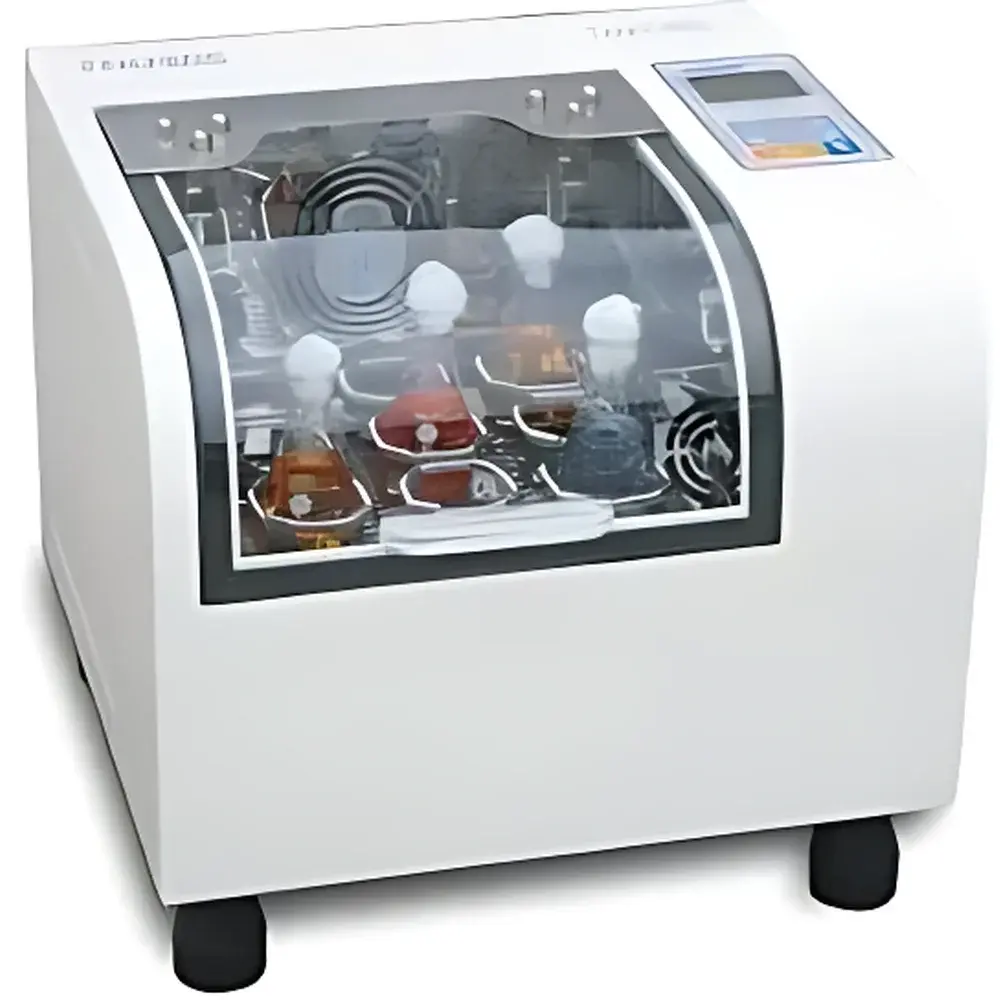
Zhicheng ZWY-103B Mini Multi-Amplitude Orbital Shaker
| Origin | Shanghai, China |
|---|---|
| Manufacturer Type | Authorized Distributor |
| Origin Category | Domestic (China) |
| Model | ZWY-103B |
| Price | Upon Request |
| Control Mode | PID Microprocessor-Based Environmental Scan Controller |
| Display | Backlit LCD |
| Air Circulation | Forced Convection |
| Oscillation Mode | Orbital (Circular) |
| Drive Mechanism | Eccentric Cam轨道 Drive |
| Ambient Temp. Range | 5–25 °C |
| Temp. Control Range | RT +5 to 60 °C |
| Temp. Resolution | 0.1 °C |
| Temp. Stability | ≤ ±0.1 °C (at 37 °C) |
| Temp. Uniformity | ≤ ±1.0 °C (at 37 °C) |
| Speed Range | 30–400 rpm |
| Speed Accuracy | ±1 rpm |
| Orbit Diameter Options | Φ24 / Φ32 / Φ38 / Φ50 mm (4-step adjustable) |
| Timer Range | 0–500 h |
| Shelf Dimensions | 280 × 220 mm |
| Shelf Quantity | 1 |
| Net Weight | 31 kg |
| Gross Weight | 54 kg |
| Chamber Volume | 34 L |
| Interior Dimensions | 360 × 340 × 280 mm |
| External Dimensions | 440 × 410 × 390 mm |
| Packing Dimensions | 560 × 530 × 560 mm |
| Max. Capacity | 9 × 50 mL |
| Power Consumption | 280 W |
| Input Voltage/Frequency | AC 220 V, 50/60 Hz |
Overview
The Zhicheng ZWY-103B Mini Multi-Amplitude Orbital Shaker is an engineered solution for precise, reproducible orbital agitation in microbiological, biochemical, and cell culture applications requiring controlled oxygen transfer and gentle-to-vigorous mixing. Utilizing a robust eccentric cam drive mechanism, the unit delivers true orbital motion—characterized by uniform circular trajectories—without mechanical backlash or resonance-induced instability. Unlike simple rotary platforms, this shaker employs a multi-amplitude drive architecture that mechanically decouples oscillation radius from rotational speed, enabling independent optimization of shear stress and mass transfer efficiency. The system operates within a thermally insulated chamber with forced-air convection, maintaining temperature stability ≤ ±0.1 °C at setpoint (e.g., 37 °C), compliant with ISO 17025 calibration traceability requirements for laboratory environmental control equipment. Designed for benchtop integration in BSL-1 and BSL-2 laboratories, its compact footprint (440 × 410 × 390 mm) and 34 L internal volume accommodate standard flasks, tubes, and microplates while supporting GMP-aligned workflows through configurable parameter locking and audit-ready operation logs.
Key Features
- Eccentric cam-driven orbital motion ensures consistent, low-vibration trajectory across all amplitude settings (Φ24 / Φ32 / Φ38 / Φ50 mm), eliminating harmonic distortion common in belt- or gear-driven systems
- PID-controlled microprocessor with environmental scan logic continuously monitors load inertia, ambient drift, and thermal gradient to maintain speed accuracy within ±1 rpm across full 30–400 rpm range
- Soft-start acceleration circuitry limits torque surge during power-up—critical for preserving fragile suspension cultures, agar-based inocula, or enzyme-labile reagents
- Backlit LCD interface displays real-time temperature, speed, amplitude setting, elapsed time, and remaining timer duration; parameters are password-locked to prevent unauthorized modification
- Integrated safety architecture includes overtemperature cutoff (dual-sensor redundancy), motor thermal protection, and automatic power resumption after grid interruption—retaining original setpoints and runtime state
- Electrostatically coated steel chassis with tempered glass viewing window provides structural rigidity (31 kg net weight) and optical access without compromising containment integrity
Sample Compatibility & Compliance
The ZWY-103B accommodates heterogeneous vessel configurations—including Erlenmeyer flasks (50–250 mL), test tubes, deep-well plates, and custom bioreactor sleeves—via its standardized 280 × 220 mm stainless-steel platform. Its four discrete orbit diameters enable empirical tuning of kLa (volumetric oxygen mass transfer coefficient), essential for aerobic fermentation, microbial growth kinetics, and hybridization stringency control. The unit complies with IEC 61010-1:2010 safety standards for laboratory electrical equipment and meets electromagnetic compatibility (EMC) Class B requirements per EN 61326-1. Temperature control performance aligns with ASTM E2500-13 guidance for qualification of environmental chambers used in pharmaceutical process development. While not inherently 21 CFR Part 11-compliant, its parameter memory and encrypted settings support ALCOA+ data integrity principles when deployed within validated SOP frameworks.
Software & Data Management
This standalone shaker operates without proprietary software dependencies; all configuration and monitoring occur via the embedded LCD interface. However, it supports external data acquisition through optional RS-232 or analog 0–5 V output modules (sold separately), enabling integration into LabVantage, DeltaV, or custom SCADA environments. Parameter logging—including timestamped speed, temperature, and alarm events—is retained in non-volatile memory for up to 1,000 cycles. Audit trail functionality records operator ID (via PIN entry), parameter changes, and fault codes—facilitating GLP/GMP documentation per ISO/IEC 17025 Clause 7.7. No cloud connectivity or remote firmware updates are implemented, preserving network isolation in regulated labs.
Applications
- Bacterial and yeast culture expansion under defined O2 transfer conditions (e.g., E. coli BL21(DE3) expression, S. cerevisiae ethanol fermentation)
- Enzyme kinetics assays requiring homogeneous substrate dispersion and minimal shear denaturation
- DNA hybridization and antigen-antibody binding protocols where oscillation amplitude directly influences binding kinetics
- Cell line maintenance in suspension culture (CHO, HEK293) with tunable agitation to balance nutrient homogenization and aggregate formation
- Media preparation and reagent equilibration prior to sterile filtration or lyophilization
- Environmental simulation studies involving temperature-coupled agitation (e.g., soil microbiome incubations, biodegradation assays)
FAQ
Is the ZWY-103B suitable for use with volatile organic solvents?
Yes—the sealed chamber and non-sparking induction motor meet Class I, Division 2 hazardous location requirements when operated within ambient temperature limits (5–25 °C) and with appropriate ventilation.
Can multiple amplitude settings be recalled without manual reconfiguration?
No—amplitude selection is mechanical (lever-actuated cam indexing) and requires physical adjustment; however, speed, temperature, and timer values are retained across power cycles.
What validation documentation is provided with the instrument?
Factory calibration certificates for temperature sensor (NIST-traceable Pt100) and speed encoder are included; IQ/OQ protocols are available upon request for GxP implementation.
Does the unit support stacking or rack-mount integration?
It is not designed for vertical stacking due to heat dissipation constraints; side-ventilated enclosures must maintain ≥100 mm clearance on all sides.
How is temperature uniformity verified across the platform surface?
Uniformity testing follows ISO 17025 Annex A.3 using nine-point thermocouple mapping (per ASTM E2251-19), confirming ≤±1.0 °C deviation at 37 °C under loaded conditions.
Related Products




