
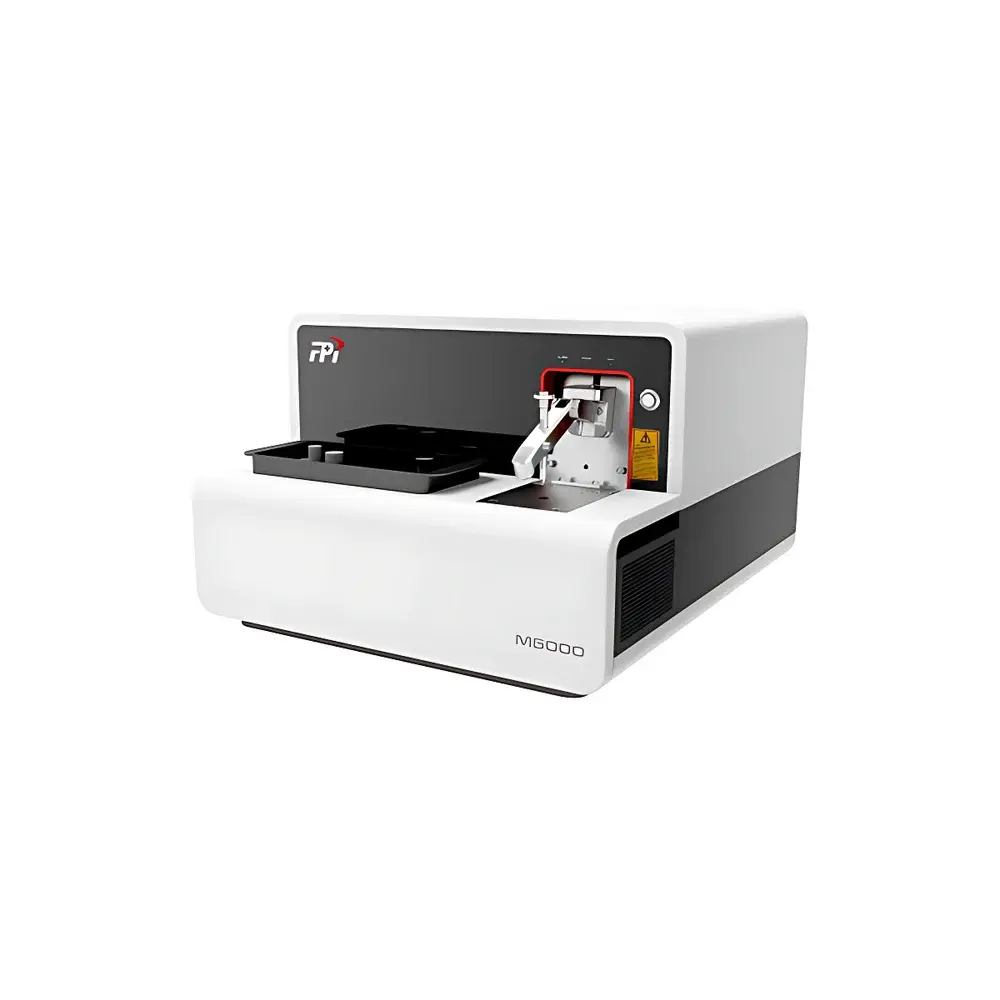
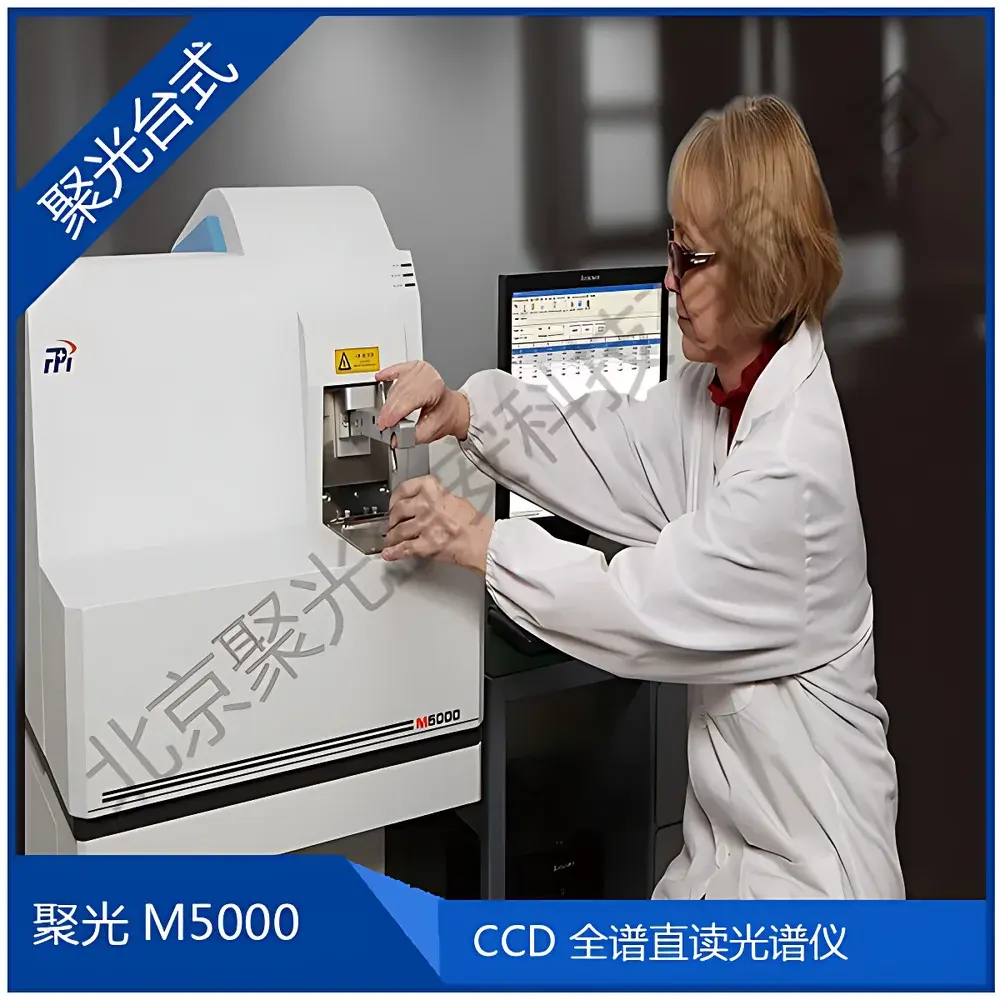
FPI M5000 F Benchtop CCD-Based Full-Spectrum Spark Optical Emission Spectrometer
| Brand | FPI |
|---|---|
| Origin | Zhejiang, China |
| Instrument Type | Benchtop |
| Excitation Method | Spark |
| Detector Type | Charge-Coupled Device (CCD) |
| Wavelength Coverage | Configurable (130–800 nm typical for metal analysis) |
| Spectral Resolution | ≤ 10 pm (typical at 200 nm) |
| Optical System | Paschen-Runge mount with dual vacuum-UV/visible chambers |
| Number of Simultaneous Detection Pixels | > 30,000 per CCD |
| Calibration Flexibility | Multi-matrix, on-site element/basis expansion supported |
| Compliance | Designed to support ISO 17025-compliant workflows, ASTM E415, E1086, and GB/T 4336 methodologies |
Overview
The FPI M5000 F is a benchtop full-spectrum spark optical emission spectrometer (OES) engineered for high-precision, laboratory-grade elemental quantification in metallic alloys. It operates on the principle of spark-induced plasma excitation: a controlled high-voltage discharge vaporizes and atomizes a micro-volume of conductive solid sample, generating excited-state atoms and ions that emit characteristic line spectra upon relaxation. These emissions are dispersed via a Paschen-Runge optical layout and captured simultaneously across the ultraviolet (UV) and visible (VIS) spectral ranges by multiple high-sensitivity CCD detectors. Unlike sequential or fixed-channel OES systems, the M5000 F acquires the entire spectrum — typically spanning 130–800 nm — enabling retrospective re-analysis, interference correction, and flexible multi-element method development without hardware modification.
Key Features
- Dual-chamber optical design: Separate vacuum-UV and air-stable visible chambers ensure optimal detection of low-wavelength elements (C, P, S, N, B, As) with minimal atmospheric absorption and enhanced signal-to-noise ratio.
- Full-spectrum acquisition: Captures >30,000 spectral pixels per CCD, supporting simultaneous monitoring of thousands of analytical lines — including secondary and tertiary sensitivity lines — for robust inter-element interference correction.
- Intelligent line selection algorithm: Automatically identifies optimal analytical wavelengths based on matrix composition, concentration level, and neighboring line overlap — minimizing self-absorption effects and spectral interferences.
- Digital spark source: Fully programmable, all-solid-state pulse generator delivers stable, reproducible energy profiles across diverse alloy types (Fe-, Al-, Cu-, Ni-, Mg-, Ti-based), eliminating electrode wear and gas consumption variability.
- Open-style argon-flushed spark stand: Accommodates irregularly shaped samples up to Ø40 mm × 50 mm height; integrated argon-saving mode reduces consumption by ≥40% during standby and low-duty-cycle operation.
- Real-time optical stabilization: Thermally regulated, sealed optical chamber maintains ±0.05 °C stability, suppressing thermal drift and preserving long-term wavelength calibration integrity.
Sample Compatibility & Compliance
The M5000 F is validated for direct solid sampling of electrically conductive metals and alloys, including ferrous (carbon steels, stainless steels, cast irons), non-ferrous (aluminum, copper, zinc, titanium, nickel, magnesium), and specialty superalloys. Sample preparation follows standardized grinding or milling per ASTM E1194 and ISO 11577. The instrument architecture supports audit-ready data handling compliant with GLP and GMP frameworks: full electronic signatures, user-access logging, method version control, and raw spectral archive retention. While not pre-certified for FDA 21 CFR Part 11, its software architecture provides the foundational traceability features required for validation under regulated quality systems.
Software & Data Management
The proprietary FPI SpectraSuite software enables comprehensive spectral processing, including background subtraction, peak deconvolution, intensity normalization, and multivariate calibration (PLS, MLR). It hosts an expandable library of certified reference material (CRM)-based calibrations for over 20 base matrices. “Smart Curve” functionality auto-selects the most appropriate calibration model for unknown samples using principal component fingerprinting — reducing operator dependency and improving first-run accuracy. All raw spectra, processed results, and system diagnostics are stored in vendor-neutral HDF5 format with embedded metadata (timestamp, operator ID, environmental conditions, lamp status). Export options include CSV, XML, and LIMS-compatible ASTM E1382-compliant reports.
Applications
The M5000 F serves as a primary analytical tool in foundry process control, incoming raw material inspection, heat-treatment verification, scrap sorting, and final product release testing. Typical use cases include rapid verification of alloy grade conformity (e.g., AISI/SAE, UNS, EN, GB standards), carbon equivalent (CE) and pitting resistance equivalent number (PREN) calculation, residual element screening (Pb, Sn, Bi, As), and low-level tramp element monitoring (Ca, Mg, Li, rare earths). Its ability to reprocess archived spectra makes it suitable for root-cause investigations, method transfer studies, and regulatory documentation requests.
FAQ
What is the minimum detectable concentration for carbon in low-alloy steel?
Detection limits are matrix- and condition-dependent; typical 3σ LOD for C in Fe-based matrices is 15–30 ppm under optimized argon flush and extended integration time.
Can I add new elements or base materials after installation?
Yes — spectral flexibility allows on-site method expansion for additional elements or alloy bases without hardware changes; only CRM validation and recalibration are required.
Is vacuum pumping required for UV analysis?
No — the dedicated vacuum-UV chamber is permanently evacuated and sealed at manufacture, eliminating operational vacuum pumps and associated maintenance.
How often is recalibration needed?
Under stable lab conditions, recalibration is recommended every 8–12 hours of continuous operation or after major environmental shifts (±2 °C, >5% RH change); automated drift correction minimizes manual intervention.
Does the system support remote diagnostics?
Yes — optional secure TLS-encrypted remote access enables real-time instrument health monitoring, spectral diagnostics, and collaborative troubleshooting with FPI application engineers.



