
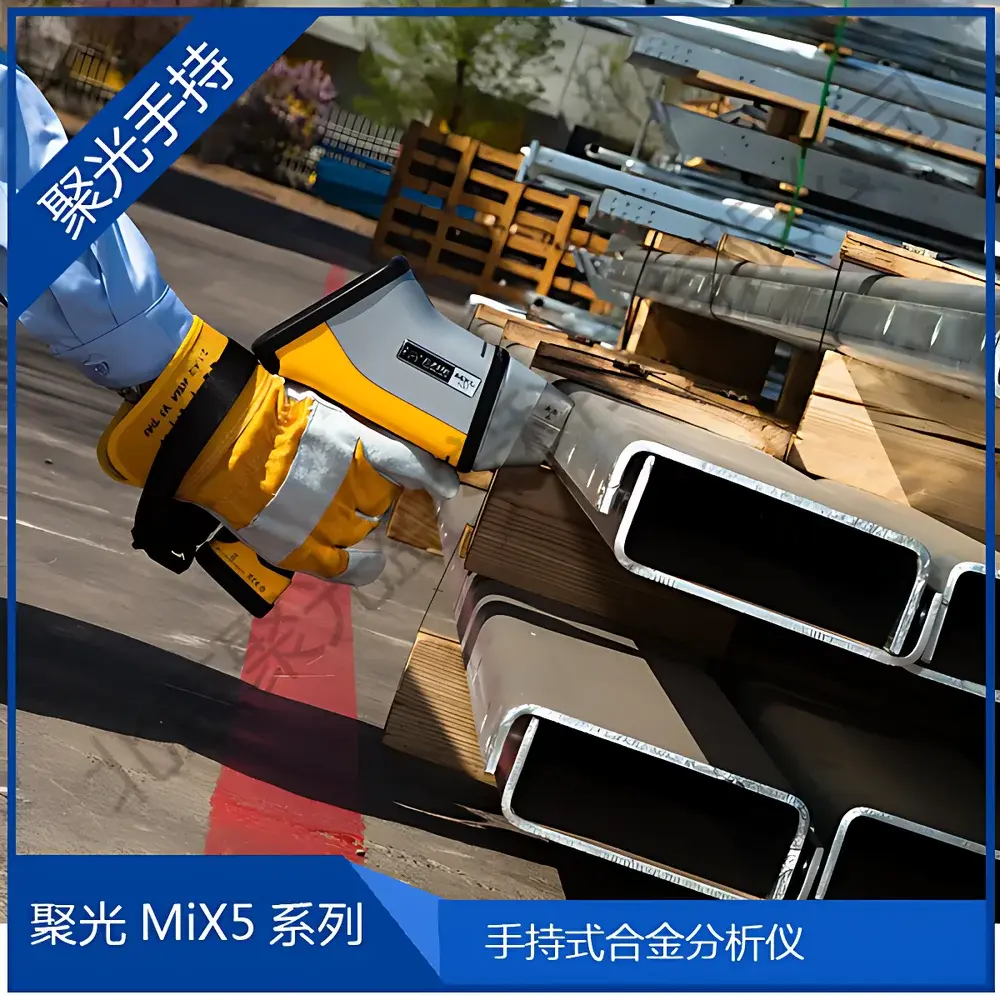
FPI MiX5 500 Handheld Energy Dispersive X-Ray Fluorescence (ED-XRF) Spectrometer
| Brand | FPI |
|---|---|
| Origin | Zhejiang, China |
| Model | MiX5 500 |
| Form Factor | Handheld / Portable |
| Target Materials | Ferrous Alloys |
| Pre-installed Alloy Libraries | AISI, DIN, JIS, GB (1600+ grades) |
| Detector | Silicon Drift Detector (SDD) |
| X-ray Tube | High-Performance Microfocus Tube |
| Display | 4.3-inch Color Touchscreen |
| Weight | 1.5 kg |
| Battery Life | 10–12 hours |
| IP Rating | IP54 |
| Data Storage | Up to 100,000 results with spectra and optional images |
| Output Formats | CSV, PDF |
| Connectivity | USB, Wi-Fi, Bluetooth |
| Compliance Support | GLP/GMP audit trail capability, FDA 21 CFR Part 11–ready software architecture |
Overview
The FPI MiX5 500 is a handheld energy dispersive X-ray fluorescence (ED-XRF) spectrometer engineered for rapid, non-destructive elemental analysis of metallic materials in field and industrial environments. Based on the fundamental principle of X-ray fluorescence—where primary X-rays excite atoms in a sample, causing emission of characteristic secondary (fluorescent) X-rays—the MiX5 500 quantifies elemental composition by measuring the energy and intensity of these emitted photons. Its optimized optical path integrates a high-stability microfocus X-ray tube and a large-area silicon drift detector (SDD), enabling high-count-rate spectral acquisition with sufficient resolution to resolve overlapping peaks from adjacent elements (e.g., Cr/Mn/Fe, Ni/Cu/Zn). Designed specifically for positive material identification (PMI), the instrument delivers laboratory-grade precision in seconds under real-world conditions—without sample preparation, vacuum requirements, or operator certification beyond standard radiation safety training.
Key Features
- Field-deployable ED-XRF platform with integrated SDD detector and microfocus X-ray source for high signal-to-noise ratio and low detection limits (LODs) for trace elements including Mg, Al, Si, P, and S.
- Proprietary fundamental parameter (FP) calibration methodology, validated against certified reference materials traceable to NIST and ISO standards, ensuring accuracy across alloy families without matrix-matched standards.
- Comprehensive, customizable alloy grade library containing >1600 entries—including AISI, DIN, JIS, and GB specifications—with support for user-defined additions, vendor-specific grades, and proprietary nomenclature.
- Ergonomic, lightweight (1.5 kg) housing with IP54-rated ingress protection, reinforced thermal management via extended heatsink design, and optional Kapton® polymer window for mechanical durability during weld seam or sharp-edge analysis.
- Intuitive icon-driven interface on a sunlight-readable 4.3-inch capacitive touchscreen; fully operable with industrial gloves; configurable result display showing grade ID, elemental concentrations, pass/fail status, and user-defined priority element ordering.
- Tool-free replaceable detector window and modular battery system enabling uninterrupted operation in remote or hazardous locations.
Sample Compatibility & Compliance
The MiX5 500 is validated for direct analysis of solid metallic samples—including castings, forgings, pipes, valves, welds, and scrap—without surface polishing or cleaning beyond removal of heavy contamination. It meets ASTM E1558 (Standard Guide for XRF Analysis of Metals), ISO 21047 (XRF determination of composition in ferrous alloys), and supports compliance workflows aligned with ASME B31.3, API RP 578, and PED 2014/68/EU for PMI verification. Software architecture includes full audit trail logging, electronic signature support, and data integrity controls consistent with FDA 21 CFR Part 11 and EU Annex 11 requirements. All firmware and calibration files are digitally signed and version-controlled to support GxP-regulated environments.
Software & Data Management
Data acquisition, processing, and reporting are managed through the embedded X-MET software suite—designed for offline and connected operation. Each measurement stores full spectral data, time/date stamp, GPS coordinates (optional), operator ID, and image capture (when camera module is installed). Internal memory retains up to 100,000 complete records. Export options include CSV (for LIMS integration), PDF (with embedded spectra and company branding), and encrypted USB transfer. The X-MET Report Generator operates as a standalone Windows application—requiring no installation on host PCs—and enables creation of client-branded reports featuring sample photos, spectral overlays, grade match confidence metrics, and custom metadata fields (batch number, location, inspector ID). Wireless synchronization via Wi-Fi or Bluetooth allows real-time upload to enterprise QA databases or cloud-based asset management systems.
Applications
The MiX5 500 serves critical roles across multiple industrial sectors where material authenticity, compositional conformity, and regulatory traceability are mandatory. Primary use cases include: Positive Material Identification (PMI) for piping, pressure vessels, and structural components in oil & gas, power generation, and chemical processing; incoming raw material inspection in metal fabrication and aerospace supply chains; scrap sorting and recycling facility grade segregation; failure analysis and root cause investigation in metallurgical laboratories; and field verification during plant turnaround or maintenance shutdowns. Its speed, portability, and robustness make it especially suited for applications requiring immediate decision-making—such as rejecting non-conforming shipments at dockside or verifying weld filler metal compatibility prior to welding procedure qualification.
FAQ
What elements can the MiX5 500 detect in ferrous alloys?
It reliably quantifies elements from magnesium (Mg) to uranium (U), with optimized performance for key alloying and tramp elements including Cr, Ni, Mo, Mn, Si, Cu, V, Nb, Ti, Co, and residual Pb, Sn, As, Sb, Bi.
Is the instrument compliant with radiation safety regulations?
Yes—it meets IEC 62495 and ANSI N43.3 standards for handheld XRF devices, incorporates automatic beam shuttering, and features dose rate monitoring with real-time alerts.
Can calibration be transferred between instruments?
Calibration models are device-specific but exportable; cross-instrument consistency is maintained through shared FP libraries and standardized CRM-based validation protocols.
Does the MiX5 500 require annual recalibration?
No scheduled recalibration is mandated; however, daily verification using check standards and quarterly performance qualification per ISO/IEC 17025 guidelines are recommended for accredited labs.
How is data integrity ensured during wireless transmission?
All Wi-Fi and Bluetooth transfers use TLS 1.2 encryption; report exports include digital hash signatures to prevent tampering and support forensic auditability.





