
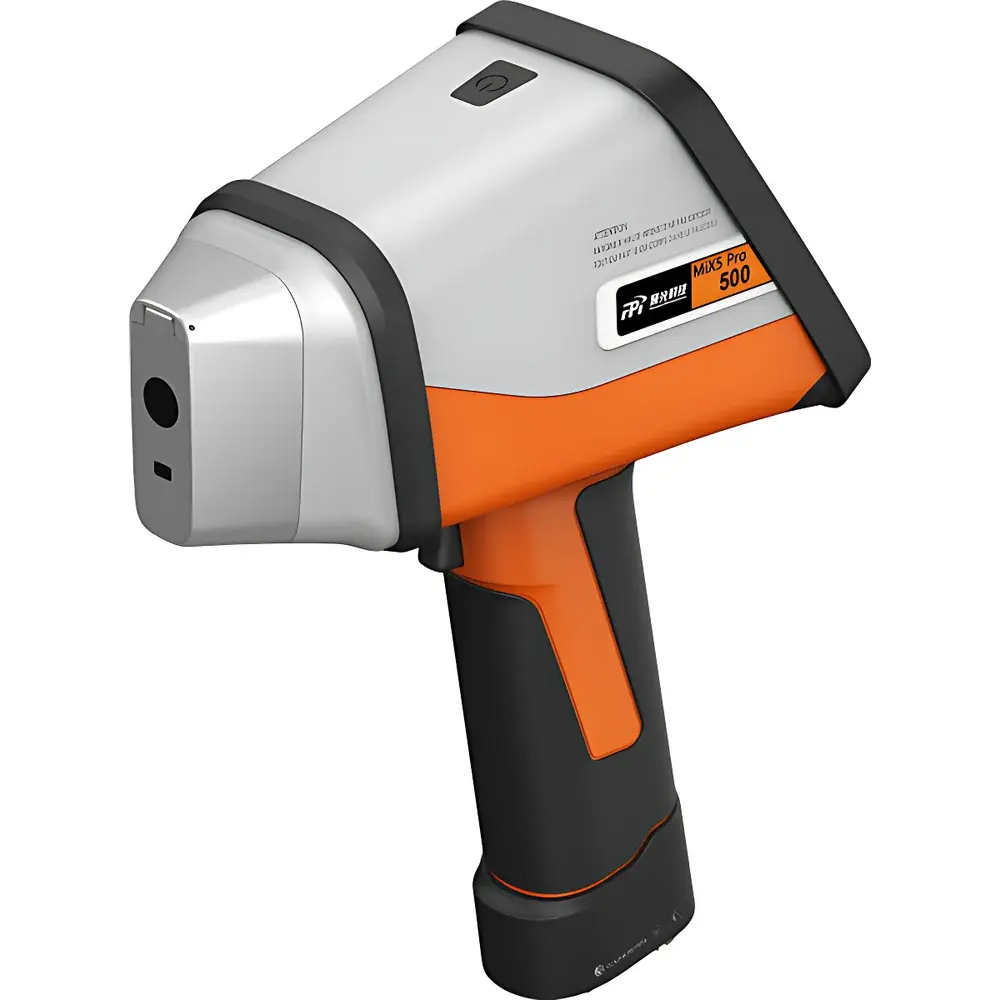
FPI MiX5 Pro Handheld Energy Dispersive X-Ray Fluorescence Spectrometer
| Brand | FPI |
|---|---|
| Origin | Zhejiang, China |
| Manufacturer Type | Authorized Distributor |
| Country of Origin | China |
| Model | MiX5 Pro |
| Form Factor | Handheld / Portable |
| Application Scope | General-Purpose Metal & Alloy Analysis |
| Elemental Range | Mg (12) to U (92) |
| Detection Limits | Sub-ppm to % level (matrix-dependent) |
| Detector | High-Performance Silicon Drift Detector (SDD) |
| Energy Resolution | ≤145 eV at Mn Kα |
| Repeatability | RSD < 1% for major elements (typical alloy matrix, ≥10 s measurement) |
| Operating Temperature | –10 °C to 50 °C |
| IP Rating | IP54 |
| Battery Life | Up to 12 hours (standard Li-ion pack) |
| Display | 5.5-inch capacitive touchscreen with sunlight-readable brightness |
| Connectivity | Wi-Fi 802.11 a/b/g/n, USB-C, optional integrated 5 MP macro camera |
| Software Compliance | Supports audit trail, user access control, and data export compliant with GLP/GMP documentation requirements |
Overview
The FPI MiX5 Pro Handheld Energy Dispersive X-Ray Fluorescence (ED-XRF) Spectrometer is an industrial-grade field analytical instrument engineered for rapid, non-destructive elemental composition analysis of metallic materials. Based on the fundamental principle of X-ray fluorescence—where primary X-rays excite atoms in a sample, inducing emission of characteristic secondary (fluorescent) X-rays—the MiX5 Pro quantifies elemental concentrations by measuring energy and intensity of emitted photons using a high-resolution silicon drift detector (SDD). Designed for real-time decision-making in dynamic environments, it delivers laboratory-comparable accuracy without sample preparation, making it ideal for on-site material verification, positive material identification (PMI), and compositional screening across manufacturing, scrap recycling, and R&D workflows.
Key Features
- High-Resolution Detection: Equipped with a thermoelectrically cooled SDD delivering ≤145 eV energy resolution at Mn Kα, enabling precise peak separation for overlapping transitions (e.g., V Kβ/Si Kα, Cr Kα/Fe Lα) and improved quantification of low-Z elements down to magnesium.
- Optimized Analytical Performance: Combines fundamental parameter (FP) algorithms with empirically calibrated matrix-matched standards, ensuring traceable accuracy across >1600 alloy grades—including AISI, DIN, JIS, and GB specifications—with typical repeatability (RSD) <1% for major constituents under standardized measurement conditions.
- Ergonomic & Rugged Field Design: Weighing <1.5 kg with balanced center-of-gravity geometry, the unit features an IP54-rated enclosure, reinforced test window with abrasion-resistant beryllium foil, and conical collimator head for reliable analysis of curved surfaces, welds, and confined geometries.
- Intelligent Thermal Management: Integrated custom thermal regulation circuitry maintains detector and electronics stability across ambient temperatures from –10 °C to 50 °C, minimizing spectral drift and preserving calibration integrity during extended field use.
- Field-Optimized Interface: 5.5-inch sunlight-visible capacitive touchscreen supports glove-compatible operation; intuitive icon-driven UI reduces operator training time; optional 5 MP macro camera enables spatial correlation between spectral data and sample morphology.
Sample Compatibility & Compliance
The MiX5 Pro is validated for direct analysis of solid metallic samples—including castings, forgings, sheet metal, weld deposits, and scrap fragments—without polishing or coating. Its small-spot mode (1 mm diameter) accommodates fine features such as wire, rivets, and thin coatings. The system complies with IEC 61000-6-3 (EMC) and IEC 61000-6-2 (immunity); radiation safety conforms to IEC 62495 and local regulatory frameworks for handheld XRF devices. Data handling protocols support traceability per ISO/IEC 17025 and ASTM E1621–22 (Standard Guide for XRF Analysis of Metals), while audit-trail functionality meets basic GLP documentation expectations for QA/QC environments.
Software & Data Management
Built on a Linux-based embedded OS, the MiX5 Pro firmware provides secure local storage for up to 100,000 test records—including full spectral files (.spc), quantitative reports (.csv/.pdf), and synchronized images (where camera option is installed). All data entries are timestamped, user-annotated, and protected by role-based access control (administrator/operator modes). Export options include encrypted USB-C transfer and Wi-Fi-enabled push to network servers or cloud platforms. Software updates are delivered via signed firmware packages to ensure integrity; configuration backups and restore functions facilitate fleet-wide standardization across multi-user deployments.
Applications
- On-Site Material Verification: Instant PMI for piping, valves, flanges, and structural components prior to installation—eliminating costly delays caused by undocumented alloy substitutions.
- Manufacturing QA/QC: Rapid incoming inspection of raw stock, in-process verification of heat-treated alloys, and final product certification against ASME B16.5, ASTM A959, or EN 10027 specifications.
- Scrap Sorting & Recycling: Real-time segregation of stainless steels (304 vs. 316), aluminum alloys (6061 vs. 7075), copper-bearing brasses, and nickel superalloys—reducing cross-contamination and maximizing recovery value.
- R&D Support: Compositional mapping of prototype alloys, failure analysis of fractured components, and validation of additive manufacturing feedstock consistency.
FAQ
What elements can the MiX5 Pro detect?
It detects elements from magnesium (Mg, Z=12) through uranium (U, Z=92), with optimized sensitivity for transition metals (Cr, Ni, Cu, Mo, W), light elements (Al, Si, P, S), and precious metals (Au, Ag, Pt) in metallic matrices.
Does it require annual recalibration?
No scheduled recalibration is required; however, daily verification using certified reference materials (CRMs) is recommended per ASTM E2857–21 to maintain measurement confidence and regulatory defensibility.
Can it analyze coated or plated parts?
Yes—using configurable measurement times and layer-fitting algorithms, it supports qualitative and semi-quantitative analysis of surface coatings (e.g., Zn on steel, Sn on Cu) when thickness is within detection depth limits (~10–50 µm depending on matrix and element).
Is the software compatible with LIMS integration?
Yes—structured CSV and XML exports, along with HTTP API endpoints (available via optional enterprise license), enable seamless integration with laboratory information management systems (LIMS) and enterprise resource planning (ERP) platforms.
What safety certifications does it hold?
The device carries CE marking for EMC and RoHS compliance; radiation output is certified below 1 µSv/h at 5 cm distance (per IEC 62495), and operational use adheres to ALARA principles supported by integrated dose monitoring and exposure logging.
Related Products






