
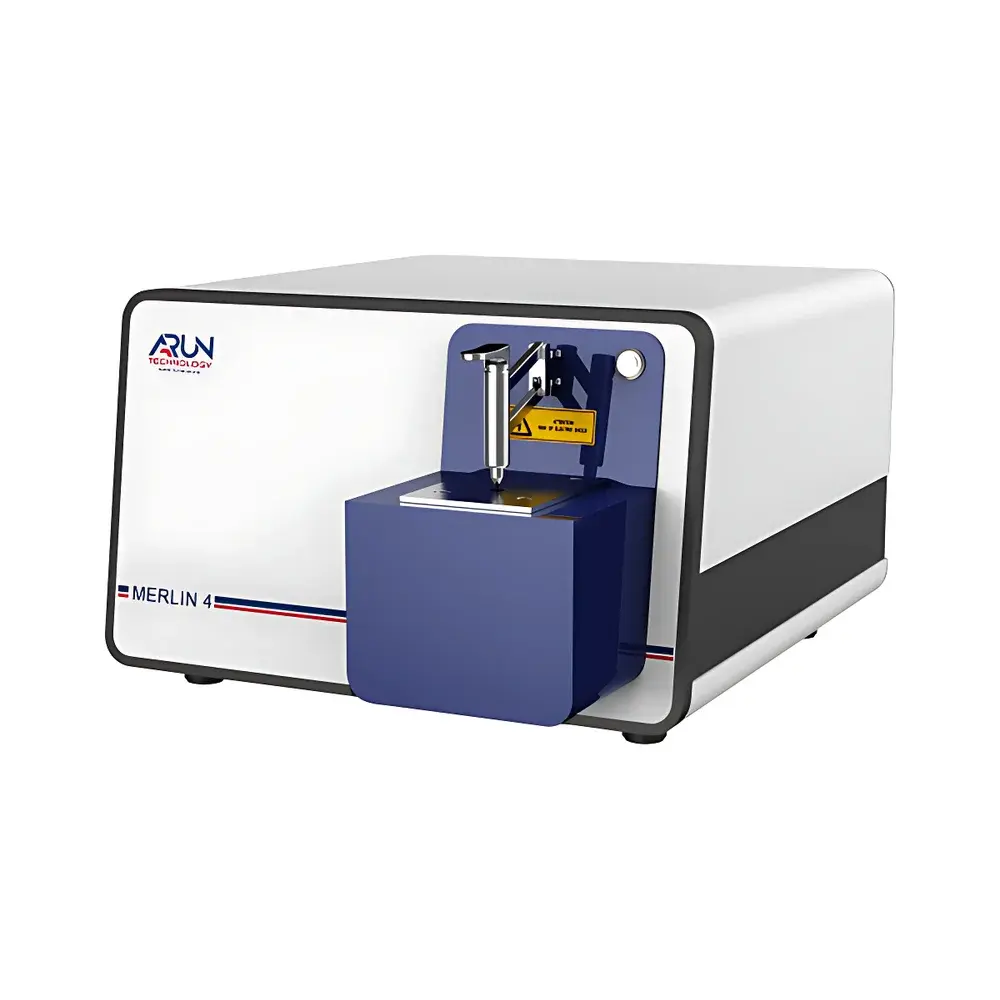
Arun Technology MERLIN 4 Direct-Reading Optical Emission Spectrometer
| Brand | Arun Technology Ltd. |
|---|---|
| Origin | United Kingdom |
| Instrument Type | Benchtop |
| Excitation Method | Spark |
| Detector Type | Charge-Coupled Device (CCD) |
| Optical System | Full-Spectrum Holographic Grating |
| Vacuum Requirement | None |
| Wavelength Range | Configurable (typically 130–800 nm) |
| Resolution | High spectral resolution enabled by optimized optical path and CCD pixel density |
| Sample Handling | Open-type spark stand with X-Y motorized sample stage |
| Compliance | Designed to support ISO/IEC 17025, ASTM E415, ASTM E1086, and GB/T 4336 workflows |
Overview
The Arun Technology MERLIN 4 Direct-Reading Optical Emission Spectrometer is a benchtop, full-spectrum spark emission spectrometer engineered for precise elemental analysis of metallic alloys in production and laboratory environments. It operates on the principle of spark-induced optical emission spectroscopy (OES): a high-energy electrical discharge excites atoms in a solid metal sample, causing them to emit characteristic wavelengths of ultraviolet and visible light. These emissions are dispersed via a holographic concave grating and simultaneously detected across the full spectrum using a high-sensitivity, thermoelectrically cooled CCD array. Unlike vacuum or purged spectrometers, the MERLIN 4 employs an air-path optical design with sealed, temperature-stabilized optics—eliminating the need for vacuum pumps or inert gas purging while maintaining stable performance for routine quantitative analysis of major, minor, and trace elements (e.g., C, S, P, N, B, Sn, Pb, As) in ferrous and non-ferrous matrices.
Key Features
- Benchtop footprint with integrated spark source and full-spectrum detection—optimized for space-constrained QC labs and foundry floor deployment.
- Open-type spark stand with motorized X-Y sample positioning, enabling reproducible analysis of irregular, large, or multi-location samples without manual repositioning.
- Holographic concave grating with high line density and aberration-corrected geometry—ensuring minimal stray light and consistent spectral fidelity across the configured wavelength range (standard configuration: 130–800 nm).
- Back-thinned, deep-depletion CCD detector with 2048 × 512 pixel resolution and <0.005 nm/pixel dispersion—supporting simultaneous acquisition of all analytical lines and internal reference channels.
- Robust spark generator with adjustable energy, frequency, and pre-spark conditioning—calibrated for stable ablation across diverse alloy types including low-alloy steels, stainless steels, Al-, Cu-, Mg-, Ti-, and Ni-based superalloys.
- Embedded real-time plasma monitoring and automatic arc suppression logic—minimizing spectral drift and ensuring measurement repeatability within ±0.02% RSD for certified reference materials.
Sample Compatibility & Compliance
The MERLIN 4 accommodates solid conductive metal samples up to Ø40 mm × 50 mm height, including castings, forgings, machined parts, electrodes, and round bars. Its open spark stand accepts both flat and curved surfaces with optional auxiliary fixtures (e.g., ring clamps, groove adapters). The system supports standardized sample preparation per ISO 11577 and ASTM E2169, and its analytical protocols align with ISO 11578 (OES calibration), ASTM E415 (carbon steel analysis), ASTM E1086 (stainless steel), and GB/T 4336 (Chinese national standard for carbon and low-alloy steels). All calibration models include certified reference material (CRM) traceability, and instrument qualification documentation complies with GLP and GMP audit requirements—including IQ/OQ/PQ templates and electronic signature-ready reports.
Software & Data Management
Controlled via Arun’s proprietary SpectraLink™ software, the MERLIN 4 provides a validated, 21 CFR Part 11–compliant environment for method development, calibration management, and reporting. Key capabilities include multivariate calibration (PLS, MLR), matrix-matched standardization, inter-element correction (IEC) modeling, and automated outlier detection. Raw spectral data (FITS format), processed results (CSV, PDF, XML), and audit trails—including user actions, parameter changes, and instrument status logs—are stored in a secure, encrypted local database. Export modules support LIMS integration via ASTM E1382-compliant interfaces and direct transfer to SAP QM or Oracle Quality modules.
Applications
The MERLIN 4 delivers rapid (<30 s per analysis), accurate compositional verification across high-volume industrial sectors. In metallurgical foundries, it verifies melt chemistry prior to casting and validates heat-treatment lot compliance. Automotive suppliers use it for incoming inspection of crankshafts, cylinder heads, and suspension components; aerospace manufacturers rely on it for PM alloy certification and turbine disk batch release. It supports regulatory submissions for AS9100, EN10204 3.1/3.2, and PED 2014/68/EU. Additional use cases include scrap sorting in recycling facilities, grade identification in maintenance depots, and research-grade alloy development in university metallurgy departments and national metrology institutes.
FAQ
Does the MERLIN 4 require external vacuum or argon purge?
No—the optical path is sealed and purged internally with dry nitrogen or synthetic air during operation, eliminating dependency on external gas supplies or vacuum infrastructure.
Can it analyze light elements such as carbon, sulfur, and phosphorus in steel?
Yes—its extended UV sensitivity (down to 130 nm) and optimized spark parameters enable reliable quantification of C (≥0.005%), S (≥0.001%), and P (≥0.002%) in carbon steels and low-alloy grades.
Is method transfer possible between different MERLIN units?
Yes—SpectraLink™ supports cross-instrument calibration migration using standardized spectral response files and CRM-based validation protocols.
What maintenance is required for long-term stability?
Routine tasks include daily electrode cleaning, monthly optical window inspection, and annual spark chamber alignment verification—documented in the included Preventive Maintenance Logbook.
How is data integrity ensured during regulatory audits?
All analytical sessions generate immutable digital signatures, timestamped audit trails, and version-controlled calibration files—fully compliant with FDA 21 CFR Part 11 and EU Annex 11 requirements.




