
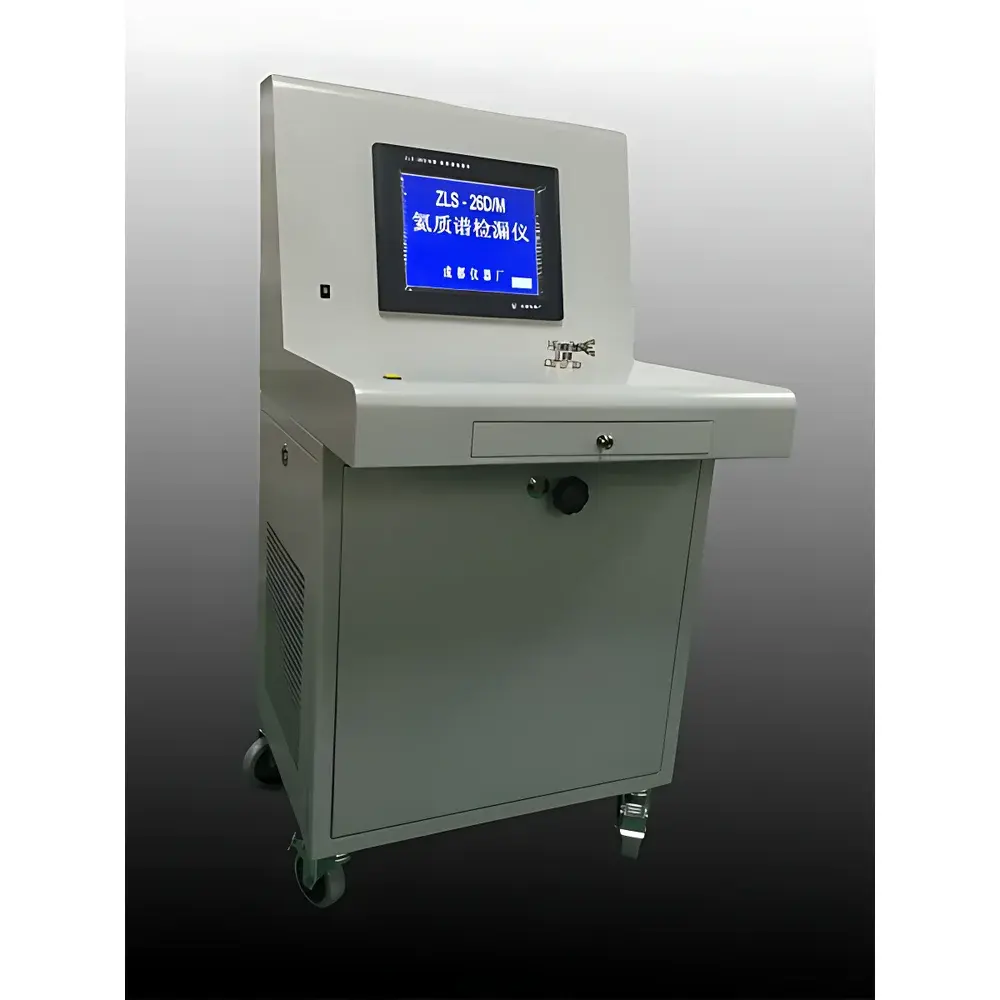
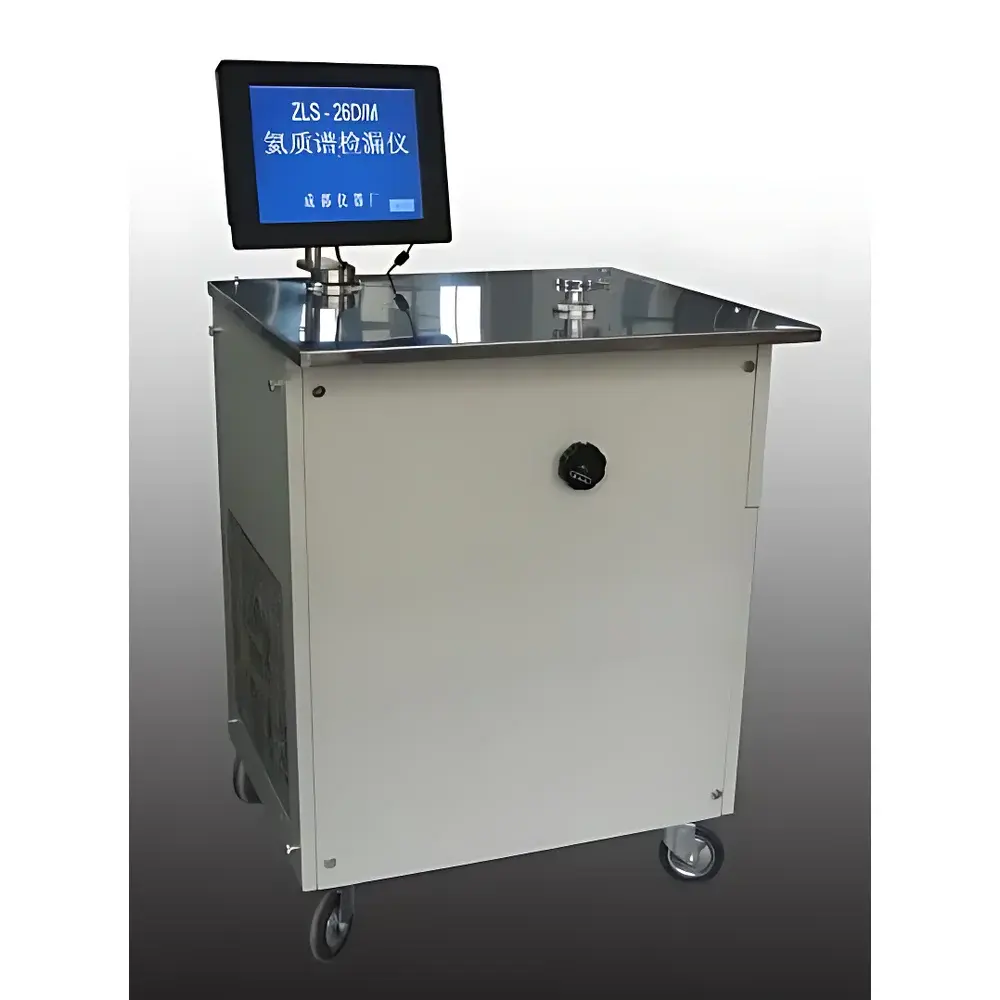
Chengyi ZLS-26D/M Helium Mass Spectrometer Leak Detector
| Brand | Chengyi (SCChengyi) |
|---|---|
| Origin | Sichuan, China |
| Manufacturer Type | Authorized Distributor |
| Country of Origin | China |
| Model | ZLS-26D/M |
| Price | Upon Request |
| Minimum Detectable Leak Rate | < 5×10⁻¹² Pa·m³/s |
| Response Time | ≤ 3 s |
| Maximum Operating Pressure in Mass Spectrometer Chamber | 1×10⁻² Pa |
| Maximum Inlet Pressure at Test Port | 1000 Pa |
| Backpressure Test Duration Range | 5–30 s |
| Pump-Down & Startup Time | ≤ 5 min |
| Dimensions (W×D×H) | 640 × 550 × 980 mm |
| Weight | ~75 kg |
| Power Supply | 220 V ±10%, 50 Hz |
| Display | 12-inch Touchscreen LCD with Real-Time Leak Rate Plotting & Unit Conversion (Pa·m³/s, atm·cm³/s, mbar·L/s, Torr·L/s) |
| Data Management | Onboard Storage, Print Export, GLP-Compliant Audit Trail (via V1.0 Control Software) |
| Detection Principle | Magnetic Sector Helium Mass Spectrometry (m/z = 4) with Positive Ion Detection and Quadrupole-Assisted Peak Discrimination |
Overview
The Chengyi ZLS-26D/M Helium Mass Spectrometer Leak Detector is a high-sensitivity, vacuum-integrated analytical instrument engineered for quantitative detection and localization of minute helium ingress in sealed components and vacuum systems. It operates on the principle of magnetic sector mass spectrometry, selectively ionizing helium atoms (mass-to-charge ratio m/z = 4) in a high-vacuum environment and resolving them from background gases—including hydrogen, water vapor, and nitrogen—using optimized ion optics and dynamic background suppression algorithms. Unlike pressure-rise or thermal-conductivity methods, this system delivers absolute leak rate quantification traceable to SI units (Pa·m³/s), making it suitable for applications requiring compliance with ISO 10648-2, ASTM E493, and MIL-STD-883 Method 1014. The instrument integrates a dedicated helium-specific ion source, a high-transmission mass analyzer, and a Faraday cup detector with low-noise amplification circuitry, ensuring stable baseline performance and repeatable sub-10⁻¹² Pa·m³/s sensitivity under routine operational conditions.
Key Features
- Real-time helium peak acquisition with automatic peak search and dynamic background subtraction—enabling reliable detection even during transient pressure fluctuations
- 12-inch industrial-grade touchscreen interface with intuitive HMI navigation, supporting multilingual operation (English, Chinese, Spanish) and context-sensitive help overlays
- Four standardized leak rate units convertible on-screen: Pa·m³/s, atm·cm³/s, mbar·L/s, and Torr·L/s—facilitating cross-laboratory data harmonization
- Configurable alarm thresholds with audible alert and visual status flagging; programmable delay and hysteresis settings to suppress false positives
- Integrated time-resolved curve logging: up to 100 independent test profiles can be stored onboard with timestamp, operator ID, and environmental metadata
- Modular vacuum architecture featuring a high-speed turbo-molecular pump (TMP), dual-stage rotary vane backing pump, and coarse vacuum stage—optimized for rapid pump-down and long-term stability
- Factory-calibrated reference leak (certified per ISO/IEC 17025) included with NIST-traceable calibration certificate for daily verification and drift monitoring
Sample Compatibility & Compliance
The ZLS-26D/M supports both vacuum (vacuum chamber) and sniffer (local probe) modes, accommodating diverse geometries—from semiconductor wafer carriers and aerospace fuel lines to medical implant housings and cryogenic dewars. Its test port withstands up to 1000 Pa inlet pressure, permitting direct connection to low-vacuum subsystems without external throttling. The mass spectrometer chamber maintains operational integrity below 1×10⁻² Pa, ensuring optimal ion transmission and signal-to-noise ratio. All firmware and control logic comply with IEC 61000-6-2 (EMC immunity) and IEC 61010-1 (safety for laboratory equipment). Data handling adheres to ALCOA+ principles: attributable, legible, contemporaneous, original, accurate, complete, consistent, enduring, and available—supporting 21 CFR Part 11 readiness when deployed with networked audit trail logging enabled.
Software & Data Management
ZLS Helium Leak Detection Control & Analysis System V1.0 is a Windows-based embedded application running on an industrial PC. It provides full instrument control, real-time spectral visualization, and post-acquisition analysis tools—including derivative curve generation, baseline correction, and comparative overlay of multiple test runs. Raw data exports as CSV or XML; reports are generated in PDF format with embedded digital signatures and configurable header/footer fields (e.g., facility name, SOP number, analyst ID). The software includes built-in GLP audit trail functionality: every parameter change, test initiation, calibration event, or user login is time-stamped, user-identified, and immutable once recorded—fully compliant with internal quality audits and external regulatory inspections.
Applications
- Leak integrity validation of hermetically sealed MEMS packages and optoelectronic modules in semiconductor manufacturing
- Final acceptance testing of vacuum-jacketed piping, heat exchangers, and fusion reactor first-wall components
- Quality assurance of implantable medical devices (e.g., pacemakers, neurostimulators) per ISO 11607-2
- Pre-shipment verification of aerospace hydraulic actuators and satellite propulsion tanks
- R&D-level evaluation of novel sealing materials, brazed joints, and thin-film barrier coatings
- Failure analysis labs performing root-cause identification of vacuum degradation in electron microscopes and particle accelerators
FAQ
What is the minimum detectable leak rate under standard operating conditions?
The instrument achieves a verified minimum detectable leak rate of < 5×10⁻¹² Pa·m³/s when operated with clean helium gas, calibrated reference leak, and stable vacuum conditions (≤ 5×10⁻³ Pa in spectrometer chamber).
Can the ZLS-26D/M perform both vacuum and sniffer-mode detection?
Yes—it supports vacuum mode (test piece placed inside chamber), hood mode (enclosed volume over component), and sniffer mode (helium spray + localized probe scanning) via interchangeable inlet configurations.
Is the system compatible with automated production line integration?
The instrument features RS-232, Ethernet (TCP/IP), and optional Profibus-DP interfaces, enabling PLC synchronization, MES data push, and recipe-driven test sequencing.
Does the software support electronic signatures and audit trail for regulated environments?
Yes—V1.0 software includes configurable role-based access control, digital signature capture, and tamper-proof audit logs meeting FDA 21 CFR Part 11 Annex 11 requirements.
What maintenance intervals are recommended for the turbomolecular pump?
Chengyi recommends inspection and bearing lubrication every 8,000 hours of operation; full rebuild service is advised after 20,000 hours or upon detection of >15% throughput degradation.




