
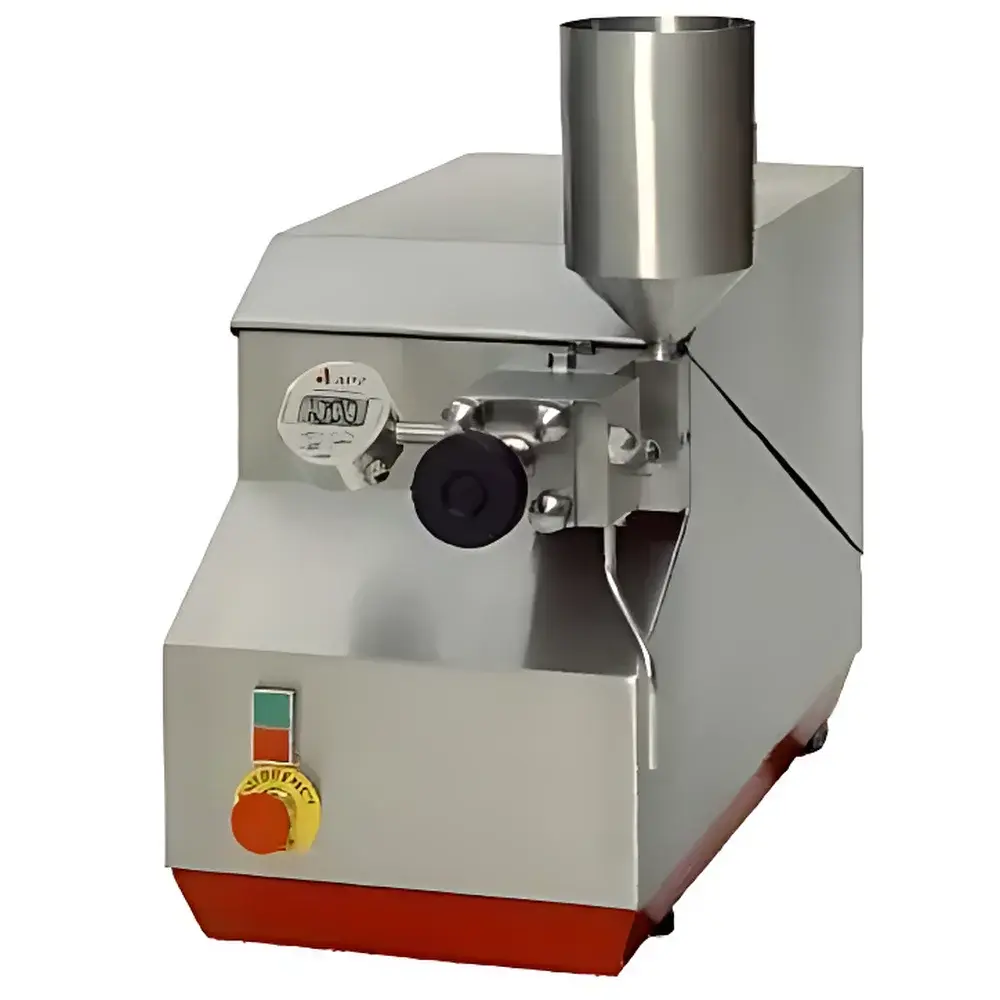
APV APV-1000 & APV-2000 Laboratory-Scale High-Pressure Homogenizers
| Brand | APV |
|---|---|
| Origin | Germany |
| Model | APV-1000, APV-2000 |
| Instrument Type | High-Pressure Homogenizer |
| Dimensions (W×H×L) | 370 × 620 × 818 mm |
| Throughput | 22 L/h (APV-2000), 11 L/h (APV-1000) |
| Valve Material | Ceramic |
| Plunger Material | Solid Ceramic |
| Pump Head Material | Duplex Stainless Steel |
| Pressure Regulation | Manual Handwheel |
| Secondary Homogenization | Optional |
| Safety Features | Overpressure Alarm, Thermal Monitoring, Emergency Stop, Current-Limiting Protection |
Overview
The APV APV-1000 and APV-2000 are precision-engineered, benchtop high-pressure homogenizers designed for laboratory-scale processing of sensitive biological and colloidal systems. Based on the principle of controlled microfluidic shear, cavitation, and impact disruption under precisely regulated hydraulic pressure, these instruments generate consistent submicron and nanoscale particle size distributions in suspensions, emulsions, and cell lysates. Operating at maximum pressures up to 1,500 bar (21,750 psi), the APV-1000 and APV-2000 utilize a positive-displacement ceramic plunger pump coupled with a ceramic homogenizing valve to deliver reproducible mechanical energy input—enabling scalable process development from lab to pilot or production scale without amplification artifacts. Their design adheres to core principles of fluid dynamics and material fatigue resistance, ensuring stable performance across repeated thermal and pressure cycles typical in biopharmaceutical and nanomaterial R&D environments.
Key Features
- Robust duplex stainless steel pump head engineered for long-term stability under high-pressure, corrosive, and abrasive conditions—including exposure to organic solvents, acidic buffers, and alkaline cleaning agents.
- Monolithic solid ceramic plungers with integrated cooling and lubrication channels, minimizing thermal drift and wear during extended continuous operation.
- Reversible tungsten carbide valve seats paired with cobalt alloy PVB inlet/outlet ball valves—designed for bidirectional use and extended service life in high-cycle applications.
- Real-time digital monitoring of homogenization pressure and inlet temperature via front-panel LED display, compliant with GLP data integrity requirements.
- Manual handwheel pressure regulation with fine-tuned resolution, enabling precise method transfer between APV lab, pilot, and industrial-scale homogenizers.
- Optional secondary homogenization stage for enhanced particle size reduction and narrow polydispersity index (PDI) control in nanoemulsions and lipid nanoparticles.
- CIP (Clean-in-Place) and SIP (Sterilize-in-Place) compatibility supported by sanitary quick-connect outlet fittings, polished 316L stainless steel housing, and fully disassemblable flow path components.
Sample Compatibility & Compliance
The APV-1000 and APV-2000 accommodate a broad spectrum of sample types—including aqueous and non-aqueous suspensions, viscous biopolymer solutions, microbial cultures (e.g., E. coli, Pichia pastoris, Mycobacterium tuberculosis), mammalian cells (Vero, CHO), plant tissues, algae, pollen, and food-grade emulsions. All wetted surfaces comply with FDA 21 CFR Part 11 traceability prerequisites when paired with validated data logging software. The system meets ISO 13485 design controls for medical device-related nanoparticle formulation and conforms to ASTM F2697–21 guidelines for characterization of lipid-based nanocarriers. CE marking certifies compliance with EU Machinery Directive 2006/42/EC and Electromagnetic Compatibility Directive 2014/30/EU.
Software & Data Management
While the base configuration operates via standalone hardware controls, optional integration with APV’s Homogenizer Control Suite (v3.2+) enables audit-trail-enabled method storage, pressure/temperature trend logging, and export of CSV-formatted process records. All electronic records support ALCOA+ principles (Attributable, Legible, Contemporaneous, Original, Accurate, Complete, Consistent, Enduring, Available) for regulatory submissions. The system supports time-stamped event logs for start/stop sequences, emergency stops, overpressure events, and maintenance alerts—fully aligned with GMP Annex 11 and USP analytical instrument qualification frameworks.
Applications
- Preclinical formulation of lipid nanoparticles (LNPs), solid lipid nanoparticles (SLNs), nanostructured lipid carriers (NLCs), and liposomes for mRNA delivery and vaccine development.
- Cell lysis and intracellular biomolecule extraction—especially for membrane-bound proteins, nucleic acids, and inclusion bodies from Gram-negative bacteria and yeast.
- Production of stable nanoemulsions and microemulsions for topical, oral, and parenteral dosage forms in pharmaceutical and cosmetic development.
- Homogenization of dairy-based emulsions, fruit juice suspensions, and functional food ingredients requiring shelf-life stabilization and sensory optimization.
- Dispersion of inorganic nanomaterials (e.g., TiO₂, SiO₂, quantum dots) in polymer matrices for advanced coating and composite R&D.
FAQ
Can APV-1000/APV-2000 results be directly scaled to production equipment?
Yes—APV’s homogenizer platform uses identical valve geometry, fluid dynamics modeling, and pressure calibration protocols across all scales. Process parameters established on the APV-1000 or APV-2000 transfer linearly to APV’s industrial units (e.g., APV GA series) without re-optimization.
What is the minimum sample volume required per run?
The system requires ≥50 mL for stable pressure build-up and representative particle size distribution; however, recirculation mode allows effective processing of as little as 150 mL total volume.
Is the unit suitable for processing highly viscous or particulate-laden feeds?
With pre-filtration (≤100 µm) and inlet temperature control (10–40 °C), viscosities up to 5,000 mPa·s can be processed reliably—though throughput rates decrease proportionally with increasing viscosity.
How often does the ceramic valve require replacement?
Under standard operating conditions (≤1,200 bar, aqueous buffers, ≤8 hrs/day), ceramic valves typically exceed 500 operational hours before performance degradation warrants replacement—verified via DLS particle size trending.
Does the system support remote monitoring or network connectivity?
The base model features isolated analog outputs (4–20 mA) for pressure and temperature; Ethernet-enabled data acquisition modules are available as field-installable options for integration into centralized lab informatics systems.



