
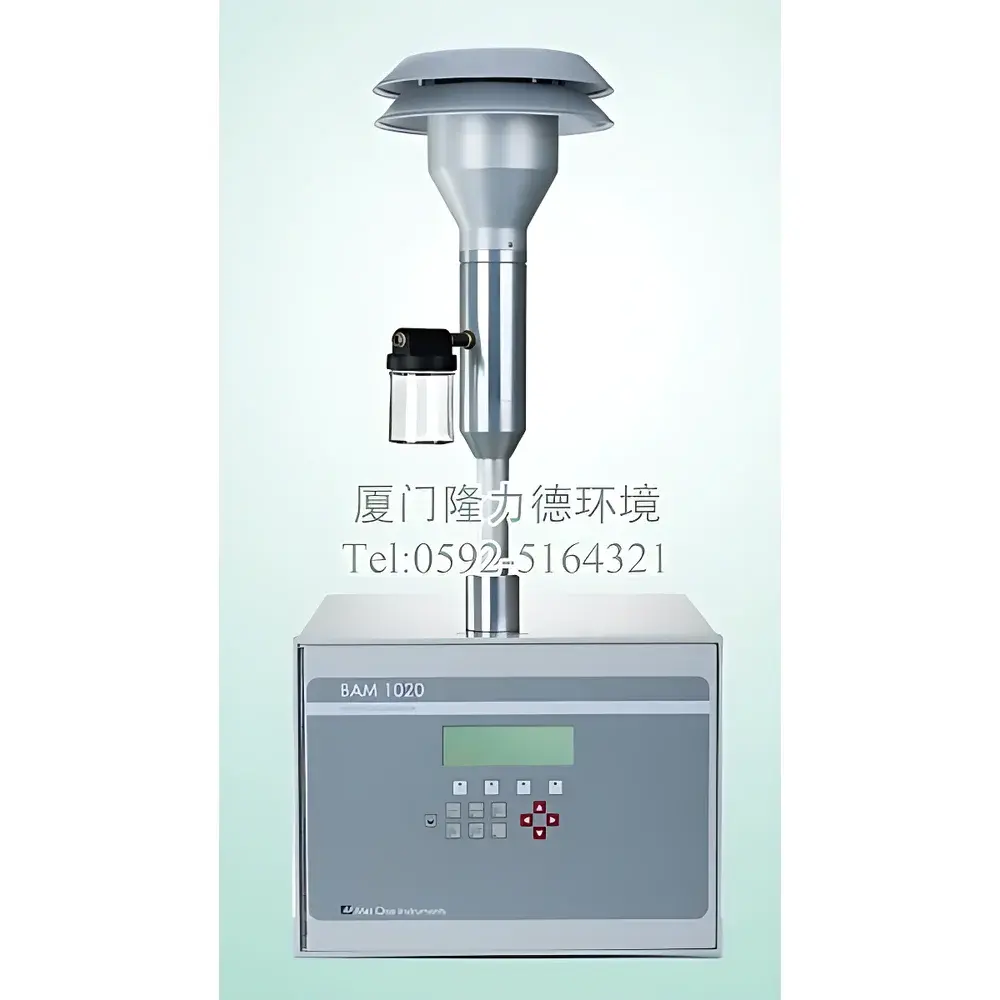
METONE BAM-1020 Beta Attenuation Monitor for Continuous PM₂.₅, PM₁₀ and TSP Measurement
| Brand | METONE |
|---|---|
| Origin | USA |
| Model | BAM-1020 |
| Certification | U.S. EPA EQPM-0798-122 |
| Measurement Principle | Beta Ray Attenuation (¹⁴C source) |
| Particle Size Fractions | PM₂.₅, PM₁₀, TSP |
| Measurement Range | 0–50 mg/m³ |
| Sampling Interval | Hourly |
| Data Storage Capacity | 182 days |
| RH Control | Integrated Heater with Precise Relative Humidity Management |
| Calibration | Automated Zero/Drift Checks per Cycle |
| Output Interface | RS-232 |
| Meteorological Integration | Up to 6 Sensors |
| Remote Operation Duration | Up to 60 Days Unattended |
| Compliance | EPA EQPM, UK MCERTS, Korea KEPIC, China CNAS-accredited Ambient Monitoring Applications |
Overview
The METONE BAM-1020 Beta Attenuation Monitor is a certified, continuous ambient particulate matter analyzer engineered for regulatory-grade measurement of PM₂.₅, PM₁₀, and total suspended particulates (TSP). It operates on the beta ray attenuation principle—utilizing a low-energy ¹⁴C radioactive source to emit beta particles through a moving filter tape. As airborne particles deposit onto the tape during sampling, they attenuate the beta flux proportionally to their mass concentration. A high-sensitivity scintillation detector quantifies the transmitted radiation, enabling direct, real-time calculation of mass concentration in mg/m³. Unlike optical or light-scattering methods, this technique is inherently insensitive to particle morphology, color, refractive index, or volatility—ensuring metrological traceability and long-term stability across diverse environmental conditions. The BAM-1020 meets U.S. Environmental Protection Agency (EPA) Equivalent Method (EQPM-0798-122) requirements and has been independently verified under UK MCERTS, Korean KEPIC, and Chinese national ambient air quality monitoring accreditation frameworks.
Key Features
- Fully automated hourly sampling cycle with integrated filter tape advancement and real-time mass loading correction
- Onboard microprocessor with LCD interface, keyboard navigation, and embedded self-diagnostic routines
- Active relative humidity control via precision heater to minimize hygroscopic bias in ambient aerosol measurements
- Automated zero and span drift verification at start and end of each sampling cycle using clean tape and certified reference membranes
- High-capacity internal memory storing up to 182 days of hourly averaged data, including diagnostic flags and event logs
- RS-232 serial interface supporting bidirectional communication with data loggers, modems, printers, or SCADA systems
- Expandable meteorological integration—up to six external sensors (wind speed/direction, temperature, pressure, RH, precipitation, solar radiation)
- Remote web-accessible operation with secure session management for unattended field deployment up to 60 days
- Compliance-ready data tagging: timestamps, error codes (e.g., power loss, flow fault, tape exhaustion), and QA/QC flags aligned with EPA 40 CFR Part 53 and ISO 12103-1 protocols
Sample Compatibility & Compliance
The BAM-1020 is validated for continuous monitoring of ambient urban, rural, and industrial air matrices. Its inert glass-fiber filter tape and laminar-flow sampling head minimize artifact formation from semi-volatile compounds. Each hourly sample is collected on a discrete segment of the tape, eliminating cross-contamination between cycles. The system complies with U.S. EPA Reference and Equivalent Method criteria (40 CFR Part 53), adheres to ISO 12103-1 (test dust standards), and supports GLP-aligned data integrity through immutable audit trails. All calibration events—including FRM-certified membrane checks—are timestamped, logged, and exportable in CSV or XML formats compatible with national air quality databases (e.g., AQS, EA Air Quality Portal, KERI, CNEMC). Instrument validation reports and certificate of conformance are supplied with each unit.
Software & Data Management
Data acquisition and instrument control are managed via METONE’s proprietary firmware, supporting both local interaction and remote configuration through encrypted HTTP(S) sessions. Raw beta counts, corrected mass concentrations, flow rates, temperature, RH, and diagnostic status codes are stored with millisecond-level timestamp resolution. The system generates automated daily summary files containing mean, max, min, and standard deviation for each measured fraction (PM₂.₅, PM₁₀, TSP), alongside QA flags indicating zero drift, span deviation (>±5%), flow deviation (>±10%), or tape tension anomalies. Exported datasets include full metadata headers compliant with ISO/IEC 17025 documentation requirements. Optional integration with third-party platforms (e.g., EPA’s AIRNow, EEA’s AQ e-Reporting) is supported via standardized API endpoints and FTP/SFTP upload scheduling.
Applications
- Regulatory compliance monitoring for national ambient air quality standards (NAAQS, EU Directive 2008/50/EC, China GB 3095-2012)
- Long-term trend analysis in background, traffic, and industrial emission sites
- Source apportionment studies when coupled with co-located gas analyzers (NOₓ, SO₂, O₃) and meteorological towers
- Validation of satellite-derived aerosol optical depth (AOD) products and regional dispersion model outputs
- Indoor-outdoor exposure assessment in occupational health and epidemiological cohort studies
- Real-time public information displays and early-warning systems for high-pollution episodes
FAQ
What regulatory certifications does the BAM-1020 hold?
The BAM-1020 is certified as an EPA Equivalent Method (EQPM-0798-122) and has undergone independent verification under UK MCERTS, Korean KEPIC, and Chinese CNAS-accredited ambient monitoring programs.
How frequently does the instrument perform calibration checks?
Zero and drift calibrations are executed automatically at the beginning and end of every hourly sampling cycle, using clean tape segments and NIST-traceable reference membranes.
Can the BAM-1020 operate without on-site personnel?
Yes—it supports fully autonomous operation for up to 60 days via secure web-based remote access, with automated alerts triggered by critical faults or consumable depletion.
Is the beta source replaceable, and what is its half-life?
The ¹⁴C source has a 5,730-year half-life and is sealed within the instrument housing; replacement is not required during normal operational lifetime (typically >10 years).
Does the system meet FDA 21 CFR Part 11 requirements for electronic records?
While not a pharmaceutical device, the BAM-1020 provides audit-trail logging, user authentication, and immutable data storage—features commonly adopted by laboratories operating under GLP/GMP frameworks for environmental data submission.
Related Products







