
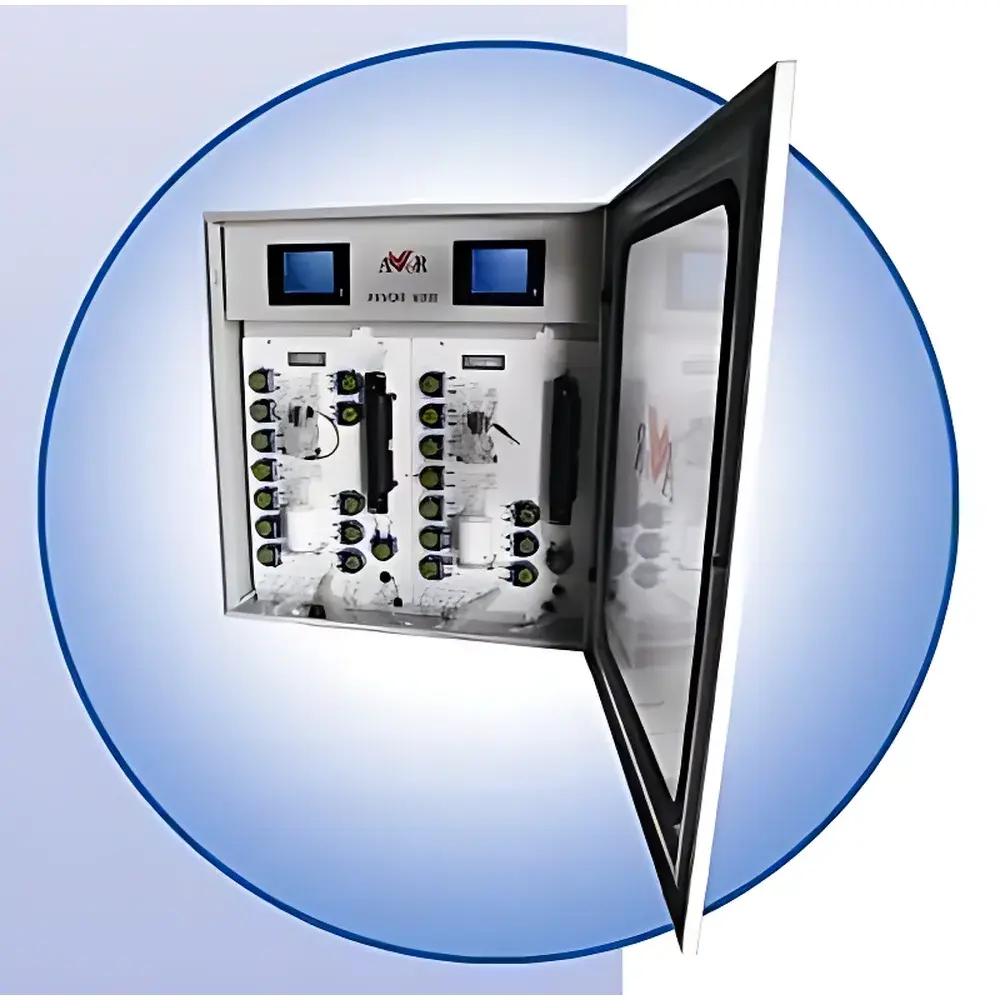
AVVOR 9000 Online Heavy Metals Analyzer for Water Quality Using Anodic Stripping Voltammetry
| Brand | AVVOR |
|---|---|
| Origin | Canada |
| Model | AVVOR 9000 |
| Detection Principle | Anodic Stripping Voltammetry (ASV) |
| Measurable Elements | Cu, Pb, Zn, Cd, Mn, Sb, Tl, Fe, Ni, As, Hg, Se, Co, Mo, Au, Ag, Cr, Cr(VI), Sn, Pd, U |
| Electrode Options | Gold, Mercury-Film, Bismuth-Film, Bare Carbon |
| Max Simultaneous Channels | 2 modules × 5 elements each |
| Output Interfaces | 8 × 4–20 mA analog outputs, RS-485, RS-232 |
| Compliance Support | Designed for ASTM D3559, ISO 11929 (uncertainty evaluation), USP <232>/<233>, EPA Method 7000B (ASV-based), GLP/GMP-ready data logging |
Overview
The AVVOR 9000 Online Heavy Metals Analyzer is an industrial-grade electrochemical instrument engineered for continuous, real-time quantification of trace heavy metal ions in aqueous matrices. It operates on the internationally standardized principle of Anodic Stripping Voltammetry (ASV), a highly sensitive and selective potentiometric technique widely adopted in regulatory environmental monitoring. In ASV, target metal ions are first pre-concentrated onto a working electrode surface via controlled cathodic deposition (electrolysis), followed by oxidative stripping under a linearly scanned or pulsed potential waveform. The resulting current peaks—each uniquely associated with the redox potential of a specific element—are digitally resolved and calibrated against multi-point standard solutions to yield quantitative concentration data in µg/L (ppb) range. Unlike optical or atomic absorption methods, ASV requires no sample digestion, minimal reagent consumption, and delivers sub-ppb detection limits for key toxicants including Pb, Cd, Hg, As, and Cr(VI) without interferences from common organic matter or turbidity—making it especially suitable for raw water, wastewater effluents, drinking water distribution systems, and marine monitoring applications.
Key Features
- Modular architecture supporting up to two independent ASV measurement modules, each configurable for up to five simultaneous elements
- Electrode flexibility: interchangeable gold, mercury-film, bismuth-film, and bare carbon working electrodes optimized for specific analyte groups (e.g., Hg/As/Se on gold; Zn/Cd/Pb/Cu/Mn on mercury-film)
- Integrated sample conditioning system with automated filtration, pH adjustment, and optional UV digestion to minimize organic interference and matrix effects
- Eight programmable 4–20 mA analog outputs assignable to any measured parameter or diagnostic status, compliant with SCADA integration standards
- Dual serial communication: isolated RS-485 (Modbus RTU) and RS-232 for local configuration, firmware updates, and bidirectional telemetry
- Automated maintenance routines including scheduled calibration, electrode cleaning cycles, and blank subtraction protocols
- IP65-rated enclosure with internal humidity control, thermal stabilization, and leak-detection safeguards for unattended outdoor deployment
Sample Compatibility & Compliance
The AVVOR 9000 is validated for direct analysis of liquid samples across a broad conductivity range (10–2000 µS/cm) and pH 4.0–9.0. It accommodates influent and effluent streams from municipal wastewater treatment plants, industrial process discharges (e.g., electroplating, mining, battery manufacturing), surface and groundwater sources, and desalination plant intakes. Instrument design aligns with performance criteria outlined in EPA Method 7000B for ASV-based metals analysis and supports uncertainty estimation per ISO/IEC 17025 and ISO 11929. Data integrity features—including time-stamped audit trails, user-access controls, electronic signatures, and non-erasable event logs—facilitate compliance with FDA 21 CFR Part 11 and EU Annex 11 requirements for regulated environments. All calibration and validation records are exportable in CSV or PDF format for regulatory submission.
Software & Data Management
The embedded firmware runs AVVOR ControlSuite™ v3.x, a deterministic real-time OS enabling sub-second sampling intervals and synchronized multi-channel acquisition. Configuration, diagnostics, and historical trend visualization are accessible via web-based interface (HTTPS/TLS 1.2) or local Ethernet connection. Data is stored internally on encrypted SD card (up to 32 GB) with automatic rollover and remote retrieval via FTP/SFTP. The system supports OPC UA server functionality for seamless integration into enterprise MES or LIMS platforms. All measurement events—including calibration checks, electrode swaps, and alarm triggers—are timestamped and archived with metadata (temperature, flow rate, pH if co-installed). Optional cloud gateway enables secure remote monitoring, predictive maintenance alerts, and over-the-air firmware updates without on-site intervention.
Applications
- Real-time compliance monitoring at NPDES discharge points and POTW outfalls
- Early-warning detection of accidental heavy metal releases in watershed protection zones
- Process control in hydrometallurgical recovery circuits and electroplating rinse tanks
- Drinking water safety verification at treatment plant entry points and distribution nodes
- Marine environmental surveillance near port facilities, offshore drilling platforms, and aquaculture zones
- Research-grade speciation studies when paired with optional valence-selective modules (e.g., Cr(III)/Cr(VI) differentiation)
FAQ
What detection limits can the AVVOR 9000 achieve for common heavy metals?
Typical method detection limits (MDLs) range from 0.05 µg/L (Hg, Pb) to 0.5 µg/L (Zn, Ni) under optimal conditions, depending on electrode type, deposition time, and matrix complexity.
Is the instrument certified for regulatory reporting under EPA or ISO standards?
While the AVVOR 9000 itself is not EPA-certified as a “listed method,” its ASV methodology conforms to EPA Method 7000B, and its performance validation documentation supports use in programs requiring ISO 17025-accredited testing laboratories.
Can the system operate unattended for extended periods?
Yes—designed for 30-day autonomous operation with scheduled calibrations, self-diagnostic routines, and low-power sleep modes between measurements.
How does the instrument handle electrode fouling in high-solids wastewater?
The system incorporates ultrasonic electrode cleaning cycles and adaptive baseline correction algorithms; optional inline filtration (5–10 µm) is recommended for suspended solids >50 mg/L.
Is remote software update and troubleshooting supported?
Firmware updates and configuration changes can be performed remotely via secure TLS-encrypted connection; diagnostic logs and real-time sensor readings are accessible through the web interface.
Related Products







