
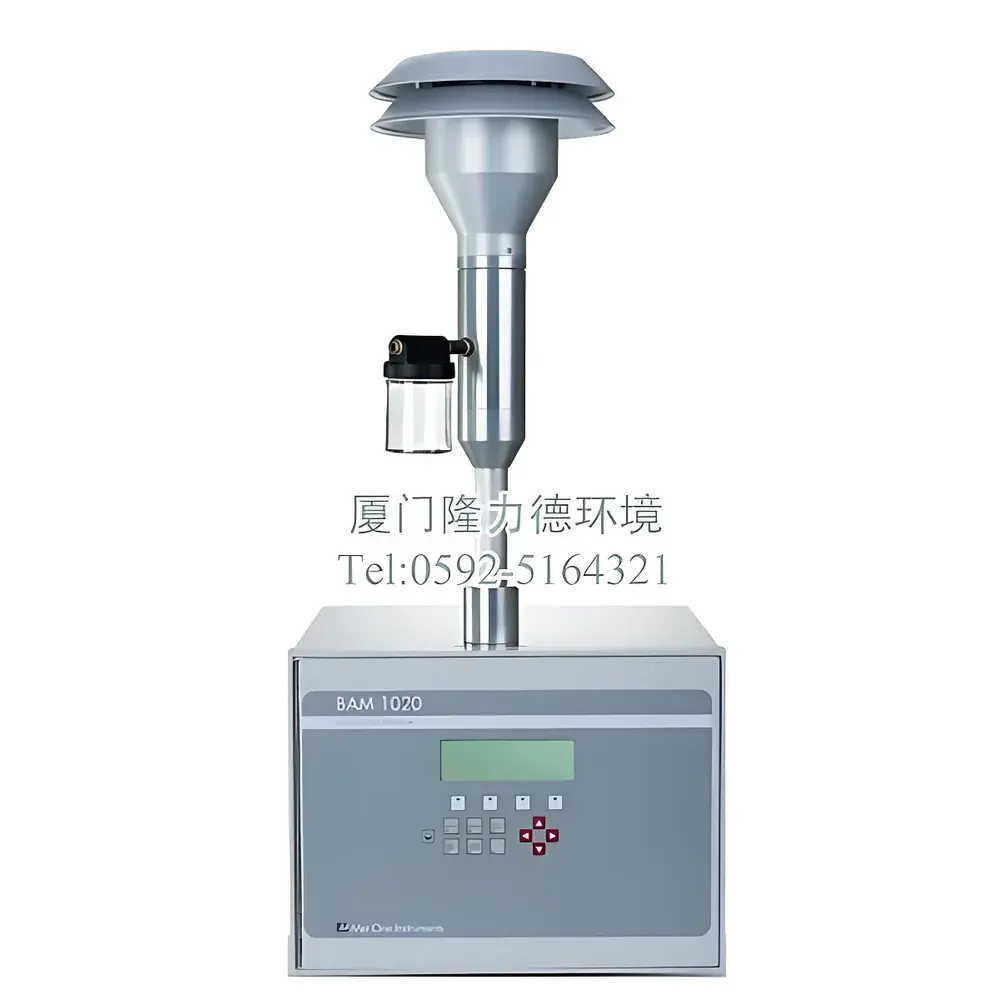
METONE BAM-1020 EPA-Certified Beta Attenuation PM₂.₅ Ambient Air Monitor
| Brand | METONE |
|---|---|
| Origin | USA |
| Model | BAM-1020 |
| Certification | EPA EQPM-0798-122 |
| Measurement Principle | Beta Ray Attenuation (¹⁴C source) |
| Range | 0–50 mg/m³ |
| Sampling Method | Isokinetic Impactor with Rotating Glass Impactor Plate (30-sample capacity) |
| Data Output | Real-time mass concentration (µg/m³ or mg/m³), automatic zero/drift correction, event logging |
| Compliance | US EPA EQPM, UK MCERTS, Korea K-EMAS, China HJ 653-2013 |
Overview
The METONE BAM-1020 is a reference-grade, continuous ambient air monitoring instrument engineered for regulatory-compliant measurement of fine particulate matter (PM₂.₅) mass concentration in outdoor environments. It operates on the beta ray attenuation (BRA) principle—a gravimetrically traceable physical method endorsed by the U.S. Environmental Protection Agency (EPA) under its Equivalent Method (EQPM) program (Certification No. EQPM-0798-122). The instrument employs a low-energy ¹⁴C beta radiation source and a high-sensitivity scintillation detector to quantify particle mass loading on a continuously advancing glass fiber filter tape. As airborne particles deposit onto the tape during isokinetic sampling, attenuation of beta particles increases proportionally to accumulated mass—enabling direct, interference-free calculation of mass concentration in µg/m³. Unlike optical scattering methods, BRA is inherently insensitive to particle morphology, refractive index, color, or hygroscopic growth, ensuring metrological robustness across diverse aerosol compositions typical of urban, industrial, and rural monitoring networks.
Key Features
- EPA EQPM-certified performance for PM₂.₅ compliance monitoring—fully aligned with 40 CFR Part 53 requirements for federal reference methods (FRMs)
- Integrated rotating glass impactor plate supporting up to 30 sequential sample collections; enables multi-site or time-resolved fractionation without manual intervention
- Automated dual-point calibration cycle: real-time zero check (using clean tape segment) and drift correction (via calibrated reference membrane insertion) performed before and after each sampling interval
- Microprocessor-controlled tape advancement, flow regulation, temperature/pressure compensation, and diagnostics—ensuring unattended operation over extended deployment periods
- Comprehensive event logging: timestamps, error codes (e.g., flow fault, tape break, power loss), deviation flags (e.g., >±15% from running mean), and maintenance alerts stored internally and exportable via RS-232 or optional Ethernet
- Configurable output modes: real-time PM₂.₅ (µg/m³), PM₁₀, or TSP; selectable averaging intervals (1-hour, 24-hour); compatible with EPA AQS, EEA AQ e-Reporting, and national air quality databases
Sample Compatibility & Compliance
The BAM-1020 is validated for ambient air matrices compliant with ISO 12103-1 (A2 test dust), ISO 29463 (HEPA/ULPA filter testing), and ASTM D1738 (dust sampling standards). Its isokinetic inlet meets EPA PS-11 specifications for PM₂.₅ size-selective sampling efficiency (>50% at 2.5 µm aerodynamic diameter, ±10% tolerance). The system satisfies data quality objectives (DQOs) outlined in EPA QA/G-5 and supports full auditability per 40 CFR Part 58 Appendix A—enabling use in State Implementation Plans (SIPs), National Ambient Air Quality Standards (NAAQS) reporting, and transboundary air pollution assessments. Certifications include UK MCERTS (EN 15267-3), Korean K-EMAS (KMOEL Notice No. 2019-124), and Chinese HJ 653-2013 for continuous emission and ambient monitoring applications.
Software & Data Management
Instrument control and data acquisition are managed via METONE’s BAMView™ software suite (Windows-based), supporting remote configuration, firmware updates, diagnostic review, and raw data extraction in CSV/ASCII format. All measurements adhere to EPA 21 CFR Part 11 requirements for electronic records: user authentication, audit trails (including operator ID, timestamp, action type), and immutable data archiving. Optional integration with third-party SCADA platforms (e.g., Ignition, Wonderware) via Modbus TCP or OPC UA ensures seamless ingestion into centralized environmental data management systems (EDMS) compliant with ISO 14001 and EU INSPIRE directives.
Applications
- Federal, state, and municipal ambient air quality monitoring networks (AQMNs) requiring FRM-equivalent data
- Long-term trend analysis for PM₂.₅ exposure assessment in epidemiological studies (e.g., cohort health surveillance)
- Source apportionment support when co-located with elemental analyzers (XRF, IC) or gas-phase monitors (O₃, NO₂, SO₂)
- Regulatory enforcement at industrial fence lines and transportation corridors
- Validation of satellite-derived aerosol optical depth (AOD) products and regional chemical transport models (e.g., CMAQ, WRF-Chem)
- Calibration transfer standard for field-deployed optical particle counters (OPCs) and low-cost sensor networks
FAQ
What regulatory standards does the BAM-1020 meet for PM₂.₅ monitoring?
It holds U.S. EPA EQPM certification (EQPM-0798-122), UK MCERTS approval, Korean K-EMAS listing, and complies with Chinese HJ 653-2013 for automated particulate monitoring.
How frequently is zero and span calibration performed?
Automatic zero checks occur before and after every sampling cycle (typically hourly); drift correction using a certified reference membrane is executed at user-defined intervals (default: daily).
Can the BAM-1020 measure PM₁₀ and TSP in addition to PM₂.₅?
Yes—by installing appropriate size-selective inlets (e.g., VSCC for PM₁₀, total inlet for TSP) and reconfiguring the data processing algorithm within BAMView™ software.
Is the ¹⁴C beta source subject to nuclear regulatory licensing?
Yes—the device contains an exempt quantity of ¹⁴C (≤37 kBq) per NRC 10 CFR 30.18; installation requires notification to national radiation safety authority but no active license for routine operation.
What maintenance is required for long-term unattended operation?
Filter tape replacement every 30 days (standard), annual flow sensor verification, biannual optical path cleaning, and source activity validation every 5 years per manufacturer’s service protocol.







