
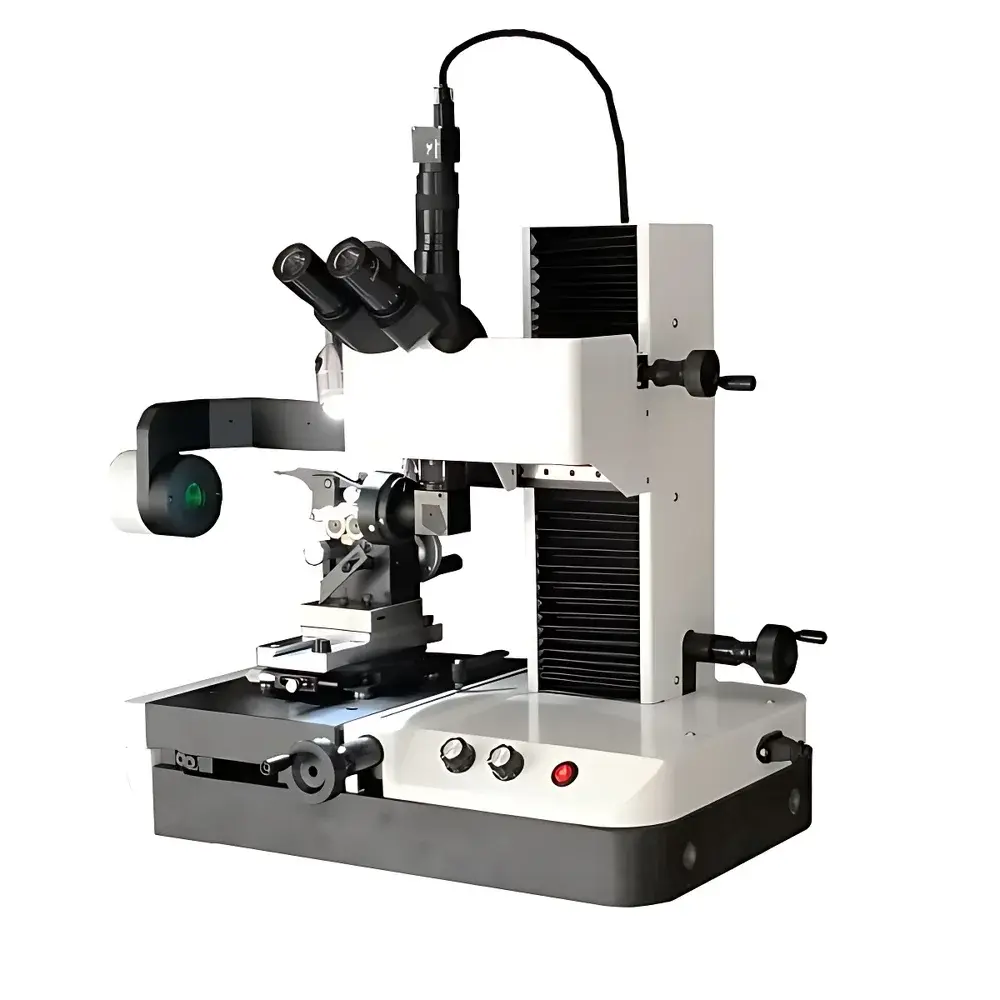
Product Intelligence and Creativity PZ-4050D Tool Measuring Microscope
| Brand | Product Intelligence and Creativity |
|---|---|
| Model | PZ-4050D |
| Origin | Beijing, China |
| Type | Video-enabled Tool Measuring Microscope with Continuous Zoom Optics |
| Imaging Interface | VGA output |
| Illumination | 12V adjustable LED ring light (optional) |
| Mounting | Dedicated base focus stand for CNC grinder integration |
| Compliance | Designed for industrial metrology environments per ISO 10360-2 (coordinate measuring systems) and aligned with GLP-aligned visual inspection workflows |
Overview
The Product Intelligence and Creativity PZ-4050D Tool Measuring Microscope is a purpose-engineered optical metrology system designed for real-time dimensional verification of cutting tools during grinding and sharpening operations. Unlike conventional benchtop microscopes, the PZ-4050D integrates directly onto CNC tool grinders and manual磨刀 machines via a rigid mounting base, enabling in-situ observation and measurement without part removal. Its core optical architecture employs a continuous zoom objective lens system coupled with a high-resolution VGA-format color camera, delivering stable, parfocal image acquisition across its magnification range. The system operates on the principle of calibrated video microscopy: a precision-ground reticle—engraved with traceable linear and angular scales—is optically superimposed onto the live tool image. This allows direct pixel-to-dimension correlation under defined optical magnification, supporting traceable measurements of edge radius, flank angle, relief angle, cutting edge width, and tip geometry. Engineered for production-floor durability, the PZ-4050D features sealed optical pathways, an external protective housing, and integrated dust- and moisture-resistant construction—ensuring long-term stability in machine shop environments with coolant mist, metal particulates, and thermal fluctuations.
Key Features
- Continuous zoom optical path with parfocal design: Maintains focus across the full magnification range, eliminating refocusing delays during rapid inspection cycles.
- Calibrated reticle overlay: High-contrast, laser-etched glass scale with dual-axis linear graduations (mm and inch) and angular references (0°–90°), certified for linearity ≤ ±0.02 mm over 10 mm field of view.
- VGA-resolution imaging system: Progressive-scan color camera with low-noise CMOS sensor, 640 × 480 active pixels, and 60 fps frame rate for jitter-free motion tracking of rotating or translating tool edges.
- Dedicated mechanical interface: Precision-machined base bracket with micrometer-adjustable Z-axis fine focus and X/Y translation for repeatable alignment to grinding wheel centerline.
- Integrated LED ring illumination: 12V DC dimmable coaxial lighting with uniform intensity distribution (±5% variation across FOV), optimized for high-contrast edge detection on carbide, HSS, and ceramic tool substrates.
- Environmental hardening: Internal conformal coating on optical mounts; external aluminum alloy housing with IP52-rated ingress protection; optional anti-reflective coated protective window at objective front element.
Sample Compatibility & Compliance
The PZ-4050D supports measurement of solid rotary and indexable cutting tools—including end mills, drills, reamers, inserts, and lathe bits—with diameters from 0.5 mm to 50 mm and lengths up to 300 mm. It accommodates both coated and uncoated geometries, including PVD- and CVD-coated surfaces, without requiring contrast enhancement agents. The system conforms to foundational metrological standards for visual inspection instrumentation: ISO 10360-2 (acceptance and reverification testing of coordinate measuring systems), ISO 9001:2015 clause 7.1.5.2 (monitoring and measuring resources), and ASTM E29-23 (standard practice for using significant digits in test data). While not a certified CMM, its measurement methodology supports traceability when used with NIST-traceable calibration artifacts (e.g., step gauges, radius standards) and documented operator training per ISO/IEC 17025 Annex A.2 requirements for non-automatic measuring equipment.
Software & Data Management
The PZ-4050D operates as a hardware-calibrated analog/digital hybrid system. No proprietary software installation is required for basic operation: VGA video output connects directly to industrial monitors or legacy CCTV displays. For enhanced documentation, optional third-party machine vision software (e.g., HALCON, OpenCV-based custom scripts) may ingest the VGA stream for automated edge detection, profile fitting, and report generation. All manual measurements are recorded via standardized inspection worksheets aligned with ASME Y14.5-2018 geometric dimensioning conventions. Audit trails—including operator ID, timestamp, tool ID, and measured values—are maintained externally in LIMS or MES platforms. The system supports FDA 21 CFR Part 11 compliance when deployed with validated electronic record procedures, including user authentication, electronic signatures, and immutable audit logs for quality-critical tool certification (e.g., aerospace or medical device tooling).
Applications
- Real-time edge geometry verification during CNC tool grinding, reducing post-process scrap by >35% in high-mix small-batch production.
- Relief angle and rake angle validation for carbide insert resharpening in automotive powertrain manufacturing.
- Tip radius quantification (0.01–0.5 mm range) for micro-end mills used in PCB drilling and medical component machining.
- Flank wear monitoring on high-speed steel drills undergoing iterative regrinding cycles.
- In-process verification of chamfer width and corner break dimensions prior to final heat treatment.
- Training and qualification of grinding operators through side-by-side visual comparison of nominal vs. actual tool profiles.
FAQ
Can the PZ-4050D be retrofitted onto existing manual or CNC grinding machines?
Yes—the base mounting bracket is modular and configurable for standard T-slot tables, magnetic chucks, and OEM-specific flange interfaces. Mechanical adaptation kits (including custom adapter plates) are available upon request.
Is calibration required before first use?
A factory calibration certificate is supplied with each unit, referencing traceable line-pair and radius standards. End users must perform initial verification using a certified step gauge or radius artifact per ISO 10360-2 Annex D before operational deployment.
Does the system support measurement uncertainty estimation?
Uncertainty contributors include optical distortion (≤0.15% at full field), reticle line width tolerance (±0.5 µm), and operator parallax error (mitigated by fixed-eye-position monitor mounting). Typical expanded uncertainty (k=2) for linear measurements is ±(2.5 µm + 0.02% of reading) under controlled lab conditions.
What maintenance is recommended for long-term accuracy?
Biannual cleaning of optical surfaces with lens-grade solvent and lint-free wipes; annual verification of reticle alignment and focus repeatability; replacement of LED ring light every 25,000 hours (L70 rating).
Is the VGA camera compatible with modern digital displays?
Yes—VGA output can be converted to HDMI or DisplayPort via commercial-grade scalers supporting 60 Hz refresh and 1:1 pixel mapping. Native VGA monitors remain widely available in industrial control rooms and shop-floor kiosks.



