
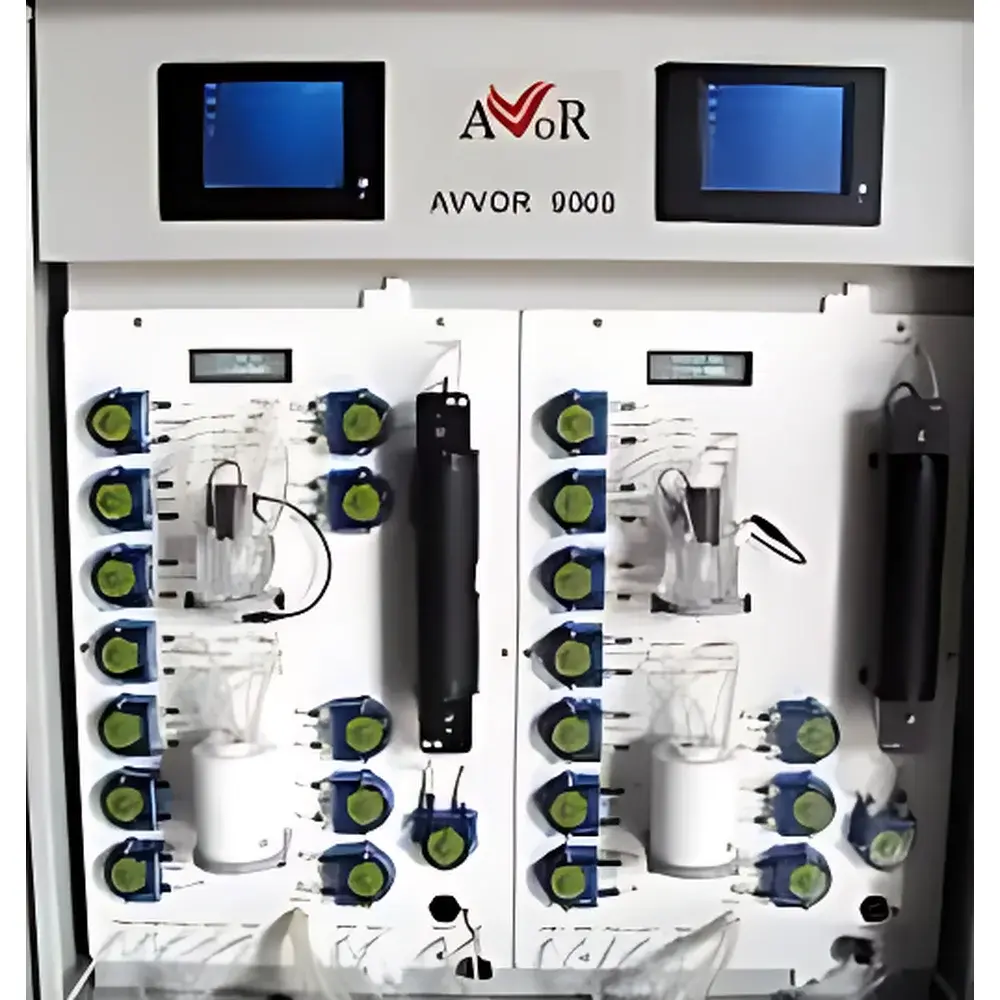
AVVOR 9000 Online Heavy Metals Analyzer for Water Quality Monitoring
| Brand | AVVOR |
|---|---|
| Origin | Canada |
| Model | AVVOR 9000 |
| Detection Principle | Anodic Stripping Voltammetry (ASV) |
| Measurable Elements | Cu, Pb, Zn, Cd, Mn, Sb, Tl, Fe, Ni, As, Hg, Se, Co, Mo, Au, Ag, Cr, Cr(VI), Sn, Pd, U |
| Electrode Options | Gold, Mercury-Film, Bismuth-Film, Bare Carbon |
| Max. Simultaneous Channels | 2 modules × 5 metals/module |
| Output Interfaces | 8 × 4–20 mA analog outputs, RS-485, RS-232 |
| Compliance | Designed for ASTM D3559, ISO 11047, USP <232>/<233>, EPA Method 7000B |
| Enclosure Rating | IP65 |
| Power Supply | 100–240 VAC, 50/60 Hz |
| Operating Temperature | 5–40 °C |
| Sample Inlet | 6–8 mm OD tubing, pressure-rated for continuous flow |
Overview
The AVVOR 9000 Online Heavy Metals Analyzer is an industrial-grade electrochemical instrument engineered for continuous, real-time quantification of trace heavy metal ions in aqueous matrices. It operates on the internationally standardized anodic stripping voltammetry (ASV) principle—a well-established, reference-method electrochemical technique recognized by ASTM D3559 (lead in water), ISO 11047 (zinc and cadmium in drinking water), and EPA Method 7000B (metals by ASV). In ASV, target metal ions are first preconcentrated onto a working electrode surface via controlled electrolysis under negative potential; following a defined deposition period, a positive-going voltage scan dissolves (strips) the accumulated metals, generating characteristic current peaks whose magnitude correlates linearly with concentration. This method delivers sub-ppb detection sensitivity for most target analytes—including Cu, Pb, Zn, Cd, Mn, Sb, Tl, Fe, Ni, As, Hg, Se, Co, Mo, Cr(VI), Sn, Pd, Au, Ag, and U—without requiring hazardous reagents or complex sample digestion. The AVVOR 9000 is purpose-built for unattended operation in municipal wastewater outfalls, industrial effluent streams, surface water monitoring stations, groundwater wells, desalination plant intakes, and potable water distribution networks.
Key Features
- Modular dual-channel architecture: Supports up to two independent ASV measurement modules—each configurable with gold, mercury-film, bismuth-film, or bare carbon working electrodes—to enable simultaneous, selective detection of up to ten distinct metals.
- Field-deployable robustness: IP65-rated sealed enclosure with integrated humidity control and thermal stabilization ensures stable performance across ambient temperatures from 5 °C to 40 °C.
- Automated operational integrity: Built-in self-diagnostics monitor electrode health, fluidic path integrity, calibration drift, and power stability; triggers audible/visual alarms and logs fault events with timestamps.
- Regulatory-ready data handling: Internal non-volatile memory stores >12 months of raw voltammograms, calibration logs, maintenance records, and audit trails compliant with GLP/GMP documentation requirements.
- Flexible integration: Eight programmable 4–20 mA analog outputs allow assignment of any measured parameter to any channel; RS-485 (Modbus RTU) and RS-232 interfaces support SCADA, DCS, and LIMS connectivity.
- Autonomous calibration management: Scheduled automatic standard addition and blank verification cycles reduce manual intervention while maintaining traceability to NIST-traceable reference solutions.
Sample Compatibility & Compliance
The AVVOR 9000 accepts continuously flowing water samples within pH 4.0–9.5 and turbidity ≤50 NTU. Integrated inline filtration (5 µm) and optional UV oxidation module mitigate organic interference and oxidize labile species (e.g., Cr(III) → Cr(VI)). Matrix compatibility has been validated per ISO 5667-3 for sampling preservation and ISO 17294-2 for multi-element electrochemical analysis. Instrument design adheres to IEC 61326-1 (EMC for laboratory equipment) and IEC 61000-6-2/6-3. Data security and electronic record integrity align with FDA 21 CFR Part 11 requirements when configured with user-access controls and digital signature logging.
Software & Data Management
The embedded firmware supports remote configuration via web-based GUI or terminal emulation. All voltammetric scans are stored in open-format CSV with metadata headers (timestamp, electrode ID, deposition time, scan rate, peak identification). Optional AVVOR Analytics Suite provides advanced baseline correction, peak deconvolution for overlapping signals (e.g., Pb/Cd), multivariate calibration modeling, and automated report generation (PDF/Excel) compliant with ISO/IEC 17025 reporting clauses. Audit trail export includes operator ID, action type, timestamp, and pre-/post-change parameter values.
Applications
- Real-time compliance monitoring at NPDES discharge points for Cu, Pb, Zn, Cd, Ni, and Cr(VI)
- Early-warning detection of industrial plume migration in aquifer monitoring wells
- Process control in metal finishing rinse baths and electroplating effluents
- Drinking water safety surveillance for As, Hg, and Pb at treatment plant entry/exit points
- Marine environmental assessment of port sediments leachate and ballast water discharges
- Research-grade speciation studies using sequential electrode swapping (e.g., Hg²⁺ vs. methylmercury via selective complexation)
FAQ
What regulatory methods does the AVVOR 9000 validate against?
It complies with ASTM D3559 (Pb), ISO 11047 (Zn/Cd), EPA Method 7000B, and supports validation protocols aligned with ISO/IEC 17025 for in-house method verification.
Can the system measure hexavalent chromium (Cr(VI)) independently of total Cr?
Yes—using a dedicated Cr(VI)-specific bismuth-film electrode and optimized deposition potential window, enabling selective quantification without interference from Cr(III) or other trivalent metals.
Is sample pretreatment required prior to analysis?
Minimal pretreatment is needed: inline 5 µm filtration is standard; for high-DOC or sulfide-rich matrices, optional UV/persulfate oxidation ensures complete metal liberation and speciation control.
How often must the working electrode be replaced or regenerated?
Gold and carbon electrodes typically sustain >5,000 measurements; mercury- and bismuth-film electrodes are automatically recoated before each analysis cycle, eliminating manual refurbishment.
Does the instrument support remote firmware updates and diagnostic telemetry?
Yes—via secure HTTPS interface with TLS 1.2 encryption; all diagnostics, error codes, and sensor health metrics are accessible through Modbus register mapping for predictive maintenance integration.







