
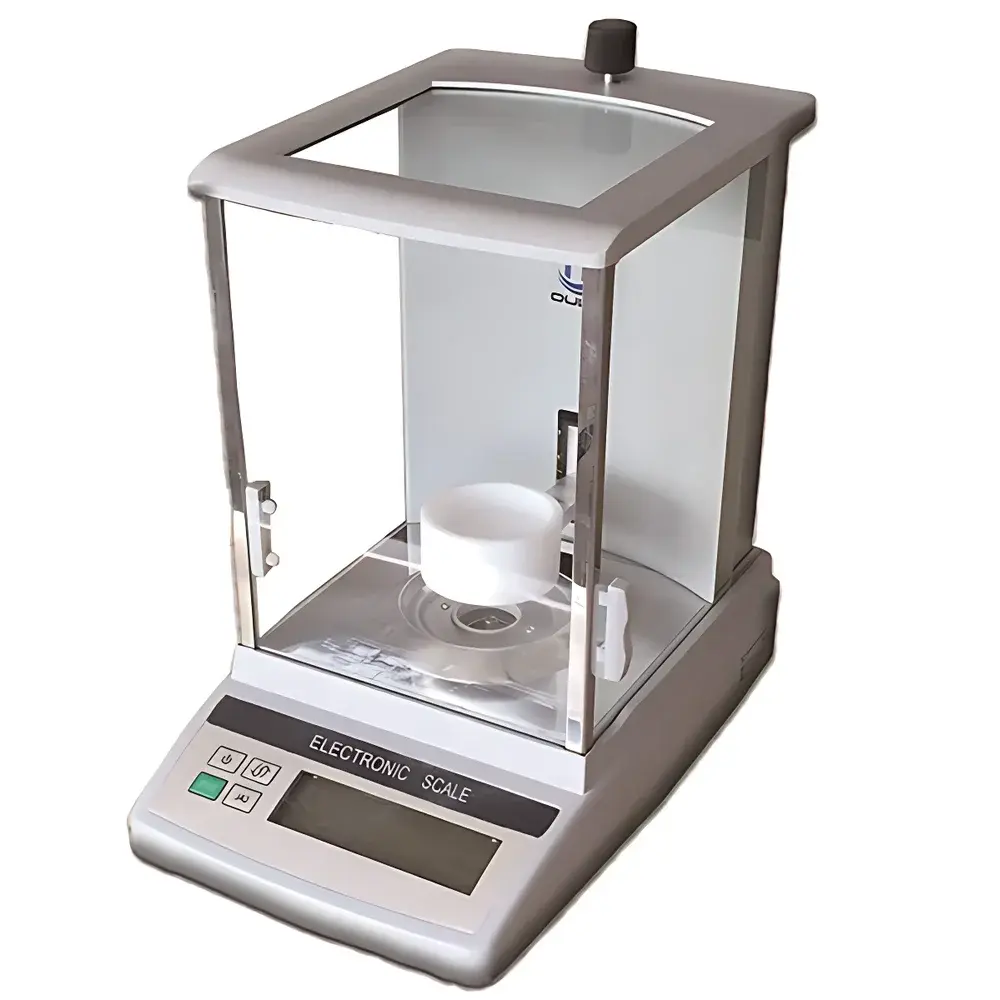
PZ-E2 Surface Tensiometer by Product Intelligence & Creativity
| Brand | Product Intelligence & Creativity |
|---|---|
| Origin | Beijing, China |
| Model | PZ-E2 |
| Measurement Range | 0–1000 mN/m |
| Resolution | 0.01 mN/m |
| Accuracy | ±0.01 mN/m |
| Temperature Display Range | 0–100 °C |
| Temperature Display Accuracy | ±0.1 °C |
| Test Methods | Du Noüy Ring Method & Wilhelmy Plate Method |
| Sample Volume Requirement | ≥3 mL (plate), ≥5 mL (ring) |
| Power Consumption | 100 W |
| Dimensions (L×W×H) | 20 × 35 × 35 cm |
| Weight | 7.5 kg |
Overview
The PZ-E2 Surface Tensiometer is a precision instrument engineered for the quantitative determination of surface and interfacial tension using two standardized physical methods: the Du Noüy ring method and the Wilhelmy plate method. Based on classical capillary force measurement principles, it operates by quantifying the vertical force exerted on a calibrated platinum probe—either a ring or a plate—as it interacts with the liquid–air (or liquid–liquid) interface. This force is directly related to the surface tension coefficient (γ), expressed in millinewtons per meter (mN/m), under equilibrium or dynamic conditions. Designed for laboratory environments requiring high reproducibility and traceable metrology, the PZ-E2 complies with fundamental test protocols referenced in ASTM D971, ISO 6295, and GB/T 6541. Its robust architecture supports routine QC testing in insulating oil analysis (e.g., transformer oil quality monitoring), surfactant formulation development, colloidal dispersion stability assessment, and academic research in interfacial science.
Key Features
- Dual-method capability: Simultaneous hardware support for both Wilhelmy plate and Du Noüy ring measurements—enabling method comparison, cross-validation, and application-specific optimization.
- High-resolution force detection: Integrated strain-gauge-based microbalance system with 0.01 mN/m resolution and ±0.01 mN/m accuracy, ensuring reliable detection of subtle interfacial phenomena including surfactant adsorption kinetics.
- Temperature-aware operation: Built-in digital temperature sensor (0–100 °C, ±0.1 °C) allows real-time thermal correction of surface tension values; optional external thermostatic bath interface enables controlled isothermal testing per ISO 1409 requirements.
- Stable mechanical design: Manual micrometer-driven sample stage with backlash-free vertical adjustment ensures precise probe immersion control and minimizes vibration-induced noise during force acquisition.
- Calibration traceability: Supports multi-point calibration using certified reference standards—including distilled water (72.75 mN/m at 20 °C) and anhydrous ethanol (22.39 mN/m at 20 °C)—as well as mechanical weight verification via supplied calibration masses.
Sample Compatibility & Compliance
The PZ-E2 accommodates a broad range of Newtonian and non-Newtonian liquids, including aqueous surfactant solutions, organic solvents, polymer melts, crude oils, and emulsions. Minimum sample volumes are 3 mL (Wilhelmy plate) and 5 mL (Du Noüy ring), minimizing reagent consumption while maintaining meniscus integrity. All wetted parts—including the platinum plate (20 × 10 × 0.1 mm) and platinum ring (19.5 mm outer diameter, 0.37 mm wire diameter)—are chemically inert and compatible with standard cleaning protocols involving flame annealing or solvent rinsing. The instrument meets essential safety and electromagnetic compatibility requirements for laboratory use (IEC 61010-1). While not certified for GMP-regulated production environments, its data logging capabilities—including timestamped measurements and user-defined metadata—support GLP-aligned documentation practices when used with validated software workflows.
Software & Data Management
The included Windows-compatible software provides full remote instrument control, real-time data visualization, and automated post-processing. Key functions include: automatic zero-point compensation, temperature-corrected γ calculation using the Harkins–Jordan equation, export of time-resolved surface tension curves (CSV/Excel), batch report generation with customizable templates, and direct printing via USB-connected thermal printers. Audit trails record operator ID, calibration events, and parameter changes—aligning with basic 21 CFR Part 11 readiness when deployed with institutional IT governance policies. Raw force-vs.-time datasets are retained in native binary format for retrospective analysis or third-party modeling integration.
Applications
- Power industry: Routine surface tension monitoring of insulating oils to detect oxidation byproducts and hydrophilic contamination affecting dielectric strength.
- Petroleum & lubricants: Interfacial tension characterization between crude oil and alkaline/surfactant flooding agents in enhanced oil recovery (EOR) studies.
- Pharmaceutical R&D: Evaluation of excipient–surfactant interactions in nanoemulsion and liposome formulations.
- Academic teaching labs: Quantitative demonstration of Gibbs adsorption isotherms, critical micelle concentration (CMC) determination, and temperature-dependent surface thermodynamics.
- Coatings & inks: Assessment of wetting behavior and substrate compatibility through dynamic surface tension profiling.
FAQ
What is the difference between the Wilhelmy plate and Du Noüy ring methods?
The Wilhelmy plate method measures the force required to maintain a vertically oriented platinum plate in contact with the liquid surface, providing continuous, time-resolved data ideal for kinetic studies. The Du Noüy ring method measures the maximum pull force needed to detach a platinum ring from the surface, offering simplicity and wide historical benchmarking—but with greater susceptibility to viscous drag and geometric distortion.
Can the PZ-E2 measure interfacial tension between two immiscible liquids?
Yes—when configured with appropriate density-matched subphases and using either probe geometry, the instrument supports liquid–liquid interfacial tension measurement per ISO 6295 guidelines.
Is temperature control built into the instrument?
The PZ-E2 includes an integrated temperature sensor for ambient monitoring and automatic thermal correction of surface tension values. For active temperature regulation, an optional external circulation bath interface is available.
How often does the instrument require recalibration?
Daily zero-point verification is recommended before each measurement session. Full multi-point calibration using reference liquids should be performed weekly or after any mechanical disturbance to the sensor assembly.
Does the software support automated CMC determination?
While the base software does not include embedded CMC algorithms, exported time- and concentration-series datasets can be processed externally using standard nonlinear regression tools to identify inflection points consistent with CMC thresholds.



