
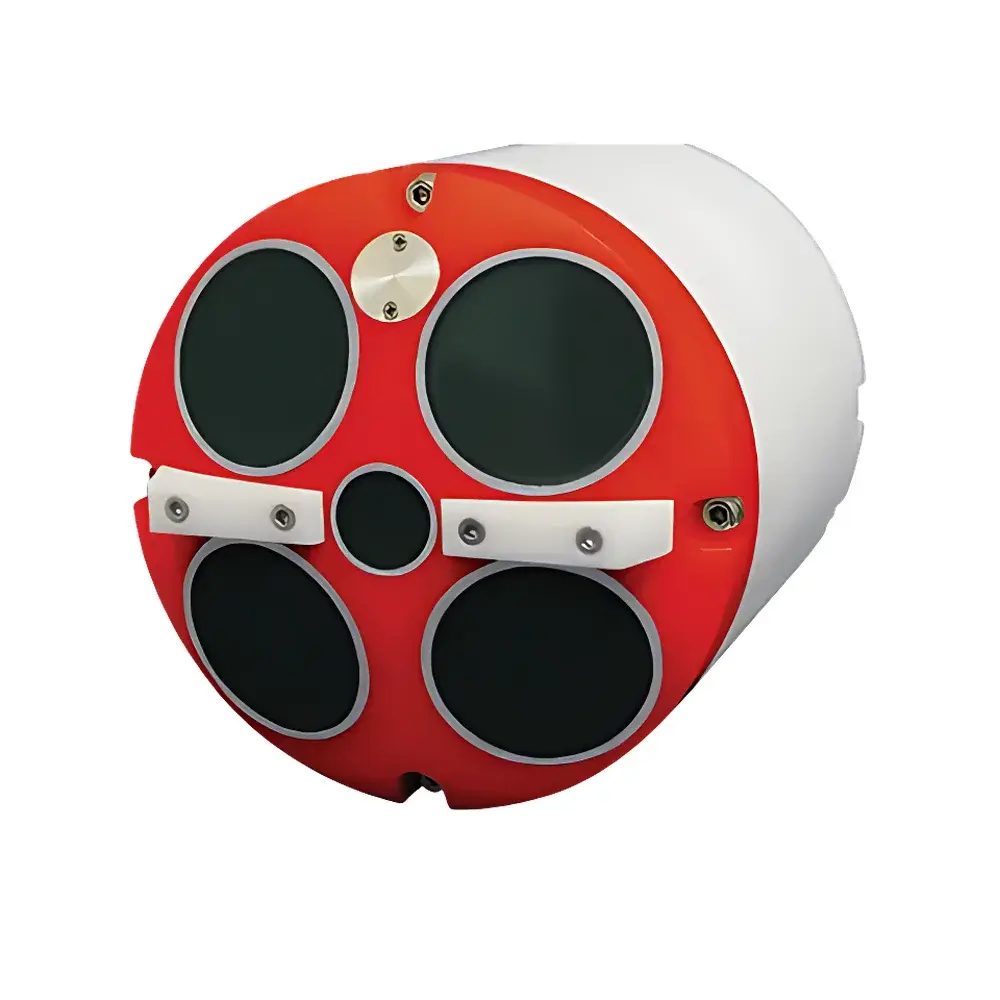
AVVOR RiverPro Doppler Velocity Profiler
| Brand | AVVOR |
|---|---|
| Origin | Fujian, China |
| Manufacturer Type | Authorized Distributor |
| Country of Origin | China |
| Model | Baihaitun RiverPro |
| Depth Measurement Range | 0.12–25 m |
| Compatible Platform | Shared buoy system with RiverRay ADCP |
| Electronics Architecture | Next-generation modular electronics platform (upgradable to RiverRay units) |
Overview
The AVVOR RiverPro Doppler Velocity Profiler is a purpose-built acoustic Doppler current profiler (ADCP) engineered for high-accuracy, real-time velocity profiling and discharge computation in shallow, low-flow environments—including small rivers, irrigation canals, drainage ditches, and urban waterways. Operating on the principle of pulsed coherent Doppler sonar, the RiverPro transmits acoustic pulses at a fixed frequency (typically 1–3 MHz, depending on configuration) and analyzes the phase shift and time-of-flight of backscattered signals from suspended sediment and planktonic particles. This enables precise, depth-resolved measurement of three-component water velocity vectors across up to 128 user-configurable bins, with bin resolution adjustable from 2 cm to 20 cm. Unlike conventional deep-water ADCPs, the RiverPro is optimized for near-surface deployment and minimal draft requirements, supporting bottom-mounted, moored, or buoy-based operation with minimal flow disturbance. Its design emphasizes robustness in turbid, vegetation-prone, and low-velocity conditions where traditional mechanical current meters exhibit poor repeatability or calibration drift.
Key Features
- Shallow-water optimized acoustic architecture: Minimum detectable depth of 0.12 m with stable near-bed velocity estimation down to 5 cm above the transducer face.
- Shared buoy compatibility: Fully interoperable with the AVVOR RiverRay ADCP buoy platform—enabling field-swappable transducers without re-deployment of flotation hardware or recalibration of buoy dynamics.
- Modular next-generation electronics: Based on a field-upgradeable digital signal processing (DSP) architecture featuring ARM Cortex-A9 dual-core processors, embedded FPGA-based pulse compression, and synchronized GPS timing (1PPS input support).
- Low-power operational mode: Consumes ≤1.8 W in continuous profiling mode; supports solar-battery hybrid power systems for unattended deployments up to 12 months.
- Integrated tilt and temperature compensation: Built-in MEMS tilt sensor (±0.1° resolution) and PT1000 thermistor enable real-time correction of beam-angle distortion and sound speed variability.
- IP68-rated titanium transducer housing: Corrosion-resistant, pressure-rated to 25 m water column, suitable for long-term submersion in brackish and freshwater environments.
Sample Compatibility & Compliance
The RiverPro is validated for use in natural and engineered open-channel flows with suspended particle concentrations ≥20 mg/L (minimum acoustic scatterer density). It complies with ISO 748:2022 (Measurement of liquid flow in open channels — Velocity-area methods) and supports traceable discharge reporting per USGS Techniques and Methods Report TM-3-A21. Data output formats include NMEA 0183 v4.10 (for integration with telemetry gateways), binary PD0/PD7 (compatible with WinRiver II, QRev, and Python-based PyCurrent libraries), and ASCII CSV with metadata headers. All firmware versions undergo GLP-aligned verification protocols, including full audit trails for configuration changes, sensor self-tests, and firmware version logging—supporting FDA 21 CFR Part 11 compliance when deployed within validated environmental monitoring workflows.
Software & Data Management
Configuration, real-time visualization, and post-processing are managed via AVVOR HydroSuite™ v4.3—a Windows/Linux-compatible desktop application with integrated quality control flags (e.g., correlation coefficient <60%, echo intensity 0.05 m²/s²). HydroSuite supports automated discharge computation using standard methods (e.g., mid-section, index-velocity, and slope-conveyance), with uncertainty propagation per ISO/IEC Guide 98-3 (GUM). Raw velocity profiles and ensemble statistics are exportable in NetCDF-4 format with CF-1.8 metadata conventions, enabling direct ingestion into hydrological modeling platforms such as HEC-RAS, MIKE HYDRO River, and EPA SWMM. Remote access is enabled via secure SSH tunneling or TLS-encrypted MQTT publishing to cloud data lakes (AWS S3, Azure Blob Storage), with configurable retention policies and role-based access controls aligned with NIST SP 800-53 Rev. 5 IA-2 and AC-3 requirements.
Applications
- Real-time irrigation district water allocation and loss auditing
- Urban stormwater outfall monitoring under EPA NPDES permit requirements
- Ecological flow assessment for fish passage studies (e.g., USFWS instream flow recommendations)
- Validation of 2D hydraulic models (e.g., TELEMAC-2D, TUFLOW) in low-Froude-number regimes
- Seasonal sediment transport budgeting in agricultural runoff channels
- Calibration and validation of stage-discharge rating curves in ephemeral streams
FAQ
Can the RiverPro be deployed in tidal estuaries with salinity gradients?
Yes—the transducer’s sound speed compensation algorithm accepts user-defined salinity inputs or integrates with co-located CTD sensors via RS-485 Modbus RTU.
Is firmware upgrade supported in-field without returning the unit?
Yes—firmware updates are delivered as signed .bin packages via USB-C or Ethernet; cryptographic signature verification ensures integrity and authenticity.
Does the system support synchronization with external GNSS base stations?
Yes—it accepts RTCM 3.3 MSM7 corrections over NTRIP or serial link for centimeter-level positioning of mobile transects.
What is the minimum recommended particle size for reliable velocity estimation?
The system achieves stable tracking with median particle diameters ≥15 µm in concentrations >50 mg/L; performance degrades below 5 µm unless enhanced by bubble injection or tracer seeding.
How is velocity bias corrected near the bed in very shallow flows?
The RiverPro applies a boundary-layer-aware blanking distance offset and applies a logarithmic law-of-the-wall correction using measured shear velocity (u*) derived from vertical velocity gradient analysis.
Related Products







