
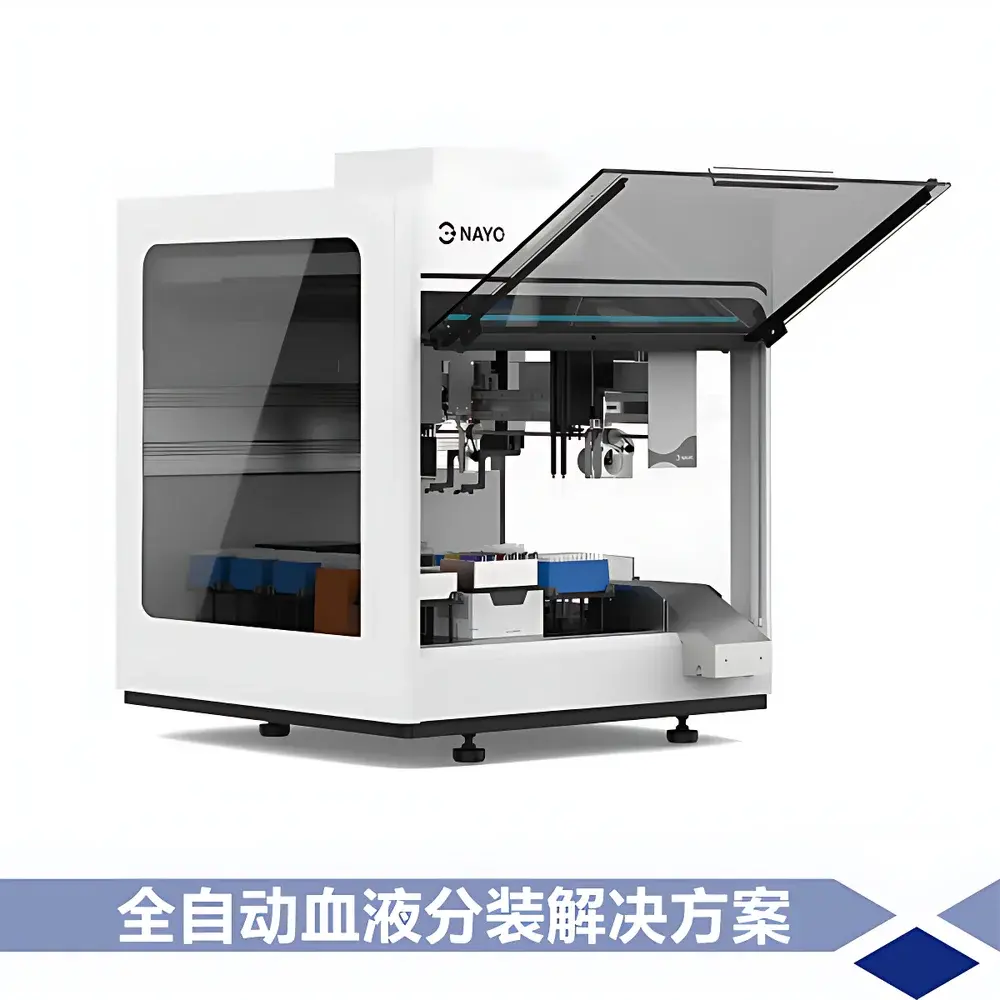
NAYO A8 Series Fully Automated Blood Aliquoting Workstation
| Brand | NAYO |
|---|---|
| Origin | Shanghai, China |
| Manufacturer Type | Direct Manufacturer |
| Product Origin | Domestic (China) |
| Model | A8 Series – Blood Aliquoting Solution |
| Sample Type | Whole Blood, Serum, Plasma |
| Pipetting Range | 1–1000 µL |
| Pipetting Accuracy | ≤4% CV at 5 µL, ≤1% CV at 200 µL |
| Throughput Flexibility | Configurable for low- to high-throughput workflows (1–96 samples per run) |
| Arm Configuration | Dual robotic arms (cap-opening + pipetting), up to 4 independent pipetting channels |
| Tube Compatibility | Standard EDTA/K2EDTA/NaCitrate blood collection tubes (vacutainers), oropharyngeal swab tubes, urine containers, 1.5–15 mL centrifuge tubes, 0.5–2.0 mL cryovials |
| Optional Modules | Integrated tube decapping/capping unit, nucleic acid extraction module, temperature-controlled shaking platform (4–40 °C), magnetic bead separation rack |
Overview
The NAYO A8 Series Fully Automated Blood Aliquoting Workstation is an integrated laboratory automation platform engineered for precision, reproducibility, and regulatory readiness in clinical diagnostics, biobanking, and translational research laboratories. Built upon a dual-arm robotic architecture, the system performs sequential or parallel cap manipulation, sample identification (via optional 2D barcode scanning), volumetric liquid handling, and tube resealing — all within a single enclosed workspace. Its core operation follows ISO 15197-compliant pipetting mechanics, utilizing air-displacement positive-displacement pipetting technology with gravimetric calibration traceable to NIST-traceable standards. Designed specifically for whole blood, serum, and plasma handling, the A8 Series mitigates pre-analytical variability by eliminating manual pipetting errors, reducing aerosol generation, and ensuring consistent sample integrity across batches. The workstation operates under Class II biosafety principles, with HEPA-filtered laminar airflow and UV-C decontamination cycles between runs — supporting compliance with CLIA, CAP, and ISO 15189 requirements for sample processing environments.
Key Features
- Dual independent robotic arms: One dedicated to tube cap manipulation (opening/closing), the other to multi-channel pipetting — enabling concurrent operations and minimizing cycle time.
- Modular pipetting configuration: Supports 1-, 2-, 4-, or 8-channel pipetting heads; each channel calibrated independently per ISO 8655-6 for volumetric accuracy and repeatability.
- Traceable liquid handling performance: Delivers ≤4% coefficient of variation (CV) at 5 µL and ≤1% CV at 200 µL, validated using gravimetric assay per ISO 8655-7 protocols.
- Universal tube adaptability: Accommodates 13–16 mm diameter vacutainer tubes (including BD Vacutainer®, Greiner Bio-One®), 5–50 mL conical centrifuge tubes, and externally threaded cryovials (0.5–2.0 mL) without custom fixtures.
- One-touch workflow initiation: Predefined SOPs stored locally or on network drives allow full run execution from loading to final sealing with minimal user intervention.
- Integrated environmental controls: Optional temperature-regulated shaker (4–40 °C ±0.5 °C) and magnetic separation rack enable on-instrument sample homogenization and bead-based purification steps.
Sample Compatibility & Compliance
The A8 Series is validated for use with anticoagulated whole blood (EDTA, citrate, heparin), serum, and plasma specimens collected in standard clinical tubes. It supports direct processing of primary collection tubes without prior centrifugation when paired with optional decanting or aspiration logic. All fluidic pathways are constructed from medical-grade PTFE and chemically resistant elastomers compliant with USP Class VI and ISO 10993-5 biocompatibility standards. The system meets IEC 61000-6-2 (EMC immunity) and IEC 61000-6-3 (EMC emission) requirements. Software logs include full audit trails with user authentication, timestamped actions, and electronic signatures — aligning with FDA 21 CFR Part 11 and EU Annex 11 data integrity expectations for GLP/GMP environments.
Software & Data Management
The NAYO A8 Control Suite provides a Windows-based graphical interface with drag-and-drop protocol builder, real-time run monitoring, and configurable alert thresholds. All instrument events — including pipette tip ejection, cap torque verification, liquid level sensing, and error recovery sequences — are recorded in encrypted SQLite databases with SHA-256 hashing. Export formats include CSV, PDF reports (with QC summary metrics), and HL7-compatible messages for LIS/HIS integration. Audit trail files retain immutable records for ≥10 years and support automated backup to NAS or cloud storage via SFTP. Software validation documentation (IQ/OQ/PQ templates) and cybersecurity risk assessments (per IEC 81001-5-1) are provided with each installation.
Applications
- Clinical biobanking: High-fidelity aliquoting of longitudinal blood specimens into storage-ready formats while preserving biomarker stability.
- Molecular diagnostics labs: Preparation of input material for downstream qPCR, NGS library prep, and digital PCR workflows — minimizing cross-contamination and pipetting-induced degradation.
- Reference laboratories: Standardized sample distribution across multiple assay platforms (e.g., immunoassay, coagulation testing, metabolomics) with full traceability.
- Vaccination response studies: Serial dilution and plating of serum samples for neutralizing antibody titer determination (e.g., PRNT, ELISA).
- Regulatory submissions: Generation of ALCOA+ compliant data packages for FDA IND/IDE applications and EMA scientific advice requests.
FAQ
Does the A8 Series support barcoded tube tracking?
Yes — optional integrated 2D barcode readers validate tube identity before and after processing, with mismatch alerts and automatic log reconciliation.
Can the system be integrated into existing LIMS environments?
Yes — native HL7 v2.x and RESTful API interfaces support bidirectional communication with major LIMS vendors (e.g., LabVantage, STARLIMS, Thermo Fisher SampleManager).
Is the software qualified for GxP use?
Yes — validated software release packages include IQ/OQ/PQ documentation, change control history, and periodic review records aligned with GAMP 5 guidelines.
What maintenance is required for long-term reliability?
Scheduled preventive maintenance includes quarterly gravimetric calibration verification, annual pipette channel alignment, and semiannual HEPA filter replacement — all tracked via embedded service scheduler.
How does the system handle viscous or clot-prone samples?
The A8 employs programmable aspiration/dispense speeds, surface-tension compensation algorithms, and delayed dispense timing to maintain accuracy across hematocrit ranges of 25–55% and plasma viscosity up to 3.5 cP.





