
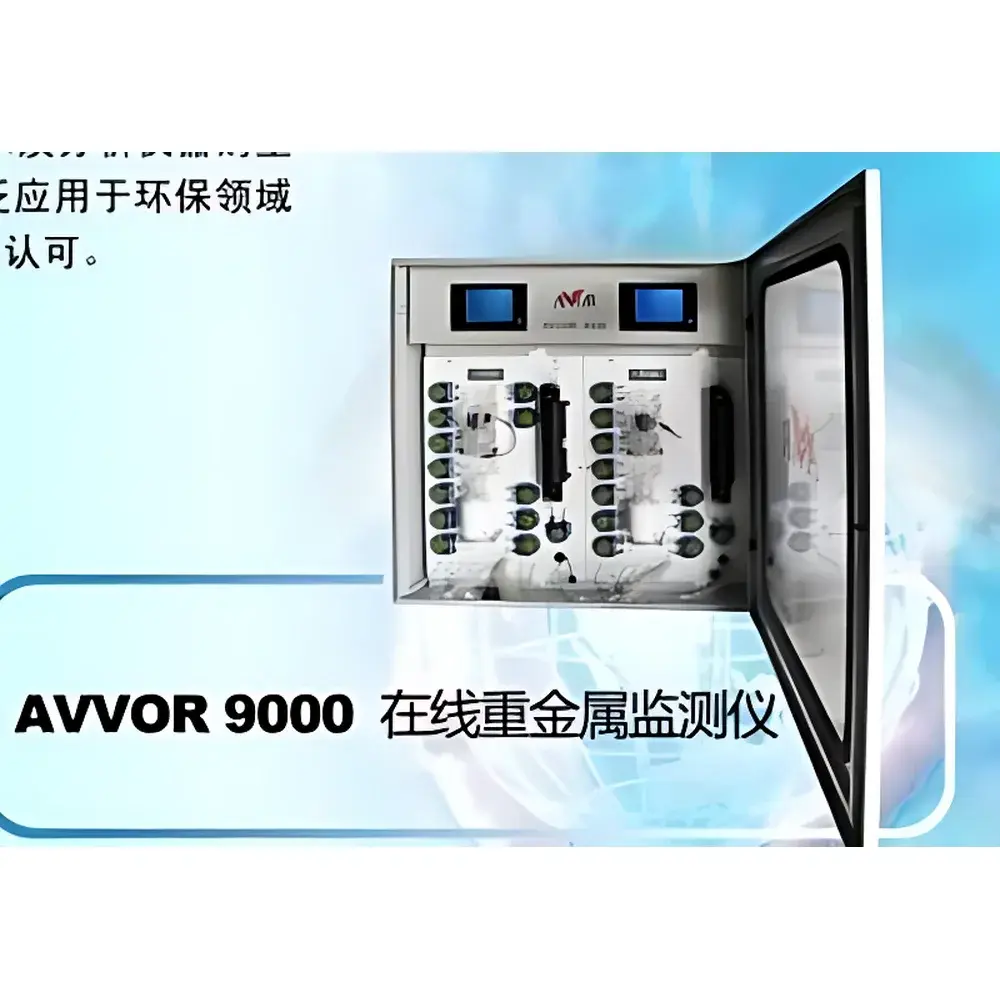
AVVOR 9000 Online Heavy Metal Analyzer
| Brand | AVVOR |
|---|---|
| Origin | Canada |
| Model | AVVOR 9000 |
| Detection Principle | Anodic Stripping Voltammetry (ASV) |
| Measurable Elements | As, Hg, Se, Zn, Cd, Pb, Cu, Mn, Sb, Sb³⁺, Tl, Fe, Ni, Sn, Cr, Cr⁶⁺, Co, Mo, Au, Ag, Pd, U |
| Electrode Options | Gold, Mercury-film, Bismuth-film, Bare Carbon |
| Max Modules | 2 |
| Max Simultaneous Parameters per Module | 5 |
| Analog Outputs | 8 × 4–20 mA |
| Digital Interfaces | RS-485, RS-232 |
| Compliance | Designed for ASTM D3559, ISO 11885, EPA Method 7063, and USP <232>/<233> trace metal guidance |
| Environmental Rating | IP65 enclosure with humidity-resistant design |
| Power Supply | 100–240 VAC, 50/60 Hz |
Overview
The AVVOR 9000 Online Heavy Metal Analyzer is a fully automated, continuous-monitoring electrochemical instrument engineered for real-time quantification of trace heavy metal ions in aqueous matrices. It operates on the internationally standardized principle of anodic stripping voltammetry (ASV), a mature and validated electroanalytical technique widely referenced in regulatory frameworks including EPA Method 7063, ISO 11885, and ASTM D3559. In ASV, target metal ions are first pre-concentrated (electrodeposited) onto a working electrode under controlled potential and time conditions; following a defined equilibration period, a reverse (anodic) potential scan dissolves the deposited metals, generating current peaks whose magnitude and position are directly correlated to concentration and elemental identity. This method delivers sub-ppb detection sensitivity for most transition and post-transition metals without requiring complex sample digestion or hazardous reagents—making it especially suitable for unattended, long-term deployment in environmentally sensitive or operationally constrained settings.
Key Features
- Modular architecture supporting up to two independent measurement modules, each configurable with one of four electrode types: gold, mercury-film, bismuth-film, or bare carbon—optimized for specific element groups and matrix compatibility.
- Simultaneous multi-element analysis: each module enables concurrent quantification of up to five metals (e.g., Module 1: As/Hg/Se; Module 2: Zn/Cd/Pb/Cu/Mn), with full spectral deconvolution of overlapping stripping peaks via embedded digital signal processing.
- Integrated sample conditioning system—including filtration, pH stabilization, and optional UV oxidation—to minimize organic interference and enhance measurement robustness across raw wastewater, drinking water, seawater, and industrial effluents.
- Eight isolated 4–20 mA analog outputs, individually assignable in software to any measured parameter or diagnostic variable; supports seamless integration into SCADA, DCS, or PLC-based plant control systems.
- Dual serial communication interfaces (RS-485 Modbus RTU and RS-232) for local configuration, remote diagnostics, and bidirectional data exchange; optional wireless telemetry (LTE-M/NB-IoT) available via field-upgradable module.
- Self-maintaining operational logic: automatic periodic calibration using onboard standard solutions, fault self-diagnosis with event-logged error codes, power/failure recovery with memory retention, and IP65-rated sealed enclosure with internal desiccant management.
Sample Compatibility & Compliance
The AVVOR 9000 is validated for direct analysis of liquid samples with total suspended solids ≤ 25 mg/L and chloride concentrations up to 20,000 mg/L (seawater-compatible with bismuth-film electrodes). It meets functional requirements outlined in ISO 11885 for dissolved metal determination and aligns with the analytical performance criteria of USP Chapters <232> and <233> for elemental impurities in pharmaceutical waters. While not a GLP-certified system per se, its audit-ready data logging—including timestamped raw voltammograms, calibration history, maintenance events, and user access logs—supports compliance with FDA 21 CFR Part 11 when deployed within validated laboratory or utility QA/QC workflows. All firmware and method files are digitally signed and version-controlled to ensure traceability.
Software & Data Management
The instrument is operated via AVVOR ControlSuite™, a Windows-based configuration and visualization platform supporting both local touchscreen (single/dual display options) and remote web interface access. The software implements role-based user permissions, encrypted database storage (SQLite with AES-256), and export to CSV, PDF, or XML formats compliant with LIMS ingestion protocols. Real-time trend plots, alarm thresholds (configurable high/low limits with hysteresis), and automated report generation (daily/weekly/monthly) are standard. Raw voltammetric data—including background-corrected current-potential curves—is retained for retrospective reprocessing and method optimization. Firmware updates are delivered via signed OTA packages with rollback capability.
Applications
- Continuous compliance monitoring at municipal wastewater treatment plant outfalls for regulated metals (e.g., Cu, Pb, Cr⁶⁺, Ni) under NPDES permit requirements.
- In-line process control in mining leachate management, electroplating rinse streams, and semiconductor fab ultrapure water loops.
- Early-warning surveillance of drinking water distribution networks for lead/copper release from aging infrastructure.
- Research-grade speciation studies (e.g., Cr³⁺ vs. Cr⁶⁺) using sequential electrode switching and differential pulse ASV protocols.
- Environmental baseline assessment in rivers, lakes, and coastal zones where rapid response to accidental spills or seasonal runoff events is critical.
FAQ
What electrode type is recommended for mercury detection in drinking water?
Gold electrodes are preferred for Hg²⁺ analysis due to superior sensitivity and minimal intermetallic interference; detection limits reach 0.02 µg/L with 10-minute preconcentration.
Can the AVVOR 9000 measure hexavalent chromium independently from total chromium?
Yes—using a dedicated Cr⁶⁺-specific module with selective complexation chemistry and optimized deposition potential, enabling direct Cr⁶⁺ quantification without offline speciation.
Is routine maintenance required beyond automatic calibration?
Electrode cleaning cycles are triggered automatically based on accumulated charge; manual replacement is typically needed every 6–12 months depending on matrix fouling severity.
Does the system support integration with third-party cloud platforms?
Yes—via MQTT or REST API adapters (available as optional software license), enabling secure transmission to AWS IoT Core, Microsoft Azure IoT Hub, or custom enterprise data lakes.
How is data integrity ensured during power interruption?
All critical parameters, calibration records, and the last 72 hours of raw voltammograms are stored in non-volatile FRAM memory with battery-backed real-time clock, ensuring zero data loss during brownouts or graceful shutdowns.
Related Products







