
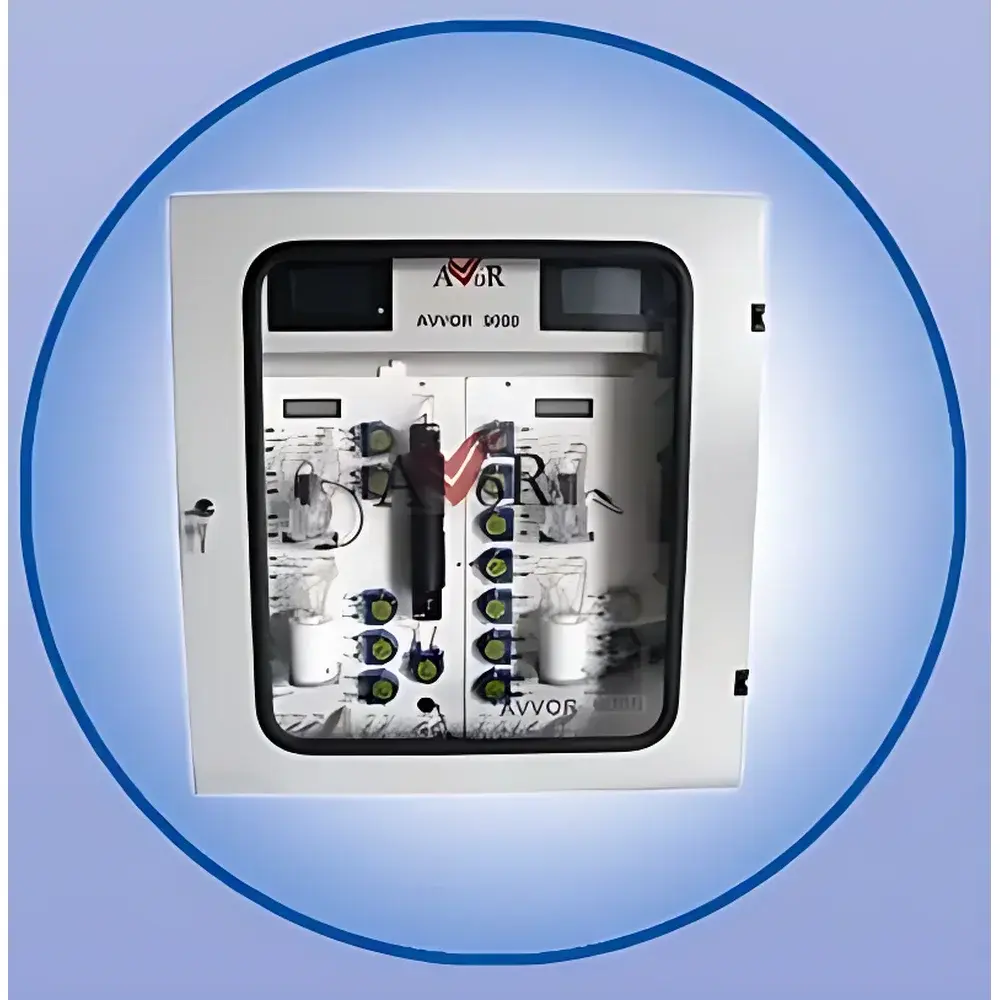
AVVOR 9000 Online Heavy Metal Analyzer
| Brand | AVVOR |
|---|---|
| Origin | Canada |
| Model | AVVOR 9000 |
| Detection Principle | Anodic Stripping Voltammetry (ASV) |
| Electrode Options | Gold, Mercury-plated, Bismuth-plated, and Bare Carbon Working Electrodes |
| Max Simultaneous Metals | 5 per module (up to 2 modules) |
| Output Interfaces | 8 × 4–20 mA analog outputs, RS-485 & RS-232 digital interfaces |
| Compliance | Designed for continuous unattended operation in compliance with ISO 10560, ASTM D3559, and EPA Method 7063 for trace metal analysis in aqueous matrices |
Overview
The AVVOR 9000 Online Heavy Metal Analyzer is an industrial-grade, electrochemical instrumentation platform engineered for real-time, multi-element quantification of dissolved heavy metal ions in aqueous environmental and process streams. It operates on the internationally standardized principle of Anodic Stripping Voltammetry (ASV), a highly sensitive and selective electroanalytical technique widely accepted by regulatory bodies including the U.S. EPA (Method 7063), ISO (ISO 10560), and ASTM (D3559). In ASV, target metal ions are first preconcentrated onto a solid working electrode via controlled electrolysis under negative potential; following a defined deposition time, the accumulated metals are oxidized (stripped) by scanning the electrode potential in the anodic direction. The resulting current peaks—each uniquely associated with a specific metal’s redox potential—are measured and quantified using calibrated peak height or area integration. This method delivers sub-ppb detection limits for key toxicants such as Pb, Cd, As, Hg, and Cr(VI), making the AVVOR 9000 suitable for early-warning monitoring in drinking water intake systems, wastewater treatment plant effluents, industrial discharge points, and surface/groundwater surveillance networks.
Key Features
- Modular architecture supporting up to two independent analytical modules per instrument chassis—enabling flexible deployment across diverse monitoring requirements.
- Electrode-swappable design: Compatible with gold, mercury-plated, bismuth-plated, and bare carbon working electrodes—each optimized for specific elemental groups (e.g., Hg/As/Se on Au; Zn/Cd/Pb/Cu/Mn on Bi-film; Cr(VI)/Co/Ni/Mo on carbon).
- Simultaneous multi-metal analysis: Each module supports up to five elements concurrently, with total system capacity reaching ten distinct analytes when dual modules are installed.
- Robust field interface: Eight programmable 4–20 mA analog outputs allow direct integration into SCADA, DCS, or PLC systems; all outputs are individually assignable to any measured parameter via embedded configuration software.
- Dual communication protocols: Standard RS-485 (Modbus RTU) and RS-232 interfaces support both wired and optional wireless telemetry (via external 4G/LTE gateway).
- Autonomous operational integrity: Built-in self-diagnostics, scheduled auto-calibration (using certified standard solutions), power/failure recovery logic, and sealed IP65-rated enclosure with internal humidity control ensure long-term reliability in harsh outdoor or semi-industrial environments.
Sample Compatibility & Compliance
The AVVOR 9000 is validated for use with raw and treated water matrices—including municipal wastewater, industrial process liquors, river/lake water, groundwater, potable supplies, and seawater (with appropriate salinity compensation). Integrated sample conditioning includes filtration (optional 5 µm inline filter), pH stabilization, and reagent-based organic interference suppression—ensuring high specificity in complex, organically rich samples. All measurement procedures adhere to GLP-aligned data handling protocols, with full audit trail logging of calibration events, maintenance logs, and raw voltammogram archives. The system supports 21 CFR Part 11-compliant electronic signatures when deployed with validated third-party LIMS integration.
Software & Data Management
Embedded firmware provides intuitive web-based configuration through HTTPS-enabled local access (no cloud dependency). Measurement data—including raw current-potential curves, peak identification metadata, calibration history, and QC flagging—is stored locally on industrial-grade microSD card (expandable to 32 GB) with automatic rollover. Export formats include CSV and XML for seamless import into laboratory information management systems (LIMS) or environmental data management platforms (EDMPs). Optional remote monitoring via secure MQTT or OPC UA enables centralized fleet management across distributed site networks without compromising data sovereignty.
Applications
- Regulatory compliance monitoring at NPDES or EU WFD discharge points
- Early detection of accidental heavy metal releases in watershed protection zones
- Process control in electroplating, mining leachate, battery recycling, and semiconductor fab wastewater streams
- Drinking water safety verification at intake and distribution nodes
- Long-term trend analysis for ecological risk assessment in estuarine and marine environments
- Research-grade speciation studies (e.g., Cr(III) vs. Cr(VI)) when paired with optional valence-selective pretreatment modules
FAQ
What detection limits can the AVVOR 9000 achieve for common heavy metals?
Typical method detection limits range from 0.05 µg/L (Pb, Cd) to 0.5 µg/L (Cr(VI), Ni), depending on electrode type, deposition time, and matrix composition. Actual performance must be verified during site-specific validation per ISO/IEC 17025 guidelines.
Is the instrument compatible with existing SCADA infrastructure?
Yes—the eight configurable 4–20 mA outputs and native Modbus RTU over RS-485 enable plug-and-play integration with most industrial automation systems without middleware.
How frequently does the system require maintenance or recalibration?
Scheduled calibration is user-definable (e.g., daily, weekly); electrode cleaning and replacement intervals depend on sample fouling potential but typically range from 3–6 months under normal operating conditions.
Can the AVVOR 9000 differentiate between oxidation states, such as Cr(III) and Cr(VI)?
Yes—when equipped with the dedicated Cr(VI) test module and operated with pH-controlled sample conditioning, the system selectively quantifies hexavalent chromium while suppressing trivalent interference.
Does the analyzer meet international certification requirements for environmental monitoring?
The AVVOR 9000 is designed and tested in accordance with IEC 61326-1 (EMC), IEC 61000-6-2/4, and conforms to performance expectations outlined in ISO 10560 and EPA Method 7063 for ASV-based metal analysis. Third-party type approval may be obtained per national accreditation frameworks upon request.
Related Products







